No cap meaning slang is one of the most searched internet expressions because people constantly see it on TikTok videos, Instagram comments, Snapchat stories, gaming chats, and text messages.
Imagine your friend texts, “That was the best burger I’ve ever had, no cap.” Or someone comments, “You’re the funniest person on this app, no cap.” If you’ve ever paused and wondered whether they’re joking, exaggerating, or being completely serious, you’re not alone.
At first glance, the phrase sounds confusing. Why would a “cap” have anything to do with honesty? Is it a compliment, a joke, or a trend that only Gen Z understands? The truth is that this simple two-word phrase carries much more emotional meaning than most people realize.
People search no cap meaning slang because they want to understand what someone is really trying to communicate, not just the dictionary definition, but the feeling behind the words. If you’re texting friends, scrolling through social media, or watching livestreams, understanding this slang helps you connect with modern internet culture.
Let’s break it down in a way that actually makes sense.
Quick Definition
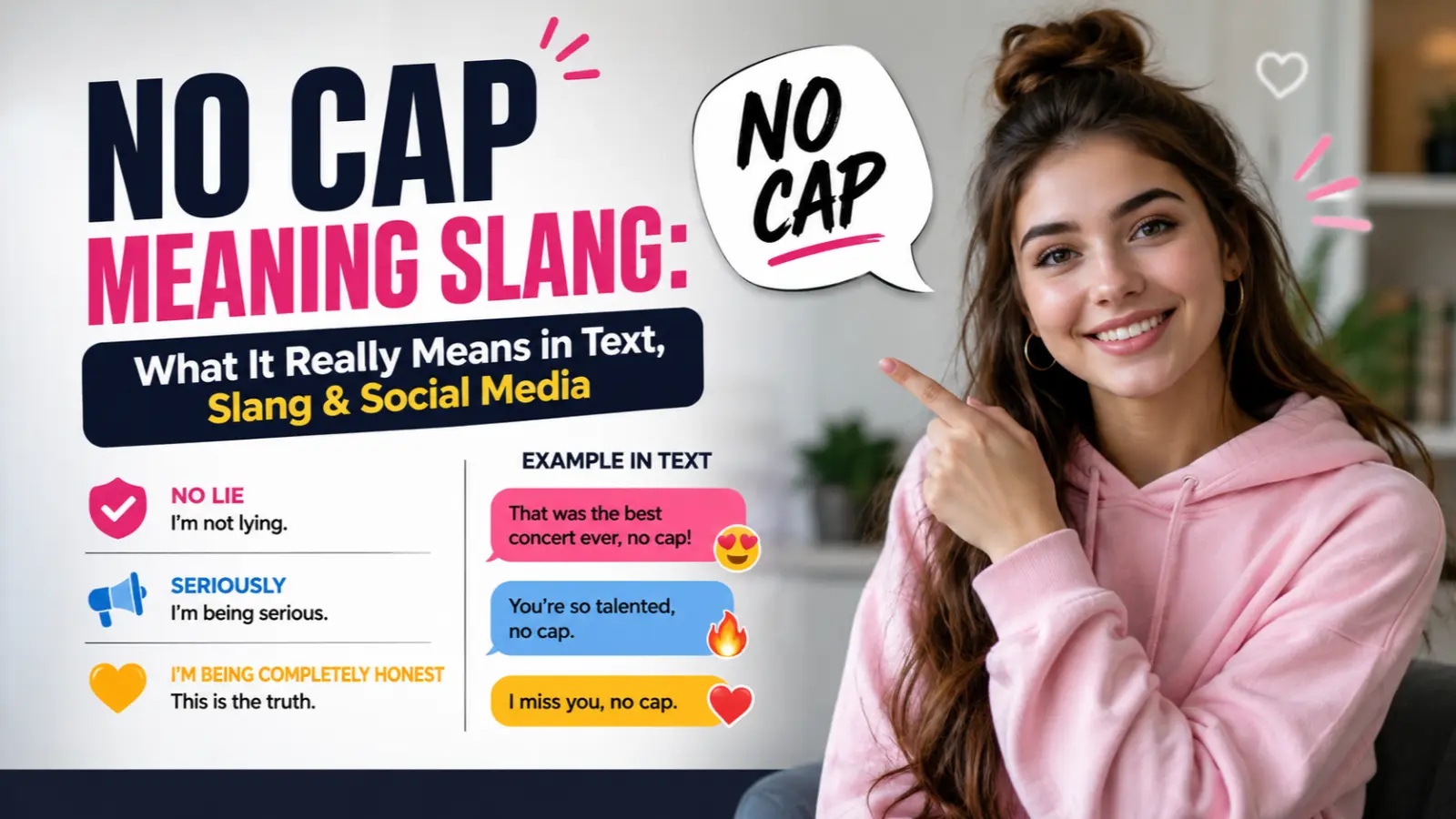
No cap means “no lie,” “seriously,” or “I’m being completely honest.” It tells the listener that the speaker is telling the truth without exaggerating.
People use it to:
- Emphasize honesty
- Show sincerity
- Strengthen an opinion
- Express genuine emotions
- Convince others they’re serious
Example:
- “That movie made me cry, no cap.”
- “You’re the nicest person here, no cap.”
At its heart, no cap signals authenticity. It’s a way of saying, “Believe me—I’m telling the truth.”
No Cap Meaning Slang as Honesty
The most common meaning is complete honesty.
Example:
“I’m exhausted today, no cap.”
The speaker isn’t trying to sound dramatic. They’re emphasizing that they’re genuinely tired.
No Cap Meaning Slang as Seriousness
Sometimes people use it to make sure others know they’re serious.
Example:
“I’d move across the country for that job, no cap.”
It adds emotional weight to the statement.
No Cap Meaning Slang as Emphasis
People also use “no cap” simply to make a statement stronger.
Example:
“That pizza was incredible, no cap.”
Here, it reinforces enthusiasm rather than proving facts.
No Cap Meaning Slang as Compliment
“No cap” often appears after compliments because it makes praise feel sincere.
Example:
“Your presentation was amazing, no cap.”
The phrase reassures the listener that the compliment is genuine.
No Cap Meaning Slang as Emotional Expression
Internet users frequently attach “no cap” to emotional experiences.
Example:
“That song healed me, no cap.”
This isn’t literal. Instead, it communicates strong emotional impact.
What Does No Cap Mean in Text?
In text messages, no cap simply means the sender wants you to believe what they’re saying.
Examples:
Friend: “This is the best coffee I’ve ever had, no cap.”
You: “Really? I need to try it.”
Dating:
“I miss you, no cap.”
Gaming:
“That boss fight was impossible, no cap.”
Social media:
“Best concert ever, no cap.”
Unlike many slang terms, “no cap” usually removes doubt instead of creating it.
Origin & Background
The phrase no cap comes from African American Vernacular English (AAVE), where “cap” evolved to mean a lie, exaggeration, or false claim. Saying “no cap” literally means “no lie” or “I’m telling the truth.”
Hip-hop artists helped popularize the phrase long before it became mainstream. As rap lyrics spread across streaming platforms, millions of listeners adopted the expression in everyday conversations. Soon afterward, TikTok creators, YouTubers, Twitch streamers, and meme pages pushed the phrase into global internet culture.
Today, people of all ages recognize “no cap,” although it remains especially common among Gen Z and younger Millennials. Social media transformed it from niche slang into a worldwide expression for honesty.
Internet language changes incredibly fast. A phrase that starts within one community can become part of everyday conversation across the world in just a few years—and “no cap” is a perfect example.
Real-Life Conversations
Understanding no cap meaning slang becomes much easier when you see how people naturally use it in everyday conversations. The phrase fits into casual chats because it adds honesty and emotion without sounding overly formal.
WhatsApp Chat
Ali: I stayed up until 3 AM watching that series.
Zain: Was it really that good?
Ali: Best show I’ve watched this year, no cap.
In this conversation, “no cap” tells Zain that Ali genuinely enjoyed the show and isn’t exaggerating.
Instagram DM
Emma: Your vacation photos look unreal.
Sophia: It was honestly the best week of my life, no cap.
Here, the phrase reinforces sincere happiness.
TikTok Comments
Comment: This recipe changed my life, no cap.
Thousands of similar comments appear under viral videos because people want to emphasize authenticity.
Text Message
Jake: Thanks for listening yesterday.
Ryan: Anytime. You’re one of my closest friends, no cap.
The phrase makes the compliment feel heartfelt instead of casual.
Group Chat
Sarah: Who’s bringing snacks?
Mike: I’m bringing pizza. Best choice, no cap.
Even simple conversations become more expressive with internet slang.
Across all these examples, one emotional pattern stands out. People use no cap when they want others to believe that their feelings or opinions are completely genuine.
Emotional & Psychological Meaning
Slang is rarely just about vocabulary. It’s about emotion.
When someone says “no cap,” they’re often trying to build trust. In online conversations where sarcasm, jokes, and exaggeration are everywhere, adding “no cap” signals sincerity.
Psychologically, it can communicate:
- Confidence
- Authenticity
- Emotional openness
- Conviction
- Social credibility
Imagine two friends discussing college.
“I think you’ll get accepted.”
versus
“I think you’ll get accepted, no cap.”
The second sentence feels warmer. It sounds like genuine encouragement rather than empty positivity.
Dating conversations also reveal this emotional layer.
“I really enjoyed tonight, no cap.”
Those final two words remove uncertainty. Instead of wondering whether the person is simply being polite, the listener hears genuine honesty.
Online culture has made sincerity surprisingly valuable. Because memes, irony, and sarcasm dominate social media, straightforward honesty stands out even more.
That’s the deeper psychology behind it.
Usage in Different Contexts
Social Media
Platforms like TikTok, Instagram, Snapchat, and X have made no cap meaning slang part of everyday digital communication.
Examples:
- “Best skincare product ever, no cap.”
- “This edit deserves a million likes, no cap.”
It strengthens opinions without sounding overly serious.
Friends & Relationships
Friends use “no cap” to reassure one another that compliments or opinions are genuine.
Examples:
- “You’re hilarious, no cap.”
- “I missed hanging out with you, no cap.”
It creates emotional closeness.
Work or Professional Settings
Generally, avoid using “no cap” in professional emails, business meetings, or academic writing.
Instead of:
“The presentation was amazing, no cap.”
Say:
“The presentation was genuinely impressive.”
Professional communication values clarity over internet slang.
Casual vs Serious Tone
“No cap” works in both humorous and emotional situations.
Funny:
“That burger deserves an award, no cap.”
Serious:
“I appreciate everything you’ve done for me, no cap.”
Context determines whether it feels playful or heartfelt.
When NOT to Use It
Although popular, “no cap” doesn’t fit every situation.
Avoid using it:
- During formal business communication
- In academic papers
- While speaking with people unfamiliar with internet slang
- During emotionally sensitive conflicts
- In international conversations where slang may be misunderstood
Imagine emailing your manager:
“I finished the report, no cap.”
It sounds unprofessional.
Similarly, using internet slang during serious disagreements can make your message feel less sincere.
Context protects meaning.
Common Misunderstandings
Many people misunderstand no cap meaning slang because they interpret it literally.
It Doesn’t Mean Hats
The word “cap” has nothing to do with baseball caps.
It Isn’t Always Gen Z Humor
Although Gen Z uses it frequently, adults increasingly understand and use the phrase online.
It Isn’t Rude
“No cap” is generally friendly and harmless.
It Doesn’t Always Mean Excitement
Sometimes it’s simply emphasizing honesty.
“I don’t feel okay today, no cap.”
The phrase can communicate vulnerability just as easily as excitement.
Comparison Table
| Expression | Meaning | Tone | Usage Context |
|---|---|---|---|
| No Cap | I’m telling the truth | Honest | Social media, texting |
| For Real | Seriously | Casual | Everyday conversation |
| No Lie | Honestly | Friendly | Friends and family |
| Seriously | Genuine emphasis | Neutral | Both casual and professional |
| Honestly | Truthful statement | Calm | Most situations |
Although these phrases are similar, “no cap” feels younger, trendier, and more connected to internet culture.
Variations & Types
Internet slang constantly evolves. Here are common variations.
Cap
Means someone is lying.
Example:
“That’s cap.”
Big Cap
Suggests someone is telling an obvious lie.
Example:
“Big cap.”
No Cappin’
A playful variation meaning “I’m seriously telling the truth.”
No Cap Fr
Adding FR (for real) increases emphasis.
Example:
“No cap fr.”
No Cap 😂
Adding laughing emojis often softens the statement into playful exaggeration.
Each variation slightly changes the emotional tone while keeping honesty at the center.
How to Respond When Someone Uses It
Casual Replies
- “I believe you.”
- “Fair enough.”
- “That’s awesome.”
- “Good to know.”
Funny Replies
- “Now you’ve got my attention.”
- “No cap detected.”
- “You’re convincing me.”
Mature Replies
- “I appreciate your honesty.”
- “Thanks for being genuine.”
Respectful Replies
- “I understand.”
- “That makes sense.”
Matching someone’s conversational energy often creates more natural interactions than using the exact same slang.
Regional & Cultural Usage
Western Culture
In North America and much of Europe, no cap is widely recognized among younger internet users thanks to hip-hop, gaming, and TikTok.
Asian Culture
Many English-speaking teenagers in countries like India, the Philippines, Japan, and South Korea recognize the phrase through global social media.
Middle Eastern Culture
Among bilingual internet users, especially those active on TikTok and Instagram, “no cap” appears regularly in English conversations.
Global Internet Usage
The internet has blurred cultural boundaries. A phrase that started in one community can now appear in gaming chats, YouTube comments, and memes worldwide.
Generational Differences
Gen Z
Uses “no cap” naturally in everyday conversation.
Millennials
Many Millennials understand it, although they may use it less frequently.
Older Generations
Some older adults recognize the phrase but may prefer traditional expressions like “honestly” or “seriously.”
Language often reflects identity. Every generation develops expressions that signal belonging, and no cap has become one of Gen Z’s most recognizable phrases.
Is It Safe for Kids?
Overall, no cap is considered harmless slang.
Parents should know that:
- It isn’t offensive.
- It doesn’t contain profanity.
- It’s commonly used to emphasize honesty.
- It reflects online culture more than risky behavior.
However, children should also learn when informal slang is appropriate. Using “no cap” with teachers, employers, or in school assignments may not create the best impression.
Teaching context is just as important as teaching vocabulary.
Frequently Asked Questions
What does no cap mean in slang?
It means “no lie,” “seriously,” or “I’m being completely honest.”
What does no cap mean in texting?
It tells the reader that the sender is being truthful and sincere.
Is no cap rude?
No. It’s generally considered friendly, casual internet slang.
Why do people say no cap on TikTok?
Creators use it to make stories, opinions, and reactions sound more believable.
Do Millennials use no cap?
Some do, but it’s significantly more common among Gen Z.
Should I use no cap at work?
Usually not. Professional communication is better suited to standard expressions like “honestly” or “seriously.”
Conclusion
Understanding no cap meaning slang isn’t just about learning another trendy phrase. It’s about recognizing how modern communication blends emotion, honesty, and identity into just two simple words.
Whether someone says “no cap“ after a compliment, an opinion, or a personal story, they’re usually signaling one thing: “no lie,” “seriously,” or “I’m being completely honest.”
As internet culture continues to shape everyday language, expressions like no cap remind us that people still look for genuine ways to express truth and build trust—even in the fast-moving world of social media.
Sometimes, the smallest slang phrase says the biggest thing: “Believe me—I really mean it.”

I’m Grace Punston, a playful writer with a passion for clever puns and joyful wordplay. I love crafting witty lines that make readers grin and giggle. My goal is to spread laughter through smart, lighthearted writing. Every pun I share is a little spark of fun meant to brighten your day.