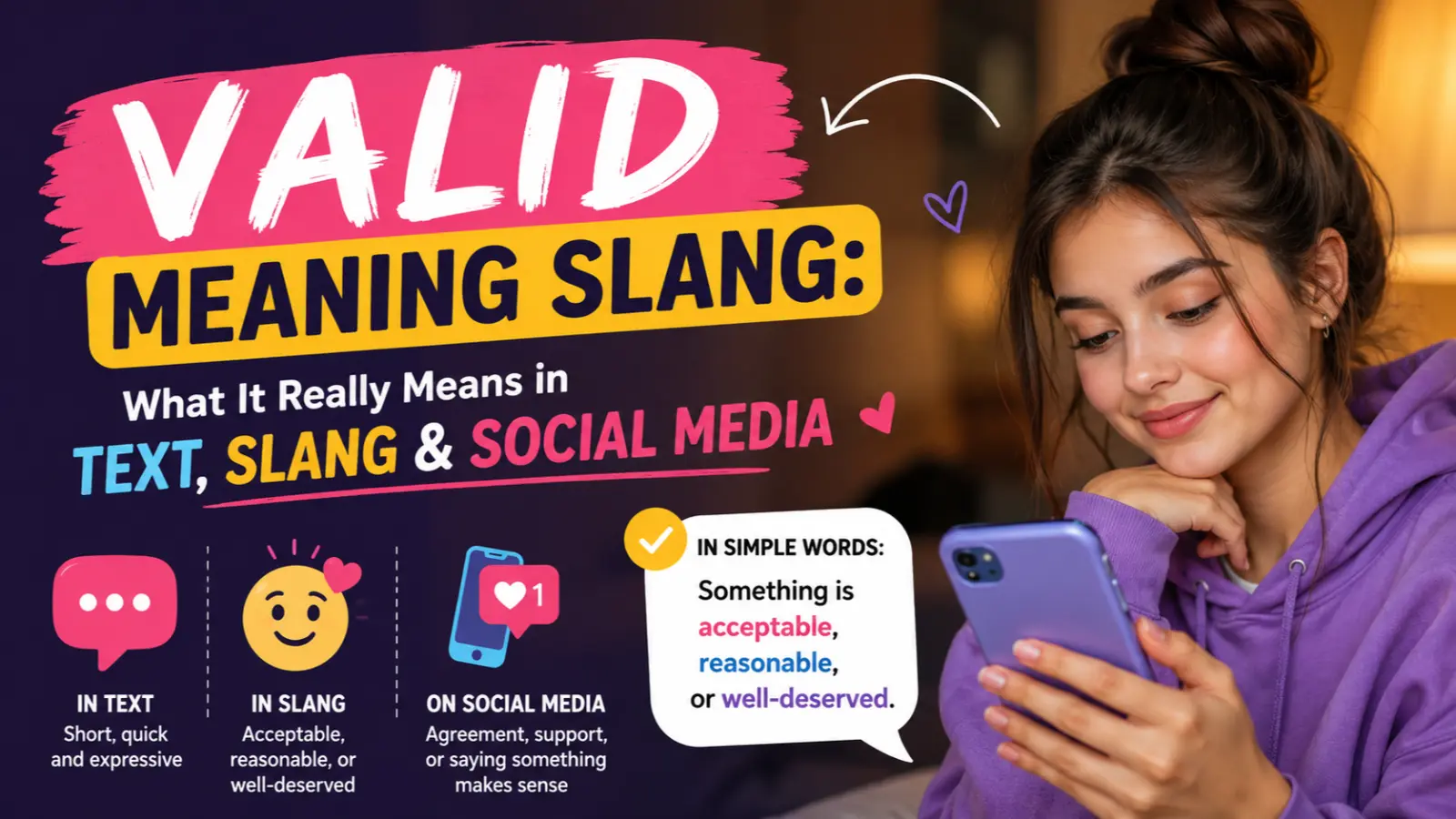
Valid meaning slang has become one of those internet expressions you suddenly notice everywhere. Imagine scrolling through TikTok and seeing comments like:
“That reaction is so valid.”
“You’re valid for feeling that way.”
“Honestly… that’s valid.”
At first glance, it sounds like people are simply saying something is “correct.” But is that really all it means? Why do friends, creators, and even strangers online use valid so often in conversations about emotions, opinions, relationships, and everyday experiences?
People search for valid meaning slang because the word carries much more emotional weight online than it does in dictionaries. Depending on the conversation, it can express understanding, agreement, support, humor, respect, or even playful sarcasm.
Let’s break it down in a way that actually makes sense.
Quick Definition
In modern internet slang, valid means something is acceptable, reasonable, or well-deserved. More importantly, it often tells someone that their feelings, opinions, choices, or reactions make sense.
Rather than judging someone, calling something valid usually acknowledges their perspective.
Examples:
- “You’re upset? That’s valid.”
- “Wanting time alone is valid.”
- “That outfit is valid.”
- “Your point is actually valid.”
The emotional meaning changes depending on the tone.
Valid as Noticing
Sometimes people simply recognize someone’s experience.
Example:
“I see why you’re frustrated. That’s valid.”
Here, the speaker acknowledges another person’s emotions without arguing.
Valid as Reacting
People also use valid as an immediate reaction.
Example:
“You stayed up all night finishing your project?”
“Valid.”
The reply means, “I understand why you did that.”
Valid as a Compliment
Online, calling something valid can be praise.
Example:
“Your playlist is valid.”
Translation: Your taste is genuinely good.
Valid as an Insult
Sometimes it’s sarcastic.
Example:
“Oh sure… skipping work was totally valid.”
The opposite meaning is implied through tone.
Valid as a Joke
Friends often exaggerate the word for humor.
“I bought five iced coffees today.”
“Honestly… valid.”
The comment playfully supports questionable behavior.
Valid as Exposing Someone
Occasionally, people admit uncomfortable truths.
“You ignored every red flag.”
“Valid. I deserved that.”
Here, the word accepts criticism.
Valid While Flirting
Support can become attractive.
“You look amazing.”
“You’re valid for thinking that.”
The exchange feels playful and confident.
Valid as Emotional Expression
Perhaps its strongest use is emotional reassurance.
“You’re allowed to cry.”
“Your feelings are valid.”
This creates emotional safety rather than judgment.
At its core, valid tells someone:
“Your experience makes sense.”
What Does valid meaning slang Mean in Text?
When someone texts “valid,” they’re usually saying one of these things:
- I understand your point.
- That makes sense.
- I agree.
- You’re justified.
- Your feelings matter.
- Fair enough.
- I respect that opinion.
Examples:
Friend: “I’m canceling because I’m exhausted.”
Reply: “Valid.”
Friend: “I still miss them.”
Reply: “That’s completely valid.”
Text conversations often move quickly. Instead of writing long paragraphs, people simply type valid to communicate empathy in one word.
Origin & Background
Although valid has existed for centuries as a formal English adjective, internet culture completely reshaped it.
Originally, it described something legally or logically acceptable.
Over time, online communities—especially Tumblr, Twitter, Reddit, and later TikTok—began using it emotionally instead of academically.
Instead of saying:
“Your emotional response is understandable.”
People simply wrote:
“Valid.”
Mental health discussions played a huge role. Therapists often talk about “validating emotions,” and social media adopted that language into everyday conversations.
TikTok accelerated the trend.
Creators discussing anxiety, dating, family relationships, and personal growth repeatedly reassured viewers by saying:
“Your feelings are valid.”
Soon the expression spread into memes, reaction videos, livestream chats, and gaming communities.
Today, valid appears almost everywhere online because it communicates empathy quickly.
Internet language evolves incredibly fast, and valid shows how ordinary words can gain entirely new emotional lives.
Real-Life Conversations
WhatsApp Chat
Friend: “I can’t deal with people today.”
Friend: “Valid. Take your time.”
Instagram DM
Person A: “I deleted my story because I got embarrassed.”
Person B: “Honestly… valid.”
TikTok Comments
Creator: “I cried over fictional characters.”
Comment:
“That’s so valid.”
Text Message
“I skipped the party because I needed sleep.”
“Valid.”
Group Chat
“I ordered food instead of cooking.”
“Completely valid.”
Across these conversations, the emotional pattern stays consistent.
People aren’t simply agreeing with facts—they’re accepting another person’s perspective without making them feel guilty.
Emotional & Psychological Meaning
The popularity of valid says something important about modern communication.
People want to feel understood.
In busy online spaces, arguments happen constantly. Receiving a simple “valid” can feel surprisingly comforting because it removes judgment.
Psychologically, the slang often signals:
- emotional awareness
- empathy
- acceptance
- confidence
- social intelligence
- emotional safety
Imagine this situation.
A friend admits they failed an interview.
They’re embarrassed and expect criticism.
Instead, another friend replies:
“That’s valid. Interviews are stressful.”
Nothing magically changes, yet the person instantly feels less alone.
Dating works similarly.
Someone says:
“I still think about my ex.”
Rather than calling them dramatic, another person says:
“That’s valid.”
The conversation becomes supportive instead of defensive.
That’s the deeper psychology behind it.
Usage in Different Contexts
Social Media
On TikTok, Instagram, and X, valid often means emotional agreement.
Example:
“Being tired after socializing is valid.”
Friends & Relationships
Friends use it to encourage openness.
Example:
“It’s valid that you’re disappointed.”
Partners also use it during difficult conversations.
Work or Professional Settings
In workplaces, saying someone’s concerns are valid can sound respectful.
Example:
“Your concerns are valid, and we’ll address them.”
However, using slang versions like “valid lol” feels too casual.
Casual vs Serious Tone
Casual:
“Valid.”
Serious:
“Your feelings are completely valid.”
Tone changes how caring the message feels.
When NOT to Use It
Avoid using valid when:
- writing formal legal documents
- speaking to audiences unfamiliar with internet slang
- during heated arguments where empathy needs more explanation
- communicating with older professionals who may misunderstand it
- discussing sensitive cross-cultural issues without context
Sometimes people need more than one reassuring word.
Context protects meaning.
Common Misunderstandings
Many people misunderstand valid online.
Misunderstanding: It only means “correct.”
Reality: It often means emotionally understandable.
Misunderstanding: It’s always supportive.
Reality: Tone can make it sarcastic.
Misunderstanding: It’s rude.
Reality: Most uses are respectful.
Misunderstanding: It always means agreement.
Reality: You can validate feelings without agreeing with someone’s actions.
Comparison Table
| Expression | Meaning | Tone | Usage Context |
|---|---|---|---|
| Valid | Acceptable, reasonable, well-deserved | Supportive | Emotions, opinions, reactions |
| Fair | Reasonable | Neutral | Everyday discussion |
| Makes sense | Logical | Friendly | Conversation |
| Understandable | Emotionally reasonable | Caring | Personal situations |
| I get it | I understand | Casual | Friends and texting |
| Based | Confidently authentic | Internet slang | Memes and opinions |
The biggest difference is emotional validation. Saying valid often reassures the person instead of simply agreeing with them.
Variations & Types
Common versions include:
That’s valid – Standard supportive phrase.
So valid – Strong agreement.
Actually valid – Unexpected approval.
100% valid – Complete support.
Valid lol – Lighthearted approval.
Extremely valid – Exaggerated internet humor.
Valid af – Strong slang emphasis.
Low-key valid – Quiet agreement.
Each variation changes intensity while keeping the same emotional foundation.
How to Respond When Someone Uses It
Casual Replies
- Thanks.
- Appreciate it.
- Exactly.
- Right?
Funny Replies
- I knew you’d understand.
- Certified valid.
- Internet approved.
- Validation unlocked.
Mature Replies
- Thanks for understanding.
- That means a lot.
- I appreciate your perspective.
- Glad you see where I’m coming from.
Respectful Replies
- Thank you for listening.
- I appreciate the support.
- That’s very kind.
- Thanks for validating my feelings.
Matching the other person’s energy helps conversations feel more natural.
Regional & Cultural Usage
Western Culture
In North America and Europe, valid is commonly linked to emotional support, therapy language, and internet culture.
Asian Culture
Younger users on TikTok, Instagram, and gaming platforms increasingly use valid, especially in English-language conversations.
Middle Eastern Culture
Many bilingual users mix valid into English chats to express empathy, even when speaking primarily in another language.
Global Internet Usage
Because social media connects people worldwide, valid has become a global internet expression that often crosses language barriers.
Even when cultures differ, the emotional message—”your feelings make sense”—remains widely understood.
Generational Differences
Gen Z
Uses valid constantly.
It reflects emotional awareness, internet humor, and inclusive communication.
Millennials
Often understand and use it, especially on social media.
They may combine it with more traditional phrases.
Older Generations
Many still interpret valid only in its dictionary sense.
They may not immediately recognize its emotional slang meaning.
Language often reflects identity, and valid has become part of how younger generations communicate empathy online.
Is It Safe for Kids?
Generally, yes.
The slang is usually harmless because it encourages understanding and emotional support.
However, parents should explain that:
- tone still matters
- sarcasm exists online
- validation doesn’t always mean agreement
- respectful communication is more important than trendy language
Teaching children when and how to use the word helps them communicate thoughtfully.
FAQs
What does valid mean in slang?
It means something is acceptable, reasonable, well-deserved, or emotionally understandable.
Is saying “valid” rude?
No. It’s usually supportive unless used sarcastically.
What does “that’s valid” mean in texting?
It means, “I understand why you feel that way,” or “Your reaction makes sense.”
Why do people say “valid” on TikTok?
Creators and viewers use it to show empathy, agreement, or emotional understanding in a quick, relatable way.
Do Gen Z use “valid” differently?
Yes. Gen Z often uses it as emotional validation rather than simply meaning something is logically correct.
Can I use “valid” at work?
Yes, but use the full phrase—such as “Your concern is valid”—instead of casual slang when communicating professionally.
Conclusion
Understanding valid meaning slang is about more than learning another internet word. In today’s online conversations, valid means something is acceptable, reasonable, or well-deserved, but it also carries a deeper emotional purpose. It tells people that their experiences, emotions, or opinions deserve acknowledgment rather than immediate judgment.
As social media continues to shape how we communicate, words like valid remind us that even a single supportive response can strengthen friendships, reduce misunderstandings, and create more compassionate conversations.
In a digital world filled with quick reactions, sometimes the most powerful thing you can say is simply: “That’s valid.”

I’m Jake Punman, a humor writer who lives for clever wordplay and laugh-out-loud puns. I love crafting witty lines that turn simple moments into bursts of laughter. My passion is making people smile through creative twists of language. With every pun I write, I aim to add a little more fun to your day.