Slay meaning slang has become one of the most popular expressions on social media, but its meaning can be confusing if you’ve only recently started seeing it in texts, TikTok comments, Instagram captions, or group chats.
Imagine opening your phone and reading messages like:
Friend: “Girl, you absolutely slayed that outfit 🔥”
TikTok Comment: “You ate and slayed.”
Instagram DM: “OMG, you really slayed that presentation!”
At first glance, you might wonder, Why is everyone saying “slay”? Isn’t that supposed to mean defeating or killing something? Or maybe you’ve noticed people using it as a compliment and wanted to understand the emotional meaning behind it.
That’s exactly why so many people search for slay meaning slang. The word has evolved far beyond its traditional dictionary definition. Today, it’s a powerful compliment that celebrates confidence, success, beauty, talent, and self-expression. More importantly, it reflects how internet culture has transformed everyday language into something more emotional, expressive, and socially connected.
Whether you’re scrolling through TikTok, chatting on WhatsApp, posting on Instagram, or texting friends, understanding this slang helps you keep up with modern conversations without feeling left behind.
Let’s break it down in a way that actually makes sense.
Quick Definition
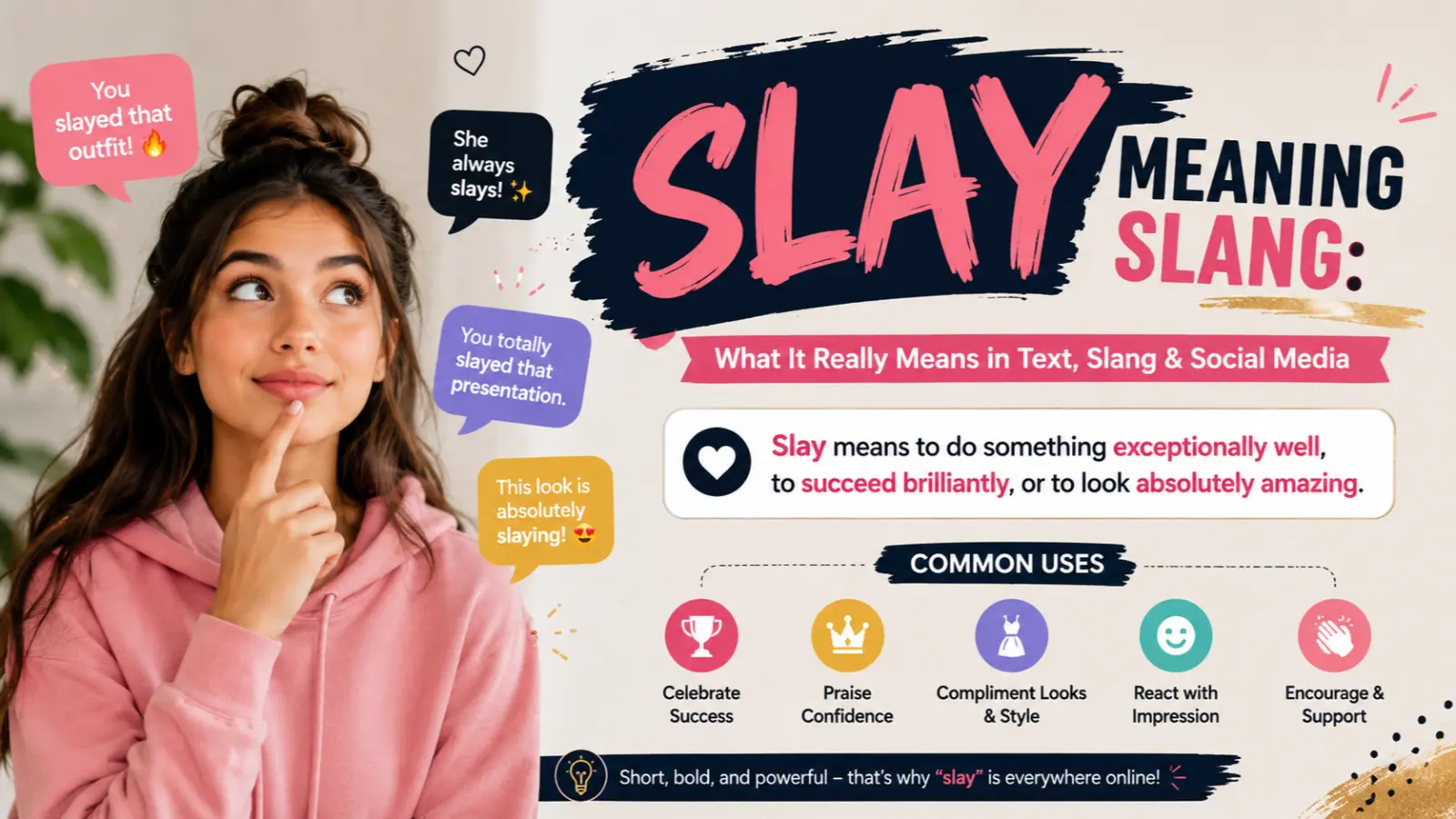
In modern internet slang, slay means to do something exceptionally well, to succeed brilliantly, or to look absolutely amazing. It is often used as an enthusiastic compliment to praise someone’s appearance, talent, confidence, personality, or achievement.
At its core, “slay” expresses admiration.
Examples:
- “You slayed that interview!”
- “She absolutely slayed her performance.”
- “Your makeup is slaying today.”
- “That speech? Total slay.”
Depending on the conversation, the emotional meaning can change slightly.
Slay Meaning Slang for Complimenting
The most common use of “slay” is as a compliment.
Example:
“Your graduation photos are stunning—you slayed!”
Here, the speaker is celebrating someone’s appearance or accomplishment with excitement.
Slay Meaning Slang for Reacting
People also use “slay” as an emotional reaction when they are genuinely impressed.
Example:
“That dance routine? Slay!”
Instead of giving a long explanation, one powerful word communicates admiration.
Slay Meaning Slang for Confidence
Sometimes “slay” encourages someone to be confident.
Example:
“Go slay your exam tomorrow.”
This means:
- Do your best.
- Believe in yourself.
- You’ll succeed.
Slay Meaning Slang for Success
When someone achieves something difficult, “slay” highlights their success.
Example:
“You slayed that job interview.”
The emphasis isn’t only on winning—it also recognizes the confidence and effort behind the achievement.
Slay Meaning Slang for Beauty and Fashion
Fashion communities use “slay” constantly.
Example:
“Your outfit is slaying.”
It means the person looks stylish, attractive, and confident.
Slay Meaning Slang for Humor
Friends sometimes use it playfully.
Example:
“You actually cooked dinner without burning it? Slay!”
The compliment is genuine but delivered with humor.
Slay Meaning Slang for Flirting
In dating conversations, “slay” can become a playful flirt.
Example:
“Every selfie you post slays.”
The speaker is expressing attraction while keeping the conversation fun.
Slay Meaning Slang in Jokes
Online communities often exaggerate the word for comedic effect.
Example:
“I answered one email today. Productivity? Slay.”
The humor comes from dramatically praising something ordinary.
Slay Meaning Slang as Emotional Expression
Sometimes people simply want someone to feel seen.
Example:
“You’ve been working so hard lately. Slay.”
This communicates encouragement, pride, and emotional support.
Overall, the emotional meaning behind “slay” is simple: it tells someone they impressed you and deserve recognition.
What Does Slay Meaning Slang Mean in Text?
When used in text messages, “slay” usually means:
- You did an amazing job.
- You look incredible.
- I’m impressed.
- Keep being confident.
- You’re winning.
Unlike formal compliments, “slay” feels energetic and emotionally expressive. That’s why it appears so often in texting, Instagram comments, Snapchat conversations, and TikTok replies.
For example:
Friend: “I finally passed my driving test.”
Reply: “SLAY!! 🎉”
That short response communicates excitement, pride, and celebration all at once.
In texting culture, people often stretch the word for emphasis:
- Slayyy
- Slaaaay
- Slay queen
- Slay bestie
These playful variations make the compliment feel even warmer and more personal.
Origin & Background
Although the literal word slay has existed in English for centuries, its modern slang meaning developed through Black and LGBTQ+ communities, particularly ballroom culture, where it became a way to praise someone for delivering an unforgettable performance, appearance, or attitude. Over time, the word expanded into mainstream internet culture and came to represent excellence, confidence, and style.
Social media accelerated its popularity. Platforms like TikTok, Instagram, and X helped “slay” become part of everyday online conversations. Influencers, creators, celebrities, and ordinary users now use it to celebrate everything from fashion and makeup to academic achievements and career milestones.
Today, saying someone “slayed” rarely has anything to do with its original literal meaning. Instead, it reflects admiration, excitement, and positive energy.
Internet language changes incredibly fast. Words that once belonged to small online communities can become global slang within months. “Slay” is one of the best examples of how digital culture reshapes language, turning a traditional word into a modern symbol of confidence, achievement, and self-expression.
Real-Life Conversations
One of the reasons slay meaning slang has become so popular is that it fits naturally into everyday conversations. Whether someone is celebrating a friend’s success or reacting to a funny social media post, “slay” adds excitement that feels genuine and supportive.
WhatsApp Chat
Ayesha: “I finally got the job I interviewed for!”
Sara: “Yesss! You absolutely slayed that interview! 🎉”
In this conversation, “slayed” congratulates someone for succeeding through hard work and confidence.
Instagram DM
Friend: “Do you like my new haircut?”
You: “Are you kidding? You slayed that look! 🔥”
Here, the word compliments someone’s appearance while boosting their confidence.
TikTok Comments
Creator: Posts a dance video.
Comments:
- “You slayed!”
- “This choreography is everything.”
- “You ate and slayed.”
Short comments like these instantly show admiration without needing long explanations.
Text Message
Friend: “I was nervous about my presentation.”
Reply: “No reason to worry—you totally slayed it!”
The reply offers both encouragement and recognition.
Group Chat
Alex: “I actually cooked dinner for everyone tonight.”
Friends:
- “Chef era unlocked!”
- “You slayed 😂”
Friends often use the slang humorously while still giving a genuine compliment.
No matter where it appears, the emotional pattern stays remarkably consistent. People use “slay” to celebrate effort, confidence, creativity, or personal growth. It’s less about perfection and more about making someone feel proud of themselves.
Emotional & Psychological Meaning
Words become popular because they communicate feelings, not just information. That’s exactly why slay meaning slang has survived beyond a simple internet trend.
When someone says, “You slayed,” they’re often expressing much more than admiration. They’re recognizing confidence, resilience, and personal expression.
Psychologically, using “slay” often signals:
- Confidence
- Encouragement
- Attraction
- Excitement
- Emotional support
- Social approval
- Positive energy
Unlike a simple “good job,” “slay” feels more personal. It suggests that someone stood out from the crowd.
Imagine your friend has been nervous for weeks about a university interview. They finally receive the acceptance email.
Instead of saying only “Congrats,” you text:
“You absolutely slayed! I knew you could do it.”
That message doesn’t just celebrate the achievement—it validates the emotional journey behind it.
The same psychology appears on social media. People compliment outfits, makeup, performances, artwork, business launches, fitness progress, or creative projects because they recognize the confidence required to share those moments publicly.
There’s also a subtle sense of community. Using modern slang helps people feel connected to internet culture and shared online experiences.
At the same time, “slay” can become playful sarcasm.
Imagine your coworker proudly fixes the office printer after struggling for twenty minutes.
Someone jokes:
“Printer expert. Slay.”
Everyone laughs because the compliment is intentionally exaggerated.
Whether serious or humorous, the word creates emotional connection.
That’s the deeper psychology behind it.
Usage in Different Contexts
Social Media
Social media is where “slay” appears most often.
You’ll see it in:
- TikTok comments
- Instagram captions
- YouTube Shorts
- Snapchat stories
- X replies
Examples:
- “You slayed this makeup tutorial.”
- “That transition was clean!”
- “Absolute slay.”
Online, the word celebrates creativity and confidence.
Friends & Relationships
Among friends, “slay” feels supportive and uplifting.
Examples:
- “Go slay your exam!”
- “You’re slaying life lately.”
- “Date night outfit? Slay.”
Partners sometimes use it flirtatiously too.
Example:
“Every picture you post is a slay.”
It communicates admiration while keeping the conversation playful.
Work or Professional Settings
Professional environments require more caution.
While younger coworkers may casually say,
“You slayed that presentation.”
it’s generally safer in formal emails or meetings to use phrases like:
- Great work.
- Excellent presentation.
- Outstanding job.
Knowing your audience always matters.
Casual vs Serious Tone
The same word changes meaning depending on tone.
Casual:
“Slayyy queen!”
Serious:
“You really slayed that difficult project.”
Playful:
“I folded my laundry today. Slay.”
Understanding the surrounding conversation helps you interpret the intended meaning correctly.
When NOT to Use It
Although slay meaning slang is overwhelmingly positive, it doesn’t fit every situation.
Avoid using it in:
Formal Business Communication
Professional emails usually require clearer language.
Instead of:
“You slayed today’s meeting.”
Use:
“Excellent presentation.”
Emotional Conflicts
If someone is discussing grief, illness, or a serious personal struggle, internet slang may feel dismissive.
Choose empathy before humor.
Older Audiences
Not everyone recognizes modern internet expressions.
Using traditional compliments often prevents confusion.
Cross-Cultural Conversations
Since slang evolves differently around the world, international audiences may misunderstand “slay” or interpret it literally.
Simple language works best when clarity matters.
Context protects meaning.
Common Misunderstandings
Many people misunderstand “slay” because they only know its dictionary definition.
| Misunderstanding | Reality |
|---|---|
| It always means killing someone. | In slang, it usually means doing something exceptionally well. |
| It’s always rude. | Most of the time it’s a compliment. |
| Only Gen Z uses it. | Millennials, influencers, and many online communities use it too. |
| It’s only about fashion. | It can praise success, talent, confidence, humor, creativity, and achievements. |
| It’s always serious. | Sometimes it’s intentionally exaggerated for comedy. |
Comparison Table
| Expression | Meaning | Tone | Usage Context |
|---|---|---|---|
| Slay | Do something exceptionally well | Excited | Social media, texting |
| Ate | Performed incredibly well | Playful | TikTok, Gen Z slang |
| Nailed It | Successfully completed something | Positive | Everyday conversation |
| Killed It | Did an amazing job | Energetic | Friends, work, sports |
| Crushed It | Achieved impressive results | Motivational | School, business, fitness |
| Iconic | Extremely memorable or impressive | Admiring | Pop culture and social media |
Although these expressions are similar, each carries a slightly different emotional flavor. “Slay” focuses heavily on confidence, style, and self-expression, making it especially popular in today’s internet culture.
Variations & Types
Like most internet slang, slay meaning slang has evolved into several creative variations. Each version carries the same positive energy but with a slightly different tone.
Slayed
The past tense is used when someone has already achieved something impressive.
Example:
- “You slayed that performance.”
- “She slayed the interview.”
Slaying
This version describes someone who is currently looking amazing or performing exceptionally well.
Example:
- “You’re slaying today!”
- “He’s slaying every challenge.”
Slay Queen
A popular phrase used to celebrate confidence, fashion, or self-expression.
Example:
- “Slay, queen! That outfit is incredible.”
Slay Bestie
Friends often use this playful variation to encourage one another.
Example:
- “Go slay, bestie!”
Slayyy
Adding extra letters increases excitement.
Examples:
- Slayyy!
- Slaaaay!
- SLAY!!!
The longer the spelling, the stronger the emotional reaction usually feels.
Meme Variations
Internet culture constantly creates humorous versions, including:
- Slay era
- Slay mode activated
- Slay all day
- Born to slay
- Certified slayer
These exaggerations are usually playful rather than literal.
How to Respond When Someone Uses It
Receiving “slay” is a compliment, so matching the other person’s energy makes conversations feel more natural.
Casual Replies
- Thank you!
- Appreciate it!
- You’re the best!
- Thanks so much!
Funny Replies
- I tried my best 😂
- Mission accomplished.
- Slay recognized slay.
- We survived!
Mature Replies
- That really means a lot.
- Thanks for the encouragement.
- I worked hard for it.
- I appreciate your support.
Respectful Replies
- Thank you for your kind words.
- That’s very thoughtful.
- I truly appreciate it.
The secret is simple: match the energy of the conversation. A playful compliment deserves a playful response, while a heartfelt compliment deserves genuine appreciation.
Regional & Cultural Usage
Although “slay” originated in specific communities, social media has helped it spread worldwide.
Western Culture
In countries like the United States, Canada, and the United Kingdom, “slay” is widely recognized among younger internet users. It’s commonly used in conversations about fashion, beauty, music, sports, and personal achievements.
Asian Culture
Many young people across Asia encounter the word through TikTok, Instagram Reels, K-pop fandoms, gaming communities, and English-language creators. While not everyone uses it in everyday speech, many recognize it online.
Middle Eastern Culture
English-speaking social media users in the Middle East often use “slay” alongside local expressions. It appears most frequently in fashion, entertainment, and influencer communities.
Global Internet Usage
Today, internet culture spreads slang faster than ever before. A phrase that starts in one online community can become a worldwide trend within weeks.
That’s why people from different countries may understand “slay” even if English isn’t their first language.
Generational Differences
Gen Z
Gen Z uses “slay” naturally in daily conversations, comments, memes, and videos.
For them, it’s part of everyday digital communication.
Millennials
Many Millennials use the word too, especially those active on TikTok, Instagram, and X. However, they may use it slightly less frequently.
Older Generations
Older adults may recognize “slay” only by its traditional dictionary meaning. Without context, they may misunderstand the compliment.
This difference highlights how language often reflects the generation and online communities people participate in.
Is It Safe for Kids?
In most situations, slay meaning slang is harmless.
Children and teenagers often use it simply to compliment friends or celebrate achievements.
Examples include:
- “You slayed your dance performance!”
- “Your drawing is amazing!”
- “You slayed that soccer game!”
However, parents should still encourage respectful communication. Like any slang, excessive use can become confusing in formal settings.
Teaching children when casual language is appropriate helps them communicate effectively both online and offline.
Overall, “slay” is generally a positive expression that promotes encouragement rather than negativity.
FAQs
What does slay mean in slang?
In modern slang, slay means to do something exceptionally well, to succeed brilliantly, or to look absolutely amazing. It’s commonly used as a compliment.
What does slay mean in texting?
In text messages, “slay” usually means someone impressed you, looked great, or achieved something successfully.
Is saying “slay” rude?
No. In most conversations, it’s a positive compliment. The tone depends on context, but it’s generally supportive and encouraging.
Why do people say “slay” on TikTok?
TikTok users often use “slay” to celebrate confidence, creativity, fashion, humor, talent, and successful performances.
Which generation uses “slay” the most?
Gen Z uses it most frequently, although Millennials and many active social media users also use it regularly.
Can you use “slay” at work?
It depends on your workplace. Casual teams may understand it, but formal professional communication usually benefits from more traditional compliments like “Excellent work” or “Great job.”
Conclusion
Understanding slay meaning slang is about more than learning another trendy internet word. It’s about recognizing how modern communication has become more expressive, supportive, and emotionally connected.
Today, slay meaning slang simply means to do something exceptionally well, to succeed brilliantly, or to look absolutely amazing. If someone is praising your outfit, celebrating your achievements, encouraging you before an interview, or reacting to your latest social media post, the message is rooted in admiration and positivity.
As internet culture continues to evolve, words like “slay” remind us that language isn’t just about definitions. It’s about making people feel confident, appreciated, and seen.
Sometimes, a single word can say, “I noticed your effort, and you absolutely nailed it.” That’s what makes “slay” more than just slang—it’s a celebration of confidence, achievement, and the joy of cheering each other on.

I’m Jake Punman, a humor writer who lives for clever wordplay and laugh-out-loud puns. I love crafting witty lines that turn simple moments into bursts of laughter. My passion is making people smile through creative twists of language. With every pun I write, I aim to add a little more fun to your day.