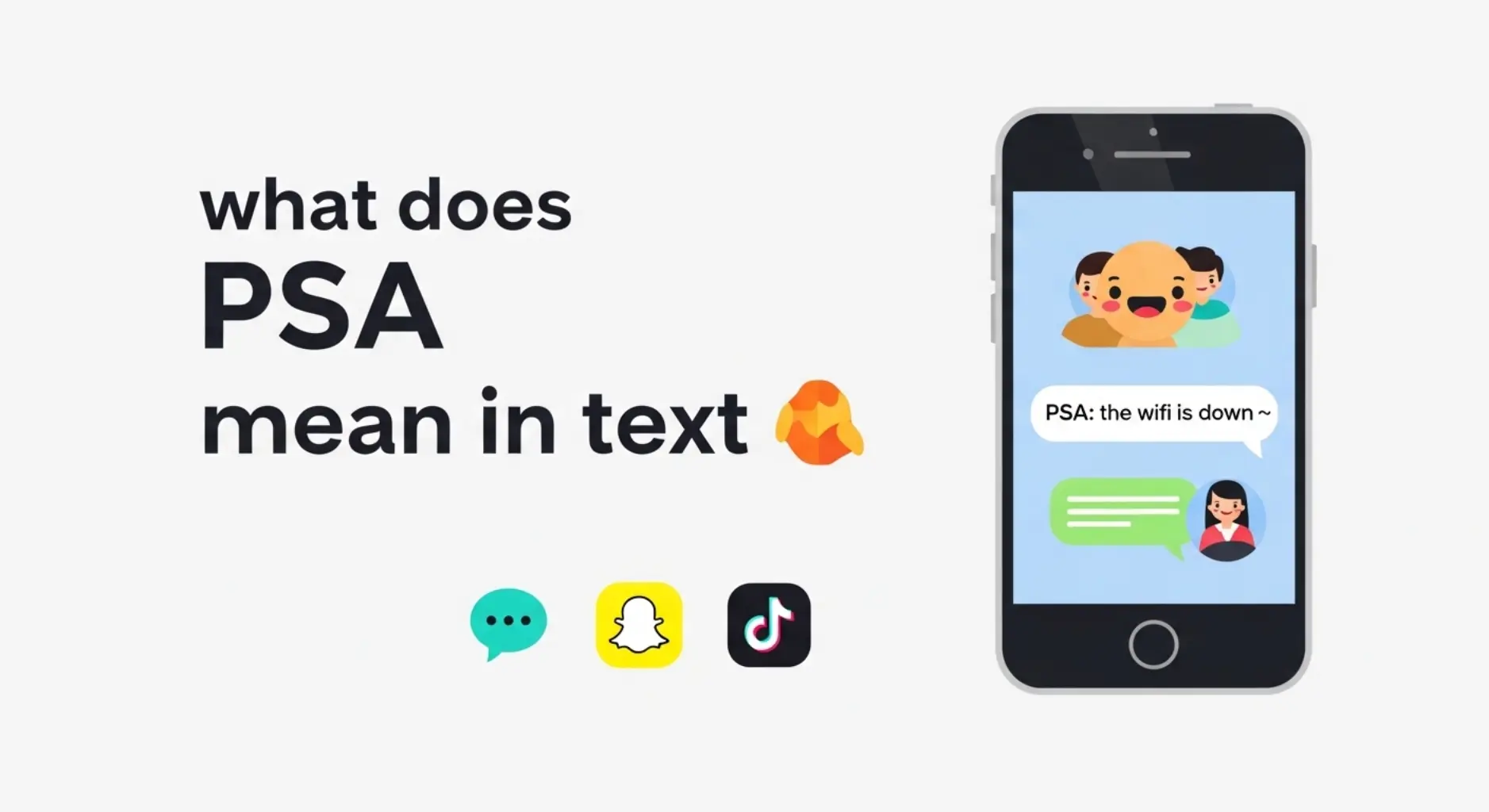
Public Service Announcement is one of those phrases you’ve probably seen online without giving it much thought—until someone starts a message with “PSA:” and suddenly you’re wondering if it’s serious, sarcastic, or just another internet joke.
Maybe you’ve come across a post that says, “PSA: Don’t click that fake giveaway link,” or a friend texts, “PSA: The coffee machine is broken today.” The meaning seems obvious in one situation and surprisingly playful in another.
So, what does Public Service Announcement really mean in text messages, social media, and online conversations? Is it always an official warning, or has internet culture given it a whole new personality?
As digital communication evolves, familiar phrases often take on fresh meanings. Public Service Announcement has become more than a formal broadcast—it now serves as a quick way to grab attention, share useful advice, make humorous observations, or even call out common mistakes.
People search for this phrase because they want to understand not only its definition but also the intention behind its use in modern conversations.
Let’s break it down in a way that actually makes sense.
Quick Definition
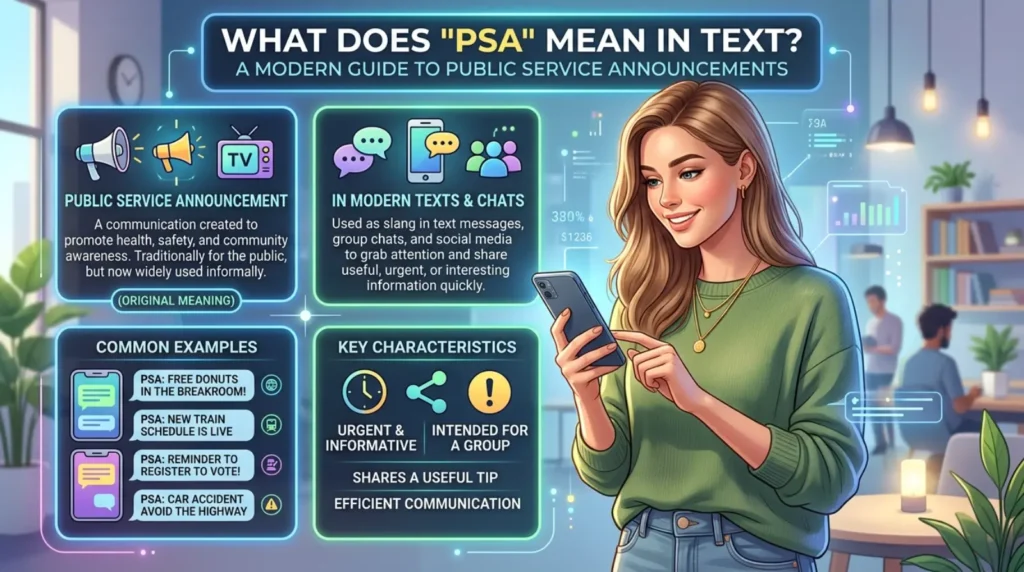
A Public Service Announcement (PSA) is a message shared to inform, remind, warn, or raise awareness about something people should know. Traditionally, PSAs were created by governments, nonprofits, or media organizations to educate the public about health, safety, or community issues. Today, the same phrase is widely used in texting and social media whenever someone wants others to pay attention to important or helpful information.
Depending on the situation, Public Service Announcement can communicate different intentions.
Public Service Announcement as a Notice
Sometimes it’s simply a friendly reminder.
Example:
PSA: The library closes early today.
Here, the sender is making sure everyone stays informed.
Public Service Announcement as a Warning
People frequently use PSA before sharing advice that helps others avoid problems.
Example:
PSA: Never share your verification code with anyone.
The emotional tone is protective and helpful.
Public Service Announcement as Helpful Advice
Friends often use PSA to offer practical tips.
Example:
PSA: Drink plenty of water during this heatwave.
Rather than sounding bossy, it feels caring.
Public Service Announcement as Humor
Internet users love turning serious formats into jokes.
Example:
PSA: Fries taste better when someone else pays.
The format mimics an official announcement, making the joke even funnier.
Public Service Announcement as Social Commentary
Creators sometimes use PSA to highlight common online behaviors.
Example:
PSA: Replying “LOL” isn’t the same as actually reading the message.
This adds a layer of playful criticism without sounding overly harsh.
Public Service Announcement as Emotional Expression
Occasionally, PSA introduces personal feelings.
Example:
PSA: It’s okay to take a break when you’re overwhelmed.
Here, the phrase creates empathy and reassurance.
Public Service Announcement as Exposure or Accountability
On social media, PSA may introduce information people believe others should know.
Example:
PSA: Always verify viral screenshots before sharing them.
The goal is awareness rather than drama.
Public Service Announcement as a Compliment
Friends sometimes use PSA creatively to praise someone.
Example:
PSA: Sarah makes the best homemade cookies in town.
Although playful, it highlights appreciation.
Public Service Announcement as a Lighthearted Insult
Used jokingly among close friends, PSA can exaggerate harmless complaints.
Example:
PSA: Jake still hasn’t learned how to mute himself on video calls.
The humor depends on friendship and shared context.
At its core, Public Service Announcement means, “Pay attention—this is worth knowing.” Whether the message is serious, funny, supportive, or sarcastic, the emotional purpose remains the same: helping others notice something important.
“I noticed something—and I feel like everyone needs to hear it.”
What does psa mean in text?
In texting, PSA is less about being formal and more about attention + intention.
It’s a way to say:
- “Listen up 👇”
- “This matters (at least to me)”
- “I’m about to say something worth noticing”
Depending on tone, it can feel:
- Helpful → “PSA: Roads are blocked today”
- Funny → “PSA: I’m not replying after 10pm anymore 😂”
- Petty → “PSA: Some people really don’t know how to act”
- Caring → “PSA: Take care of your mental health”
So yeah—it’s not just what you say.
It’s how you frame it.
Origin & Background
Originally, Public Service Announcements were serious broadcasts.
Think TV or radio messages like:
- Health warnings
- Safety alerts
- Government information
They were formal. Structured. Important.
Then the internet happened.
Social media platforms—especially Twitter (X), TikTok, and Instagram—took this formal phrase and flipped it into something more casual, expressive, and sometimes dramatic.
Now? Anyone can drop a “PSA.”
No authority needed. Just vibes.
How it evolved:
- 📺 Traditional media → official alerts
- 🌐 Early internet → ironic usage
- 📱 Social media → emotional + expressive shorthand
- 🎭 Meme culture → dramatic, funny, exaggerated
And here’s the truth about internet language:
👉 Online words don’t stay fixed. They evolve based on how people feel, not just what they mean.
👉 Real-Life Conversations
Let’s look at how PSA actually shows up in daily life:
WhatsApp Chat
- “PSA: Don’t trust that new food place 😭”
- “PSA: I’m broke till next week, don’t ask me for plans”
Instagram DMs
- “PSA: You looked really good today btw”
- “PSA: Stop overthinking. You’re fine.”
TikTok Comments
- “PSA: This song hits different at night”
- “PSA: We all ignored the red flags 😭”
Group Chat
- “PSA: We’re meeting at 6, don’t be late this time”
- “PSA: Someone needs to bring snacks or I’m not coming”
Text Message
- “PSA: I miss you, just saying”
- “PSA: That was not funny 😐”
What’s the pattern?
People use PSA when they want to:
- Grab attention quickly
- Add a sense of importance (even if it’s playful)
- Express something they’ve been thinking
It’s like putting a spotlight on a thought.
Emotional & Psychological Meaning
Here’s where it gets interesting.
Using “PSA” isn’t just about sharing information.
It’s about how you want to be perceived.
When someone says “PSA,” they’re often signaling:
- 🧠 Awareness → “I see what’s going on”
- 😌 Confidence → “I’m comfortable saying this out loud”
- 😏 Subtle shade → “I won’t name names… but you know”
- ❤️ Care → “I want you to be okay”
- 😂 Humor → “I’m being dramatic on purpose”
A Quick Real-Life Moment
You’re in a friend group. One person keeps dating toxic people.
Instead of directly calling them out, someone posts:
“PSA: Stop ignoring red flags just because they’re cute.”
Everyone laughs.
But deep down?
The message landed.
That’s the power of PSA—it lets people say something real without saying it directly.
👉 That’s the deeper psychology behind it.
Usage in Different Contexts
Social Media
PSA is everywhere.
- Dramatic posts
- Relatable content
- Viral captions
Example:
“PSA: Healing isn’t linear.”
Tone: emotional, reflective
Friends & Relationships
Used for:
- Advice
- Teasing
- Subtle honesty
Example:
“PSA: You deserve better.”
Tone: caring (or slightly confrontational)
Work or Professional Settings
Use carefully.
Example:
“PSA: Meeting moved to 3 PM.”
Tone: neutral, informational
But avoid overly casual or sarcastic PSA in formal emails.
Casual vs Serious Tone
Same phrase. Different vibes:
- “PSA: Drink water” → caring
- “PSA: Learn how to text back” → annoyed
- “PSA: I’m amazing” → joking
👉 Tone changes everything.
When NOT to Use It
PSA isn’t always safe to drop.
Avoid using it in:
- ❌ Formal emails
- ❌ Serious emotional conflicts
- ❌ Professional communication
- ❌ Conversations with older audiences
- ❌ Cross-cultural situations where tone may be misunderstood
Because sometimes it can feel:
- Passive-aggressive
- Mocking
- Overdramatic
👉 Context protects meaning.
Common Misunderstandings
Let’s clear a few things up:
❌ “PSA is always serious”
Nope. It’s often playful or sarcastic.
❌ “It’s rude”
Not necessarily—it depends on tone.
❌ “It always means warning”
Sometimes it’s just a thought or opinion.
❌ “It’s formal language”
Originally yes. Now? Very casual online.
Comparison Table
| Expression | Meaning | Tone | Usage Context |
|---|---|---|---|
| PSA | Announcement or callout | Serious / Funny / Dramatic | Social media, chats |
| FYI | For your information | Neutral | Work, casual info |
| BTW | By the way | Casual | Everyday texting |
| Note | Important info | Slightly formal | Work or reminders |
| Heads up | Warning | Friendly | Informal alerts |
Insight
- PSA = emotional + attention-grabbing
- FYI = calm and informational
- Heads up = friendly warning
PSA stands out because it adds personality.
Variations & Types
You’ll see PSA used in different ways:
- Serious PSA → “PSA: Stay safe during the storm”
- Funny PSA → “PSA: I’m the funniest person alive”
- Sarcastic PSA → “PSA: Not everyone deserves your energy”
- Emotional PSA → “PSA: It’s okay to not be okay”
- Exaggerated meme PSA → “PSA: I will never recover from this 😭”
Each version shifts the tone—but keeps that announcement energy.
How to Respond When Someone Uses It
Casual Replies
- “Noted 😂”
- “Okay that’s fair”
Funny Replies
- “Breaking news huh?”
- “Thanks for the announcement 😭”
Mature Replies
- “That actually makes sense”
- “I needed to hear that”
Respectful Replies
- “Appreciate you saying that”
- “Good point”
👉 Matching energy matters.
If it’s serious, don’t joke. If it’s playful, don’t overreact.
Regional & Cultural Usage
Western Culture
Very common. Used casually and creatively.
Asian Culture
Used mostly in English-speaking online spaces.
Middle Eastern Culture
Often mixed with humor and indirect expression.
Global Internet Usage
PSA has become universal thanks to social media.
Different cultures may interpret tone differently—especially sarcasm.
Generational Differences
Gen Z
- Uses PSA creatively, emotionally, ironically
- Often layered with humor or subtle meaning
Millennials
- Mix of serious + casual usage
- Less dramatic than Gen Z
Older Generations
- May interpret PSA literally (as formal announcement)
👉 Language shows identity—and PSA is a perfect example.
Is It Safe for Kids?
Mostly, yes.
But consider:
- It can include teasing or indirect criticism
- Tone may be misunderstood
- Social media influence shapes usage
Best approach?
👉 Teach context and tone—not just meaning.
FAQS:
What does PSA mean in texting?
It means Public Service Announcement, used to share something important, funny, or noticeable.
Is PSA rude?
Not inherently. It depends on tone—can be caring, funny, or sarcastic.
How is PSA used on TikTok?
Often in captions or comments to highlight relatable or emotional points.
Can I use PSA in professional messages?
Only for neutral info. Avoid humor or sarcasm.
Why do people use PSA instead of just saying it?
It adds attention, emphasis, and personality.
Is PSA a Gen Z slang?
It’s widely used by Gen Z, but not limited to them.
Conclusion
Understanding “psa mean in text” isn’t just about knowing it stands for Public Service Announcement.
It’s about recognizing how people use it to:
- Express thoughts
- Share emotions
- Call things out
- Connect socially
In today’s digital world, language isn’t just communication, it’s identity.
And PSA?
It’s a small phrase with a big emotional voice.
👉 Because sometimes, we don’t just want to say something…
we want it to feel like it matters.

I’m Jake Punman, a humor writer who lives for clever wordplay and laugh-out-loud puns. I love crafting witty lines that turn simple moments into bursts of laughter. My passion is making people smile through creative twists of language. With every pun I write, I aim to add a little more fun to your day.