You’re scrolling through messages late at night. Someone drops a line like:
“Relax bro, I was just messing… JP 😭”
Or maybe:
“Bro hit that shot… JP!!! 🔥”
And suddenly… you pause.
Wait… what does JP even mean here? Is it a joke? A compliment? Something serious?
That’s exactly why so many people search “JP Meaning in Text”, because it looks simple, but emotionally, it can shift depending on the moment.
Sometimes it softens tension.
Sometimes it celebrates luck.
It labels identity.
And honestly? It’s one of those tiny internet codes that carries way more feeling than it looks like.
👉 Let’s break it down in a way that actually makes sense.
Quick Answer:
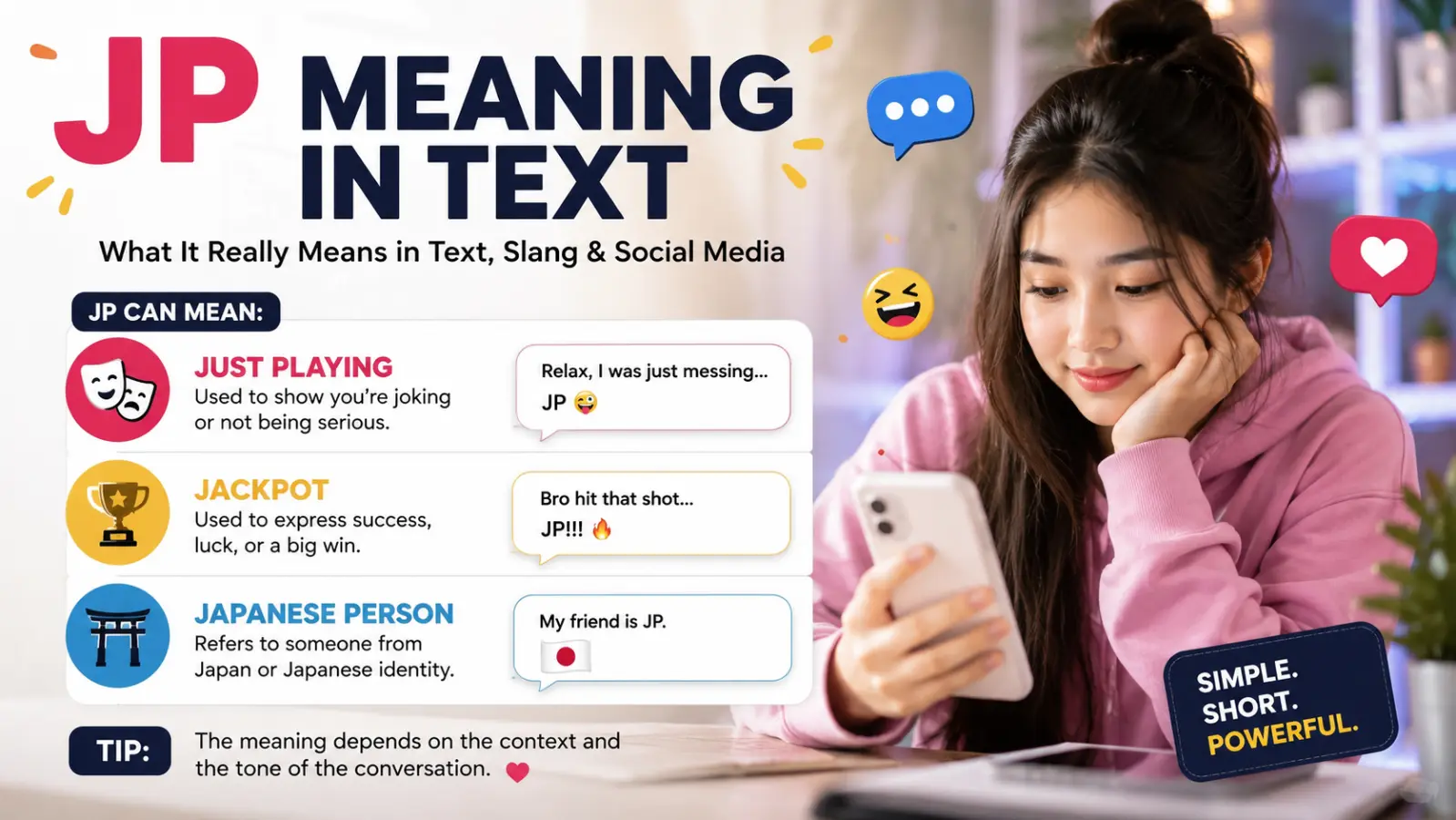
JP is a short slang abbreviation used in texting and social media, and it can mean:
- “Just Playing” – joking, not serious
- “Jackpot” – success, luck, or hitting something big
- “Japanese Person” – referring to nationality or identity
The meaning depends heavily on tone, context, and conversation flow.
Simple Examples:
- “Why you acting like that 😂 JP” → Just Playing (I’m joking)
- “Bro got 10k views overnight… JP 🔥” → Jackpot (huge win)
- “My friend is JP” → Japanese Person
At its core, JP is about signaling intent, If you’re joking, reacting, or describing someone.
What Does JP Mean in Text
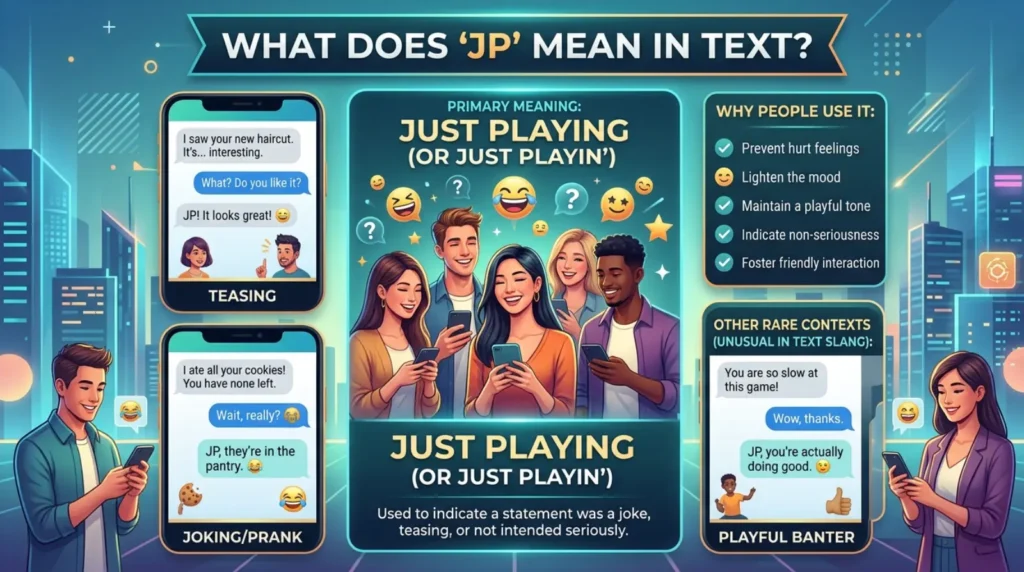
In texting, JP usually means “Just Playing.”
It’s often used to:
- soften a joke
- avoid conflict
- show playful intent
- protect emotions after teasing
Example:
“Your outfit kinda weird today… JP 😂”
That “JP” at the end? It’s not random. It’s emotional protection. It says:
👉 “Don’t take it seriously. I’m still on your side.”
But depending on context, it can also mean:
- excitement → “JP!!!” (Jackpot vibe)
- identity → neutral description
So the real meaning comes from how it feels, not just what it says.
Origin & Background
“JP” didn’t come from one place—it evolved naturally across internet culture.
- Early texting culture shortened everything
- Gamers used quick reactions like “Jackpot”
- Social media normalized tone-softening phrases like “just kidding”
- TikTok accelerated fast, emotional shorthand communication
Over time:
“Just Playing” → shortened → JP
And just like that, it became part of the unspoken language of online emotion.
What’s interesting is how platforms like TikTok and Instagram made tone markers essential. Without voice or facial expression, people needed shortcuts.
👉 That’s where JP fits perfectly.
Because online, words alone aren’t enough.
You need signals.
And slang evolves fast—sometimes faster than people can keep up.
Real-Life Conversations
WhatsApp Chat
“Bro you’re always late 😭 JP”
Instagram DM
“You really thought I’d forget your birthday? JP 😂”
TikTok Comment
“He really pulled that off… JP 🔥🔥”
Group Chat
“Acha ji, now you’re ignoring us? JP 😏”
Text Message
“You owe me food for that… JP (but not really 👀)”
What’s happening emotionally?
People use JP to balance tension and humor.
- tease → then soften
- flex → then lighten
- react → then exaggerate
It’s like adding a smile after a risky sentence.
Emotional & Psychological Meaning
This is where it gets deeper.
Using JP often signals:
- emotional awareness – you don’t want to offend
- social intelligence – you know how tone works
- playfulness – you enjoy teasing safely
- protection – you avoid conflict
Let’s be real.
We’ve all had that moment where we say something slightly risky… then quickly add something to fix it.
That’s what JP does.
Mini Story
You’re joking with a friend:
“You’re kinda annoying sometimes… JP 😂”
Without “JP”? That could hit differently.
With it?
It becomes safe. Playful. Acceptable.
👉 That’s the deeper psychology behind it.
Usage in Different Contexts
Social Media
JP is used for humor and reactions.
“Bro just went viral… JP 🔥”
Friends & Relationships
Used for teasing and emotional safety.
“You forgot me? JP 😭”
Work or Professional Settings
Rarely used. Can seem immature or unclear.
Casual vs Serious Tone
- Casual → “JP 😂” = joking
- Serious context → confusing or inappropriate
Tone changes everything.
When NOT to Use It
Avoid JP in:
- professional emails
- serious emotional conversations
- arguments or conflicts
- talking to older audiences
- cross-cultural communication without clarity
Example mistake:
“I didn’t mean that… JP”
In serious moments, that can feel dismissive.
👉 Context protects meaning.
Common Misunderstandings
- Thinking JP always means one thing → it doesn’t
- Assuming it’s rude → it’s usually playful
- Missing sarcasm → tone matters
- Taking it literally → emotional intent is key
JP isn’t about words. It’s about feeling behind the words.
Comparison Table
| Expression | Meaning | Tone | Usage Context |
|---|---|---|---|
| JP | Just Playing / Jackpot | Playful / Excited | Casual chats |
| JK | Just Kidding | Light humor | General texting |
| LOL | Laughing Out Loud | Reaction | Universal |
| FR | For Real | Serious / Emphasis | Conversations |
| LMAO | Strong laughter | High humor | Informal |
Insight:
“JP” feels more intentional. It actively manages how your message is received.
Variations & Types
- “jp” (lowercase casual)
- “JP 😂” (clear joking tone)
- “JP bro” (friendly tone)
- “JP!!!” (excitement / jackpot energy)
- “just playinggg” (dramatic version)
Each variation shifts emotional intensity slightly.
How to Respond When Someone Uses It
Casual Replies
“😂 I knew it”
“Good one”
Funny Replies
“Yeah yeah JP, I see you 👀”
“Don’t hide now 😂”
Mature Replies
“Alright, got it”
“No worries”
Respectful Replies
“All good 👍”
“I understand”
👉 Matching energy matters. That’s how conversations stay smooth.
Regional & Cultural Usage
Western Culture
Mostly used as “Just Playing”
Asian Culture
Less common in slang form, more literal interpretations
Middle Eastern Culture
Used among younger, social media-active users
Global Internet Usage
Spreads through TikTok, memes, and gaming
Slang doesn’t stay local anymore—it travels instantly.
Generational Differences
Gen Z
Uses JP naturally and creatively
Millennials
Understands it but uses less
Older Generations
May find it confusing or unnecessary
Language reflects identity—and online identity evolves fast.
Is It Safe for Kids
Mostly yes.
But:
- teasing can go too far
- tone may be misunderstood
- kids may hide real feelings behind “JP”
It’s harmless—but context still matters.
FAQs
What does JP mean in texting?
It usually means “Just Playing”, used to show a joke or playful tone.
Is JP rude?
No. It’s typically used to avoid being rude.
Can JP mean Jackpot?
Yes, especially in gaming or success-related reactions.
Is JP used on TikTok?
Yes, often in comments and captions for humor or hype.
Can JP be used professionally?
Not recommended. It’s too informal.
Do all generations understand JP?
Mostly Gen Z and younger users. Others may not.
Conclusion
The JP Meaning in Text goes far beyond just three letters.
It can mean:
- “Just Playing” → emotional safety and humor
- “Jackpot” → excitement and success
- “Japanese Person” → identity
But more importantly, JP shows how modern communication isn’t just about words—it’s about feeling.
In a world where tone gets lost in text, small signals like JP help us stay connected, understood, and emotionally safe.
Because sometimes…
👉 A simple “JP” is the difference between misunderstanding and a shared laugh.

I’m Grace Punston, a playful writer with a passion for clever puns and joyful wordplay. I love crafting witty lines that make readers grin and giggle. My goal is to spread laughter through smart, lighthearted writing. Every pun I share is a little spark of fun meant to brighten your day.