You get a message like: “Bro stop dtm 😭” or “She went full dtm again” and suddenly you’re stuck staring at your phone like… wait, what?
Is it “don’t trust men”? Is it “dead to me”? Or maybe “don’t text me”? And why does it feel like every friend online is using it in a slightly different emotional tone?
That’s the confusing beauty of internet slang like dtm meaning in text. It looks simple, just three letters, but depending on who’s texting, it can carry attitude, humor, frustration, or even emotional distance. One person is joking, another is shading, and someone else is lowkey cutting ties.
So why is everyone searching it? Because modern texting isn’t just words anymore,it’s mood, tone, and social behavior compressed into acronyms.
Let’s break it down in a way that actually makes sense.
Quick Answer
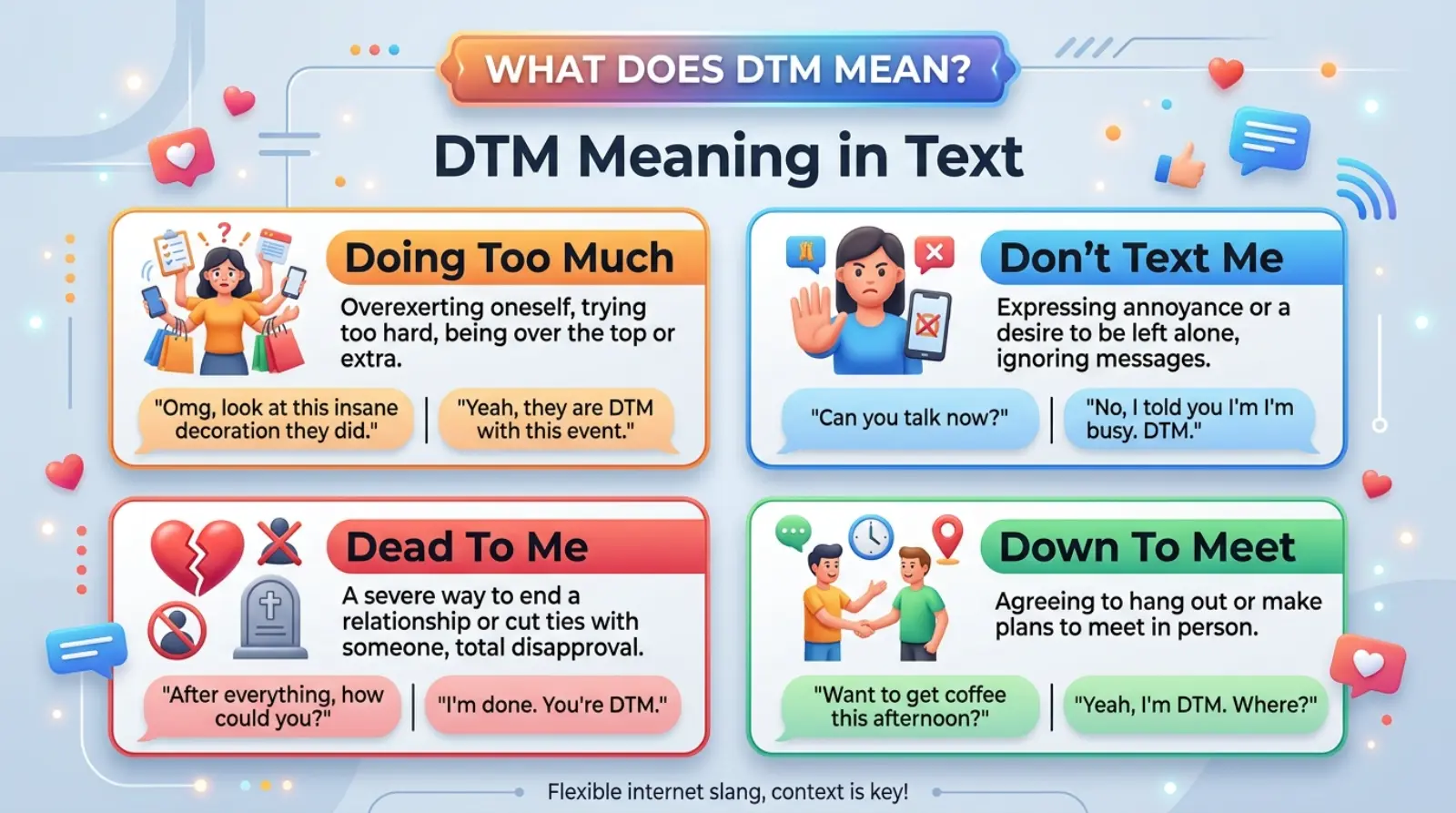
“DTM” is a flexible internet slang acronym with multiple meanings depending on context. The most common interpretations include:
• Doing Too Much
• Don’t Text Me
• Dead To Me
• Down To Meet
• Don’t Trust Men (less common but used in niche contexts)
The meaning shifts based on emotion and situation. That’s why confusion happens so often.
For example:
• “She’s dtm in the group chat again 💀” → Doing Too Much (overreacting or being dramatic)
• “I’m dtm with everyone today” → Don’t Text Me (needing space)
• “After that argument, he’s dtm” → Dead To Me (emotional cutoff)
• “You free later? dtm?” → Down To Meet (planning to meet)
At its core, dtm is about emotional expression—distance, frustration, humor, or connection depending on tone.
👉 what does dtm mean in text
DTM in text is not a fixed dictionary word—it’s a mood-based abbreviation.
Unlike formal language, internet slang evolves through usage. So dtm meaning in text depends heavily on:
• who is sending it
• the emotional situation
• the relationship between people
• whether it’s serious or joking
In simple terms, dtm is a “context-sensitive slang code.” One phrase, multiple emotional directions.
That’s why misunderstanding it is so common—because you’re not just decoding letters, you’re decoding feelings.
👉 Doing Too Much
This is the most popular meaning of dtm in modern texting.
When someone says “you’re dtm,” it usually means you’re overreacting, being extra, or exaggerating a situation.
Example:
• “You said hi and she didn’t reply yet?? bro you’re dtm 😭”
It’s not always negative. Sometimes it’s playful teasing between friends.
Emotion behind it:
• light sarcasm
• social correction
• playful judgment
• “calm down” energy
It reflects how online culture polices dramatic behavior in a humorous way.
👉 Don’t Text Me
Here, dtm becomes emotional distance in digital form.
Example:
• “I’m not okay right now, dtm”
This version is more serious. It signals:
• need for space
• emotional overwhelm
• boundary setting
Unlike the playful “doing too much,” this one carries weight. It’s a quiet way of saying “I need silence right now.”
👉 Dead To Me
This is the most emotionally intense version of dtm.
Example:
• “After what he did, he’s dtm”
It means someone is emotionally cut off—no longer important.
Psychologically, it reflects:
• betrayal
• emotional shutdown
• strong boundaries
• anger or disappointment
It’s dramatic, but intentionally so. Social media loves dramatic emotional shorthand.
👉 Down To Meet
This version is the most neutral and positive.
Example:
• “You dtm later or nah?”
Here, dtm simply means availability or willingness to meet.
It reflects:
• social planning
• casual coordination
• friendliness
This meaning is often used in fast texting culture where people shorten everything.
👉 Don’t Trust Men
This is a niche, emotionally charged variation.
Example:
• “After that situation… dtm 😭”
Used mostly in humorous or venting contexts online, especially in conversations about relationships.
It signals:
• frustration
• generalization
• emotional venting
• sometimes meme culture exaggeration
It’s less literal and more expressive of mood than actual advice.
👉 Origin & Background
DTM didn’t come from one single place—it evolved from internet abbreviation culture.
It spread through:
• texting shortcuts
• Twitter/X slang evolution
• TikTok captions and comments
• meme culture shorthand
As internet communication got faster, people started compressing emotional sentences into acronyms. Instead of typing full thoughts like “don’t text me right now,” users shortened it to dtm.
Over time, different communities gave it different meanings. That’s how one acronym became multiple emotional expressions.
Internet language evolves fast—today’s meaning can shift completely in a few months depending on viral usage.
👉 Real-Life Conversations
WhatsApp chat:
• A: “Bro she ignored my message 😭”
• B: “Stop dtm she’s probably busy”
Instagram DM:
• “We dtm later or what?”
TikTok comment:
• “This video got me dtm 💀”
Group chat:
• “He’s dtm again with those excuses”
Text message:
• “I need space rn, dtm”
Emotional pattern:
DTM appears most when people are either joking, overwhelmed, planning something, or reacting emotionally. It acts like a shortcut for tone more than words.
👉 Emotional & Psychological Meaning
DTM is more than slang—it’s emotional compression.
It reflects how people communicate feelings quickly online:
• frustration without full explanation
• humor instead of conflict
• boundaries without long arguments
• emotional intensity in short form
Using dtm often signals social awareness. The speaker expects the listener to “get the vibe” without needing full context.
Mini story:
Imagine two friends in a group chat. One keeps overreacting about a small issue. Instead of arguing, another friend just replies “bro you dtm 😭”. The tension disappears instantly. It turns conflict into humor.
That’s internet psychology—softening emotions through slang.
That’s the deeper psychology behind it.
👉 Usage in Different Contexts
Social Media
Used in captions, comments, memes. Mostly casual or humorous.
Friends & Relationships
Can be emotional, playful, or boundary-setting depending on tone.
Work or Professional Settings
Rare and not recommended. Can cause confusion.
Casual vs Serious Tone
Casual: joking, teasing, memes
Serious: emotional distance, boundaries, conflict
👉 When NOT to Use It
Avoid dtm in:
• formal emails
• workplace communication
• serious emotional conversations
• with people unfamiliar with slang
• cross-cultural misunderstandings
It can easily be misinterpreted.
👉 Context protects meaning.
👉 Common Misunderstandings
• Thinking dtm has only one meaning
• Assuming it is always rude
• Misreading joking tone as serious
• Confusing “down to meet” with emotional meanings
• Overanalyzing in formal settings
DTM is flexible, not fixed.
👉 Comparison Table
Expression | Meaning | Tone | Usage Context
DTM | Multiple meanings | Flexible | Texting, social media
LOL | Laughing | Light humor | All casual chats
IDC | I don’t care | Neutral/cold | Arguments, texting
BRB | Be right back | Neutral | Chat pauses
SMH | Shaking my head | Disapproval | Reactions
DTM stands out because it shifts meaning based on emotional context more than other acronyms.
👉 Variations & Types
• dtm 😭 (playful exaggeration)
• DTM!!! (emotional intensity)
• dtm fr (serious tone)
• dtm vibes (meme culture)
• lowkey dtm (soft expression)
Each variation changes emotional weight.
👉 How to Respond When Someone Uses It
Casual Replies:
• “facts 😭”
• “nah you right”
Funny Replies:
• “I’m dtm certified”
• “don’t expose me like that 💀”
Mature Replies:
• “What do you mean by that?”
• “Explain please”
Respectful Replies:
• “Got it, I understand”
• “Okay I’ll give space”
Matching tone matters in digital conversations.
👉 Regional & Cultural Usage
Western Culture:
Heavy use on TikTok, Twitter/X, and Instagram.
Asian Culture:
Adopted quickly through meme pages and youth texting culture.
Middle Eastern Culture:
Used in English texting communities, especially among Gen Z.
Global Internet:
DTM spreads through memes faster than formal definitions.
👉 Generational Differences
Gen Z:
Uses dtm naturally in jokes, memes, and emotional texting.
Millennials:
Understand it but use less frequently.
Older generations:
Often confused or interpret it literally.
Language reflects identity—slang becomes digital culture signaling.
👉 Is It Safe for Kids
Yes, generally harmless in casual use.
But:
• can encourage sarcasm
• may confuse tone
• sometimes used in emotional arguments
So context matters more than the word itself.
👉 FAQs
1. What does dtm mean in text?
It can mean “doing too much,” “don’t text me,” “dead to me,” or “down to meet.”
2. Is dtm rude?
Not always. It depends on tone—can be playful or serious.
3. What does dtm mean on TikTok?
Usually “doing too much” in meme or reaction videos.
4. Can dtm mean dating related?
Sometimes “down to meet,” but context is key.
5. Is dtm used in professional chats?
No, it’s informal slang.
6. Why does dtm have multiple meanings?
Because internet slang evolves through usage, not fixed definitions.
👉 Conclusion
The internet slang dtm meaning in text is more than just an abbreviation—it’s a reflection of how people compress emotions, humor, and social signals into three simple letters.
Whether it means Doing Too Much, Don’t Text Me, Dead To Me, or Down To Meet, its real power lies in context and emotional tone.
Modern communication is no longer just about words, it’s about how quickly we can express feelings without saying everything.
And that’s exactly why dtm meaning in text matters in today’s digital world, it captures emotion faster than full sentences ever could.
Because sometimes, three letters say more than a whole paragraph ever will.

I’m Grace Punston, a playful writer with a passion for clever puns and joyful wordplay. I love crafting witty lines that make readers grin and giggle. My goal is to spread laughter through smart, lighthearted writing. Every pun I share is a little spark of fun meant to brighten your day.