You’re scrolling through your messages, and suddenly someone texts:
“ATP you just playing with me 😭”
or
“ATP just answer the phone bro…”
And you pause.
Wait… what does ATP even mean here? Is it serious? Is it playful? Are they annoyed… or just being dramatic?
That moment of confusion is exactly why so many people search for atp meaning in text. Because this tiny three-letter slang can completely change tone depending on context—and honestly, it hits different every time.
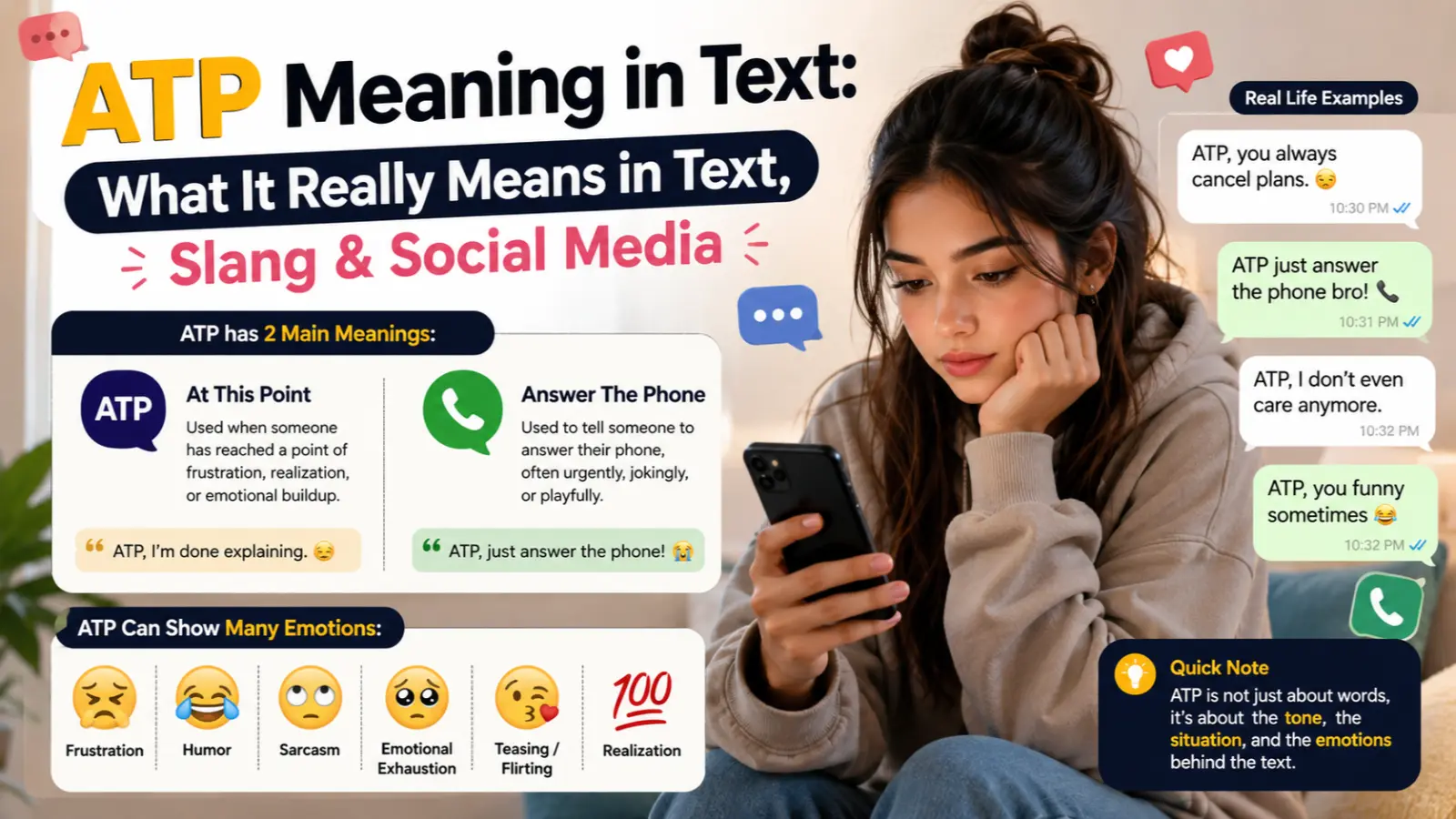
At its core, ATP means “At This Point” or “Answer The Phone.” But emotionally? It says way more than that.
Let’s break it down in a way that actually makes sense.
Quick Answer
ATP is a common internet slang abbreviation used in texting and social media.
It mainly has two meanings:
• At This Point – expressing frustration, realization, or emotional buildup
• Answer The Phone – telling someone (often urgently or playfully) to pick up
But here’s the real thing…
ATP isn’t just about words—it’s about tone.
It can signal:
• frustration (“ATP I’m done explaining”)
• sarcasm (“ATP you gotta be joking”)
• humor (“ATP just give me the food 😭”)
• emotional exhaustion (“ATP I don’t even care anymore”)
• urgency (“ATP answer the phone bro”)
• teasing or flirting (“ATP you ignoring me on purpose huh 👀”)
Simple examples:
• “ATP I’m not arguing anymore.”
• “ATP just answer the phone 😭”
• “ATP you really think that makes sense?”
👉 In short: ATP captures a moment where emotions reach a point—and spill out casually.
what does atp meaning in text
When people ask what does ATP mean in text, they’re usually trying to decode the emotion behind the message.
Because ATP isn’t literal—it’s situational.
• If someone says “ATP I’m tired” → they’ve reached their limit
• If someone says “ATP answer the phone” → they want immediate attention
• If someone says “ATP you funny” → it’s likely sarcasm
So the meaning depends on:
• tone
• relationship
• situation
• emotional intensity
👉 ATP is less about definition and more about emotional timing.
Origin & Background
ATP didn’t come from a dictionary—it came from real conversations.
It grew out of casual texting culture, especially among younger users on platforms like:
• Twitter (now X)
• TikTok
• Instagram
• Snapchat
“At This Point” has always been a normal phrase. But internet culture shortened it to ATP for speed and vibe.
Then came TikTok.
Short videos, captions, and comment sections turned ATP into a reaction phrase. People started using it to express:
• frustration in a funny way
• dramatic realizations
• relatable moments
Later, “Answer The Phone” became another meaning—especially in group chats and close friendships.
👉 The internet doesn’t just shorten language—it reshapes emotion into shorthand.
And ATP is a perfect example of that.
Real-Life Conversations
Here’s how ATP shows up in real life:
WhatsApp Chat
“ATP I told you 3 times already 😭”
Instagram DM
“ATP you just ignoring me lol”
TikTok Comment
“ATP just delete the whole app 💀”
Text Message
“ATP answer the phone bro it’s important”
Group Chat
“ATP we all know who ate the last slice 😒”
Now notice the pattern…
👉 ATP usually appears when emotions hit a turning point.
It’s not random—it’s reactive.
Emotional & Psychological Meaning
This is where ATP gets interesting.
When someone uses ATP, they’re often signaling:
• emotional buildup
• mental exhaustion
• playful frustration
• social awareness
• subtle confrontation
It’s like saying:
“I’ve reached a point… and now I’m reacting.”
For example:
Imagine your friend keeps canceling plans. You text:
“ATP just tell me you don’t wanna come.”
That’s not just information, it’s emotion layered with honesty.
Or in dating:
“ATP you gotta like me back 😭”
That’s playful… but also slightly vulnerable.
👉 ATP creates a safe space to express feelings without sounding too serious.
It softens emotions with humor or casual tone.
That’s the deeper psychology behind it.
Usage in Different Contexts
Social Media
On TikTok or Instagram, ATP is often dramatic and funny.
Example:
“ATP just restart the whole year 😭”
It turns frustration into entertainment.
Friends & Relationships
With friends, ATP feels natural and expressive.
Example:
“ATP you owe me food”
With romantic interest, it can be teasing or flirty.
Work or Professional Settings
Honestly? Avoid it.
“ATP please send the report” sounds unprofessional.
Casual vs Serious Tone
• Casual → funny, sarcastic, playful
• Serious → frustration, emotional limit
👉 Tone changes everything.
When NOT to Use It
Avoid ATP when:
• talking to elders
• in professional emails
• during serious conflicts
• with people unfamiliar with slang
• in cross-cultural communication
Because it can sound:
• disrespectful
• confusing
• too casual
👉 Context protects meaning.
Common Misunderstandings
1: ATP always means anger
Not true, it can be playful or sarcastic.
2: It only means “At This Point”
It can also mean “Answer The Phone.”
3: It’s always rude
Tone and emojis often soften it.
4: It’s literal
It’s emotional, not just logical.
Comparison Table
| Expression | Meaning | Tone | Usage Context |
|---|---|---|---|
| ATP | At this point / Answer the phone | Emotional, reactive | Texting, social media |
| TBH | To be honest | Honest, neutral | Conversations |
| NGL | Not gonna lie | Casual honesty | Online chats |
| SMH | Shaking my head | Disapproval | Reactions |
| IDC | I don’t care | Dismissive | Arguments |
👉 ATP stands out because it signals a moment of emotional shift, not just opinion.
Variations & Types
ATP evolves like everything online.
You might see:
• “ATP bro…” → casual frustration
• “ATP 😭” → emotional + humor
• “ATP just…” → dramatic setup
• “ATP you serious?” → disbelief
• “ATP ANSWER THE PHONE” → urgency
Even exaggerated forms exist:
• “ATPATPATP” → chaotic emotion
• “ATP I’m DONE” → peak frustration
Each variation adds tone—not just meaning.
How to Respond When Someone Uses It
Casual Replies
• “Lol what happened?”
• “Relax 😭”
Funny Replies
• “ATP you dramatic”
• “ATP you need help 💀”
Mature Replies
• “Okay, I get your point.”
• “Let’s fix it.”
Respectful Replies
• “Sorry, I’ll respond properly.”
• “I understand what you mean.”
👉 Matching energy matters. If they’re joking, joke. If they’re serious, respond calmly.
Regional & Cultural Usage
Western Culture
Highly common in Gen Z slang, especially on TikTok.
Asian Culture
Used in English-based online spaces, often mixed with local slang.
Middle Eastern Culture
Popular among bilingual users on social media.
Global Internet Usage
ATP spreads fast because it’s simple, emotional, and relatable.
👉 Social media makes slang borderless.
Generational Differences
Gen Z
Uses ATP naturally, emotionally, and frequently.
Millennials
Understand it but use it less.
Older Generations
Often confused by it—or interpret it too literally.
👉 Language shows identity. ATP is part of digital-native expression.
Is It Safe for Kids
Mostly, yes.
ATP is:
• not offensive
• widely used
• emotionally expressive
But:
• tone can sometimes be sarcastic
• kids may use it to express frustration indirectly
👉 It’s harmless—but still shaped by emotional context.
FAQs
1. What does ATP mean in texting?
It means “At This Point” or “Answer The Phone,” depending on context.
2. Is ATP rude?
Not always. It can be playful, sarcastic, or frustrated.
3. How is ATP used on TikTok?
Mostly in captions and comments to express dramatic or relatable moments.
4. Can ATP mean something else?
In slang, mainly these two meanings. Outside slang, it can have scientific meanings.
5. Should I use ATP at work?
No—it’s too informal for professional communication.
6. Why do people use ATP so much?
Because it expresses emotion quickly and feels relatable.
Conclusion
The atp meaning in text goes beyond simple words. Whether it’s “At This Point” or “Answer The Phone,” it captures something deeper, a moment where feelings become too real to ignore.
That’s why it resonates.
In a world of fast messages and short attention spans, slang like ATP lets people express frustration, humor, and emotion in seconds.
It’s not just language, it’s emotional shorthand.
And honestly?
👉 ATP shows that sometimes, the smallest phrases carry the biggest feelings.

I’m Jake Punman, a humor writer who lives for clever wordplay and laugh-out-loud puns. I love crafting witty lines that turn simple moments into bursts of laughter. My passion is making people smile through creative twists of language. With every pun I write, I aim to add a little more fun to your day.