You’re scrolling through your messages and suddenly you see something like:
“IMS… I didn’t mean to hurt you.”
“Bro IMS, relax.”
“Walk a mile IMS before judging.”
Now you pause.
Wait… what does IMS even mean here? Is it an apology? A warning? A mood? A whole personality?
That confusion is exactly why people search for IMS meaning in text , because this tiny three-letter slang can carry completely different emotional tones depending on who’s saying it, how it’s said, and where it shows up.
And honestly? That’s the beauty (and chaos) of internet language.
👉 Let’s break it down in a way that actually makes sense.
Quick Answer:
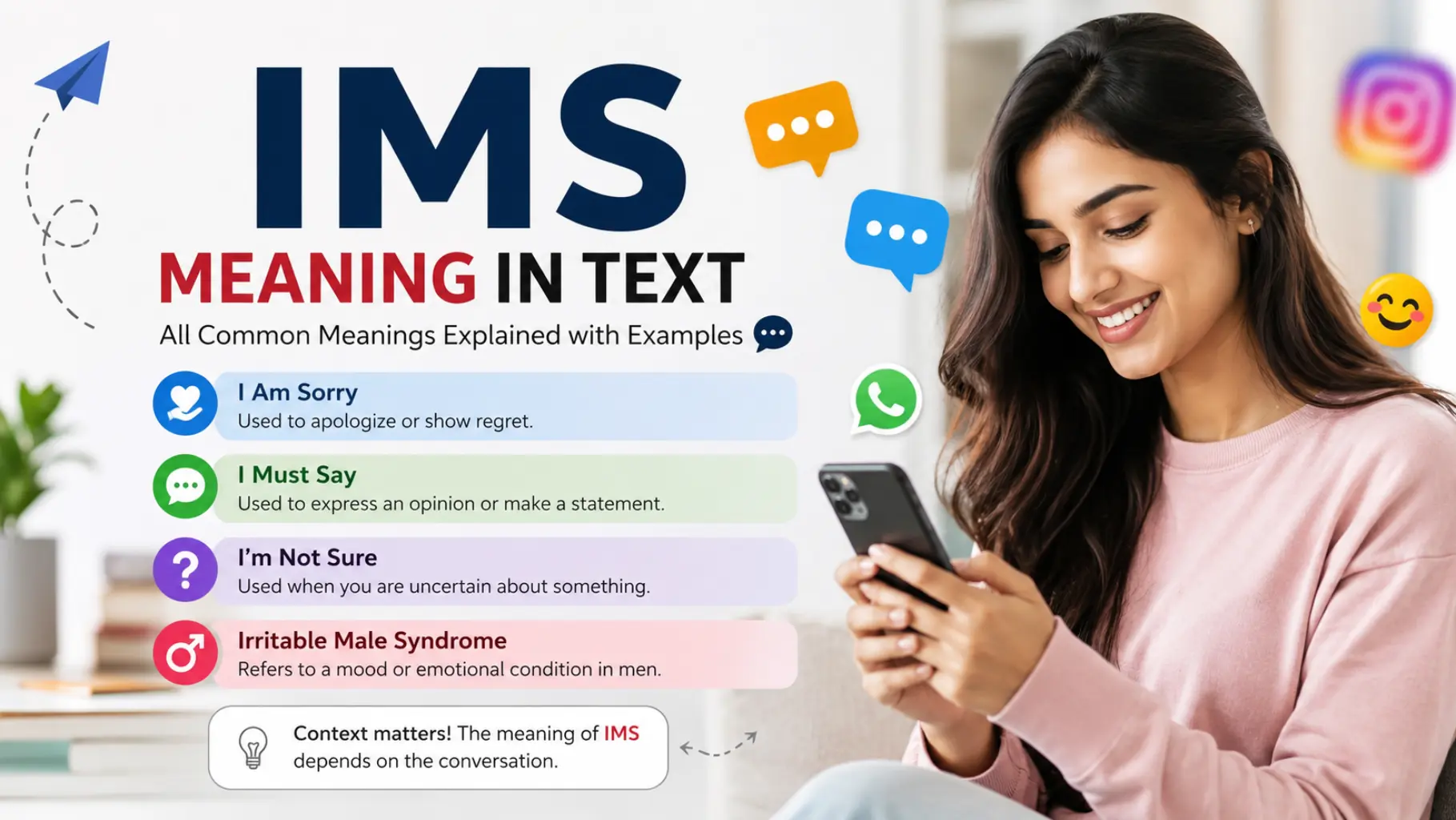
IMS is a multi-meaning slang abbreviation used in texting and social media. Depending on context, it can mean:
• I Am Sorry → apology or regret
• In My Shoes → empathy or perspective
• I’m Saying → emphasis or agreement
• Irritable Male Syndrome → mood/personality reference
But here’s the real thing people miss:
👉 IMS is not just about words , it’s about emotional intent.
The same “IMS” can feel:
• soft and apologetic
• defensive and serious
• casual and conversational
• even slightly passive-aggressive
Examples:
• “IMS, I didn’t mean it like that.” (genuine apology)
• “IMS, you don’t get it.” (frustration + perspective)
• “That’s what IMS!” (agreement / emphasis)
• “He’s acting IMS today.” (mood observation)
👉 At its core, IMS is about expressing emotion quickly without typing everything out.
What Does IMS Mean in Text
In texting, IMS meaning in text shifts based on tone, relationship, and situation.
It can signal:
• regret → “IMS for last night”
• emotional distance → “IMS, but I disagree”
• emphasis → “IMS, that’s facts”
• empathy → “Try living IMS first”
Unlike fixed slang, IMS is context-sensitive — and that’s why it confuses people.
Origin & Background
IMS didn’t start as one clear slang term.
It’s actually a multi-origin abbreviation, shaped by different communities:
• “I Am Sorry” → early SMS culture (short typing era)
• “I’m Saying” → urban slang and conversational speech patterns
• “In My Shoes” → emotional storytelling and advice culture
• “Irritable Male Syndrome” → psychology + meme culture
As social media platforms like TikTok, Instagram, and WhatsApp grew, people started reusing abbreviations in different ways.
Suddenly, one abbreviation = multiple identities.
That’s classic internet evolution.
👉 Online language doesn’t stay stable — it adapts to emotion, speed, and culture.
Real-Life Conversations
WhatsApp Chat
“IMS yaar, I forgot your birthday 😭”
→ emotional apology
Instagram DM
“You think it’s easy? Try living IMS for a week.”
→ defensive + emotional perspective
TikTok Comment
“IMS THAT’S SO TRUE 💀”
→ agreement + hype
Group Chat
“He’s in IMS mode again 😂”
→ joking about mood swings
Text Message
“IMS, I didn’t mean it like that.”
→ soft damage control
👉 Pattern?
IMS is often used when people don’t want to fully explain their feelings… but still want them understood.
Emotional & Psychological Meaning
Here’s where things get interesting.
Using IMS often signals:
• emotional awareness (you know something went wrong)
• vulnerability (you’re not fully opening up, but hinting)
• social intelligence (you understand tone matters)
• protection (you’re softening your message)
Think about this:
Instead of writing a full apology, someone says “IMS.”
Why?
Because full vulnerability feels risky.
Mini Story
You argue with a friend. Things get tense.
Later, they text:
“IMS… I was just stressed.”
That “IMS” is doing a lot of emotional work:
• it opens the door
• it reduces tension
• it avoids sounding too dramatic
👉 It’s a safe emotional shortcut.
That’s the deeper psychology behind it.
Usage in Different Contexts
Social Media
IMS is quick, expressive, and flexible.
“IMS this trend is overrated”
→ opinion + tone
Friends & Relationships
More emotional and personal.
“IMS for snapping earlier”
→ repair attempt
Work or Professional Settings
Rarely used — can feel unclear or unprofessional.
Casual vs Serious Tone
Casual:
“IMS bro chill 😂”
Serious:
“IMS… I didn’t mean to hurt you.”
👉 Tone changes everything.
When NOT to Use It
Avoid IMS when:
• you’re in formal communication
• emotions are very sensitive
• clarity is important
• talking to older audiences unfamiliar with slang
• cross-cultural conversations
Because sometimes, shorthand creates misunderstanding.
👉 Context protects meaning.
Common Misunderstandings
Misconception 1: IMS always means “I am sorry”
→ Not true — context decides
Misconception 2: It’s always polite
→ Can sound dismissive or passive-aggressive
3: Everyone understands it
→ Many people don’t
Comparison Table
| Expression | Meaning | Tone | Usage Context |
|---|---|---|---|
| IMS | Multiple meanings | Flexible | Casual texting |
| IMO | In my opinion | Neutral | Discussions |
| TBH | To be honest | Direct | Honest opinions |
| SMH | Shaking my head | Judgmental | Reactions |
| IDC | I don’t care | Cold | Emotional distancing |
👉 IMS stands out because it’s emotionally layered, not fixed.
Variations & Types
• “IMS…” → softer, hesitant
• “IMS bro” → casual apology
• “IMS!!!” → exaggerated / dramatic
• “IMS lol” → apology + humor
• “IMS fr” → serious tone
Each variation subtly changes the emotional weight.
How to Respond When Someone Uses It
Casual Replies
“Yeah it’s fine”
“No worries”
Funny Replies
“IMS accepted 😂”
“Apology approved”
Mature Replies
“I appreciate that”
“Thanks for saying that”
Respectful Replies
“It’s okay, I understand”
“Let’s move forward”
👉 Matching energy is key in social communication.
Regional & Cultural Usage
Western Culture
Used casually, often emotional shorthand.
Asian Culture
Less common; clarity preferred over abbreviations.
Middle Eastern Culture
Used among younger audiences, especially online.
Global Internet Usage
Spreading through memes and TikTok language.
Generational Differences
Gen Z
Uses IMS fluidly, emotionally, creatively.
Millennials
Understand it but use it less often.
Older Generations
May misunderstand or not recognize it.
👉 Language = identity online.
Is It Safe for Kids
Mostly yes.
But watch for:
• passive-aggressive use
• emotional misunderstanding
• unclear communication
It’s harmless — but context matters.
FAQs
1. What does IMS mean in text?
It can mean “I am sorry,” “In my shoes,” or “I’m saying,” depending on context.
2. Is IMS rude?
Not usually, but tone can make it feel dismissive.
3. Is IMS used on TikTok?
Yes, especially in comments and captions.
4. Can IMS mean apology?
Yes, very commonly.
5. Should I use IMS at work?
Better to avoid it — use clear language instead.
6. Why is IMS confusing?
Because it has multiple meanings and depends on tone.
Conclusion
Understanding IMS meaning in text isn’t just about decoding slang — it’s about understanding how people express emotion in a fast, digital world.
Whether it means “I am sorry,” “In my shoes,” “I’m saying,” or even “Irritable Male Syndrome,” IMS reflects something deeper:
👉 The human need to communicate feelings quickly… but not always fully.
In a world of short messages and fast conversations, IMS becomes a bridge between emotion and simplicity.
And sometimes, three small letters carry more feeling than a full paragraph ever could.

I’m Jake Punman, a humor writer who lives for clever wordplay and laugh-out-loud puns. I love crafting witty lines that turn simple moments into bursts of laughter. My passion is making people smile through creative twists of language. With every pun I write, I aim to add a little more fun to your day.