Ever opened a message and just saw:
“WTV.”
And suddenly… you’re not sure how to feel?
Was that attitude?
Was that chill?
that passive-aggressive?
Maybe it looked like this:
- “Do whatever, WTV.”
- “WTV you wanna do.”
- “I mean… WTV.”
And now you’re stuck thinking: Are they mad… or just tired?
That’s exactly why people search this. Because WTV doesn’t just mean something, it feels like something.
👉 Let’s break it down in a way that actually makes sense.
Quick answer:
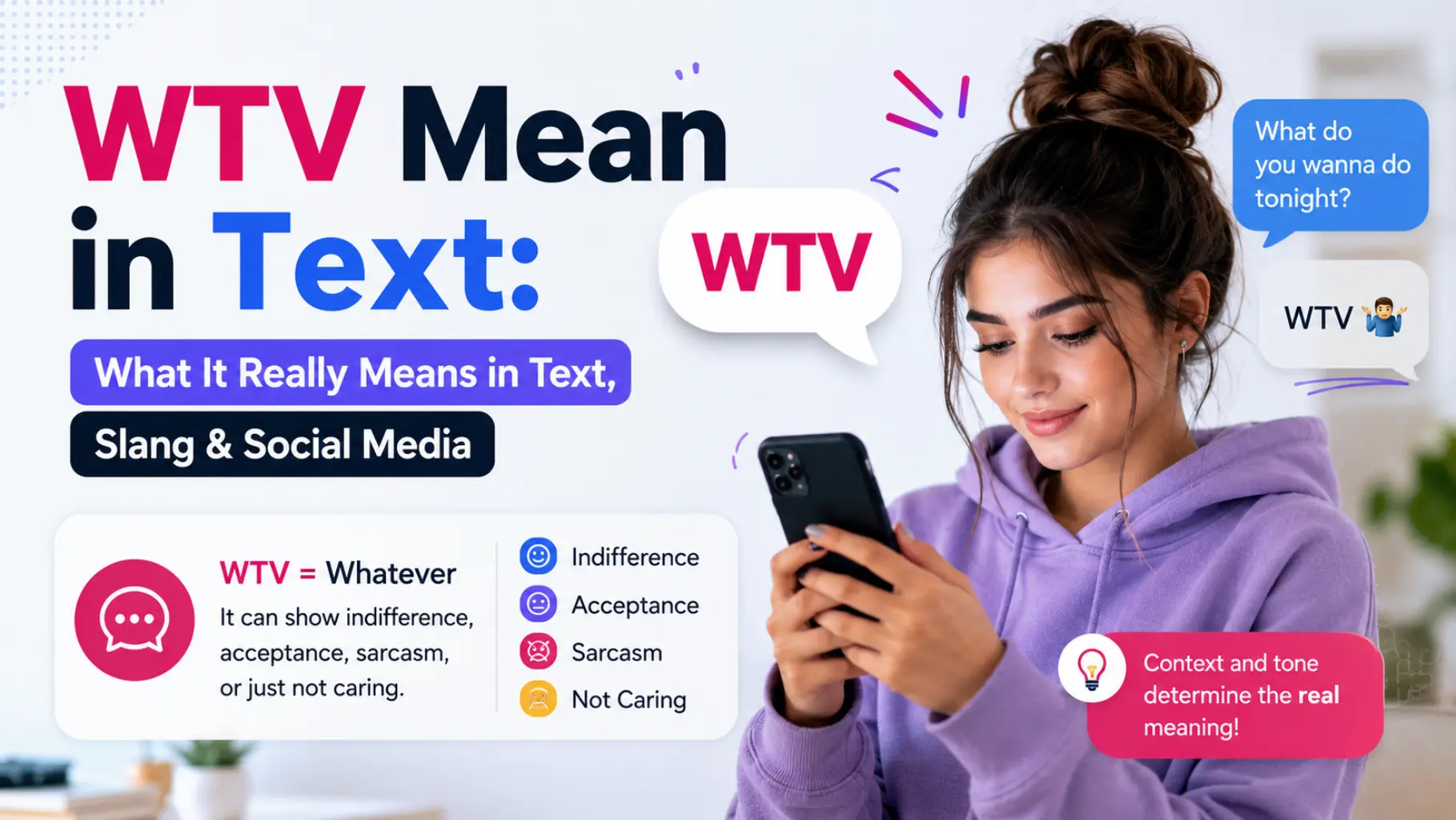
WTV is short for:
👉 “Whatever.”
But here’s the twist , it’s not just about the word. It’s about the tone behind it.
Depending on how it’s used, WTV can mean:
- Indifference → “I don’t care”
- Agreement → “I’m fine with anything”
- Dismissiveness → “Do what you want”
- Annoyance → “I’m done arguing”
- Chill acceptance → “All good either way”
- Sarcasm → “Yeah… sure, whatever”
Simple Examples:
- “WTV you say, I’m cool.” → relaxed, easygoing
- “WTV bro.” → slightly annoyed
- “Okay… WTV.” → emotionally checked out
👉 Core emotional meaning:
WTV = emotional distance + low energy response
What Does WTV Mean in Text?
At its core, WTV means “whatever” — but emotionally, it signals disengagement.
It can show:
- You don’t want to argue anymore
- You’re giving up control of the decision
- You’re slightly irritated but not expressive
- You’re protecting your energy
Sometimes, it’s peaceful.
Sometimes, it’s a warning.
Origin & Background
“Whatever” has been around forever, but WTV is a product of fast texting culture.
It evolved from:
- Early SMS abbreviations (like “LOL”, “BRB”)
- Online chat rooms
- Gaming communities
- Social media comments
Then came platforms like:
- TikTok
- Instagram DMs
- Snapchat
These spaces reward fast, low-effort communication.
And that’s where WTV thrives.
Instead of typing:
“I don’t really mind what happens, you decide.”
People just say:
“WTV.”
👉 Shorter message. Same meaning. More attitude.
Internet language evolves fast because emotions need shortcuts.
👉 Real-Life Conversations
Let’s look at how WTV actually shows up in real life.
WhatsApp Chat
- A: “Pizza or burgers?”
- B: “WTV, I’m hungry.”
👉 Meaning: doesn’t care, just wants food.
Instagram DM
- A: “You didn’t reply all day…”
- B: “I was busy… WTV.”
👉 Meaning: slightly defensive + dismissive.
TikTok Comments
- “People still believe this? WTV 💀”
👉 Meaning: sarcastic + judgmental.
Group Chat
- Friend 1: “Let’s go out tonight!”
- Friend 2: “I can’t.”
- Friend 3: “WTV, next time.”
👉 Meaning: neutral, moving on.
Emotional Pattern Behind Usage
WTV usually appears when:
- Energy is low
- Interest is fading
- The person wants to end the topic
- They don’t want conflict
It’s a soft exit word.
Emotional & Psychological Meaning
Here’s where it gets real.
When someone says WTV, they’re often doing one of these:
- Avoiding conflict
- Hiding irritation
- Acting emotionally detached
- Protecting themselves from over-explaining
It’s not always about laziness.
Sometimes, it’s about emotional boundaries.
Mini Story
You’re arguing with a friend:
You: “You never listen.”
Them: “That’s not true.”
You: “It literally is.”
Them: “WTV.”
That “WTV” isn’t neutral.
It means:
👉 “I’m done with this conversation.”
Or even:
👉 “I don’t feel like explaining myself anymore.”
It’s subtle… but powerful.
👉 That’s the deeper psychology behind it.
Usage in Different Contexts
Social Media
- Often sarcastic or dismissive
- Used in comments to show attitude
- Example: “WTV helps you sleep at night”
Friends & Relationships
- Can be chill OR passive-aggressive
- Example: “WTV you wanna watch” (relaxed)
- Example: “WTV.” (argument = emotional distance)
Work or Professional Settings
- Risky and usually inappropriate
- Can seem disrespectful or careless
- Better to avoid entirely
Casual vs Serious Tone
- Casual → flexible, easygoing
- Serious → dismissive, cold
👉 Tone depends on context, not just the word.
When NOT to Use It
Avoid using WTV when:
- You’re in a professional conversation
- Someone is expressing real emotions
- You’re resolving conflict
- Talking to older audiences unfamiliar with slang
- Cross-cultural conversations
Because sometimes, WTV can feel like:
👉 “I don’t care about what you’re saying.”
And that can hurt.
👉 Context protects meaning.
Common Misunderstandings
❌ “WTV always means rude”
Not true. Sometimes it’s just relaxed.
❌ “It literally just means whatever”
No — tone changes everything.
❌ “It shows confidence”
Sometimes… but it can also show avoidance.
❌ “It’s always sarcastic”
Only in certain contexts.
Comparison Table
| Expression | Meaning | Tone | Usage Context |
|---|---|---|---|
| WTV | Whatever | Neutral / dismissive | Casual chats |
| IDC | I don’t care | Stronger, colder | Arguments |
| IG | I guess | Uncertain | Decisions |
| Fine | Acceptance | Slightly emotional | Relationships |
| Sure | Agreement | Neutral / polite | General use |
👉 Insight:
WTV sits in the middle — not as harsh as “IDC,” but not as warm as “sure.”
Variations & Types
You’ll see WTV in different forms:
- “wtv” → casual lowercase texting
- “WTV…” → trailing emotion, hesitation
- “WTV bro” → annoyed tone
- “WTV 😂” → joking, playful
- “WTV I guess” → uncertain + passive
Each variation slightly shifts the emotional meaning.
How to Respond When Someone Uses It
Casual Replies
- “Alright, cool 😄”
- “Got it 👍”
Funny Replies
- “WTV = secretly you care 😂”
- “That sounded personal 👀”
Mature Replies
- “If something’s bothering you, just say it.”
- “We can talk it out if you want.”
Respectful Replies
- “Okay, I’ll decide then.”
- “Let me know if you change your mind.”
👉 Matching energy is key in social communication.
Regional & Cultural Usage
Western Culture
- Common in texting and memes
- Often used casually or sarcastically
Asian Culture
- Less direct use
- May be replaced with softer expressions
Middle Eastern Culture
- Can feel disrespectful depending on tone
- Direct dismissal is less socially accepted
Global Internet Usage
- Widely understood due to social media
- Meaning stays similar, tone varies culturally
Generational Differences
Gen Z
- Uses WTV frequently
- Understands tone instantly
- Uses it playfully or sarcastically
Millennials
- Use it, but more cautiously
- More aware of emotional tone
Older Generations
- May find it rude or confusing
- Prefer full expressions over abbreviations
👉 Language reflects identity — and WTV is very Gen Z energy.
Is It Safe for Kids?
Mostly, yes.
But watch for:
- Passive-aggressive use
- Emotional shutdown habits
- Miscommunication in serious conversations
Used casually, it’s harmless.
Used emotionally, it can create distance.
FAQS:
What does WTV mean in texting?
It means “whatever,” often expressing indifference or emotional distance.
Is WTV rude?
Not always. It depends on tone. It can be chill or dismissive.
What does WTV mean on TikTok?
Usually sarcastic or humorous, often used in comments to dismiss something.
Is WTV the same as IDC?
No. IDC is harsher. WTV is softer but still detached.
Can WTV be used in serious conversations?
It’s not recommended. It can feel emotionally cold.
Why do people use WTV?
To save time, avoid conflict, or express low emotional energy.
Conclusion
WTV might look like just three letters.
But in reality?
👉 It’s a shortcut for emotion.
It can mean peace.
It can mean distance.
can mean “I’m done explaining.”
That’s the power of modern slang , it doesn’t just communicate words…
it communicates feelings without saying them out loud.
And sometimes…
“WTV” says more than a full paragraph ever could.

I’m Zara Winkwell, a playful writer who loves blending wit, charm, and creativity into every pun I craft. I find inspiration in everyday moments that can turn into clever wordplay. Making people grin through humor and smart twists of language is my passion. With every line, I aim to turn simple words into a reason to smile.