Ever been in a chat where someone casually drops “IMR” and suddenly the whole vibe feels… unclear?
“You still coming?”
“Yeah IMR.”
Or maybe:
“That movie was overrated.”
“IMR it was actually good.”
And you pause for a second.
Wait… what does IMR mean here? Are they agreeing? Being sarcastic? Being serious?
That tiny three-letter slang can shift tone a lot depending on context—and that’s exactly why people search for it.
Because it’s not just about the words. It’s about the feeling behind them.
👉 Let’s break it down in a way that actually makes sense.
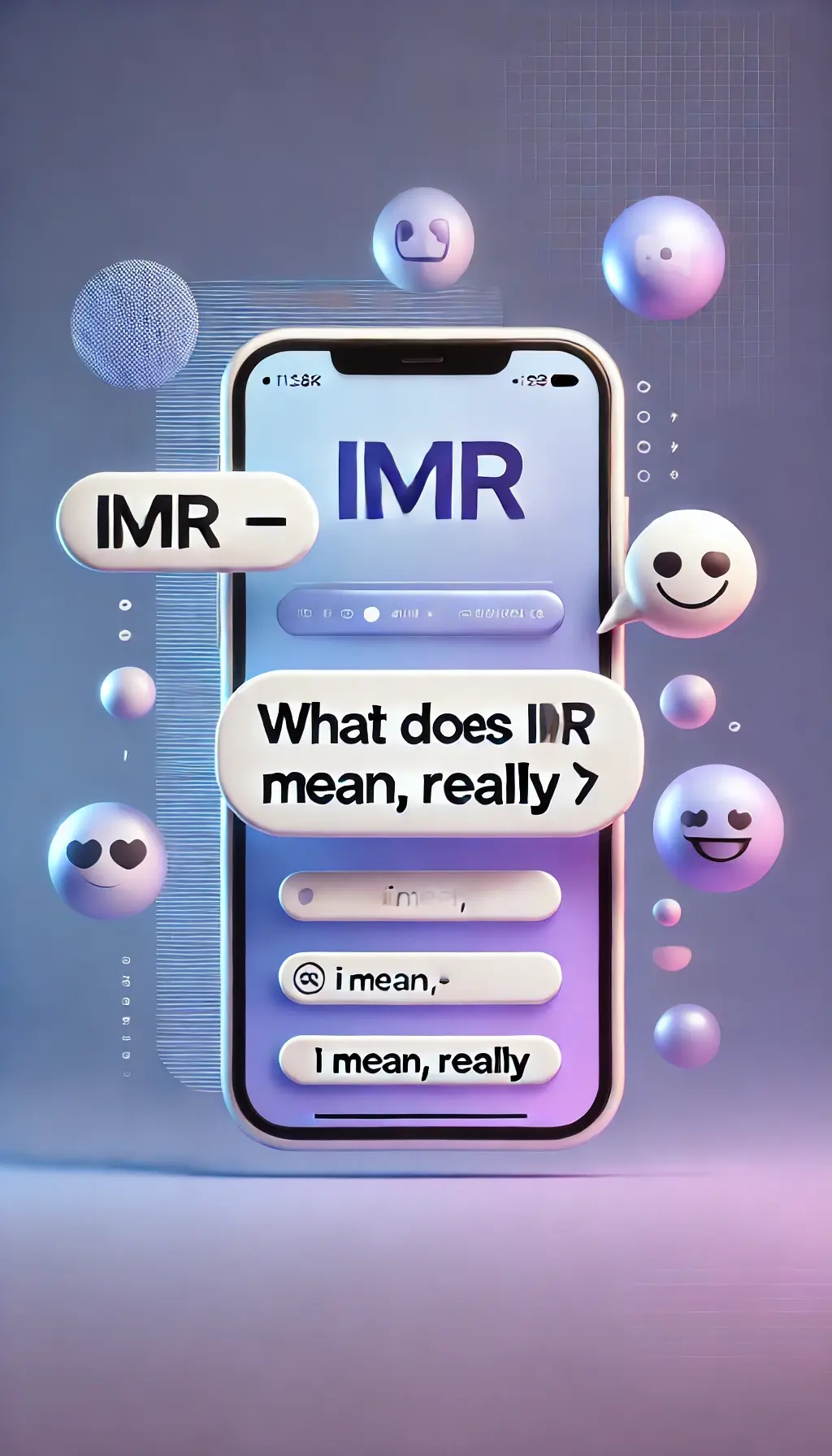
IMR – Quick Definition
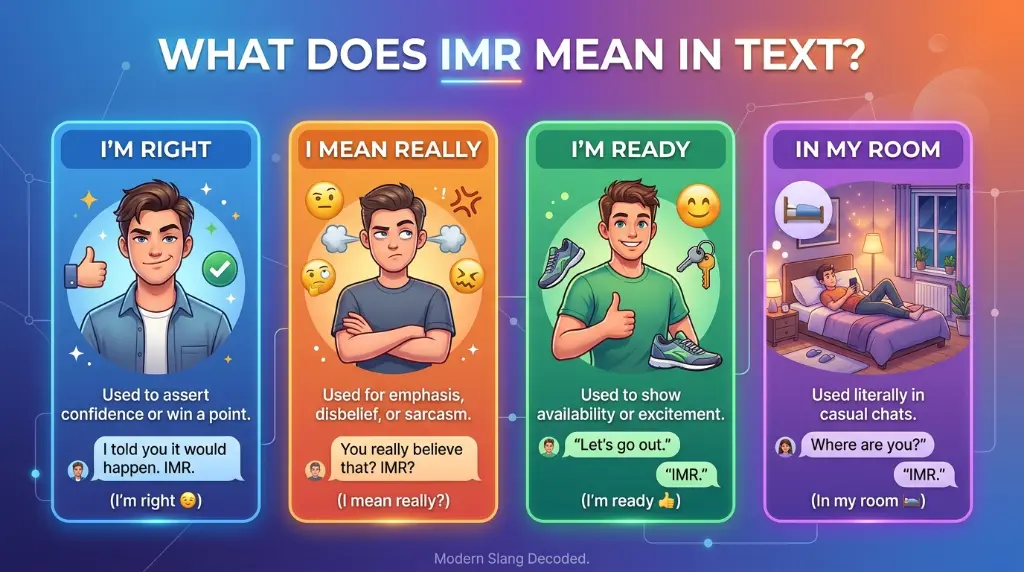
IMR is a flexible internet slang abbreviation that can mean:
- “I’m Right” → Used to assert confidence or win a point
- “I Mean Really” → Used for emphasis, disbelief, or sarcasm
- “I’m Ready” → Used to show availability or excitement
- “In My Room” → Used literally in casual chats
Simple Examples:
- “I told you it would happen. IMR.” → (I’m right 😌)
- “You really believe that? IMR?” → (I mean really?)
- “Let’s go out.” / “IMR.” → (I’m ready 👍)
- “Where are you?” / “IMR.” → (In my room 🛏️)
👉 The core emotional meaning of IMR is:
a quick expression of reaction, confidence, or emphasis depending on context.
What Does IMR Mean in Text
In texting, IMR acts like a shortcut for tone.
Instead of typing a full sentence, people drop IMR to:
- show confidence (“I’m right”)
- add attitude or sarcasm (“I mean really”)
- confirm readiness (“I’m ready”)
- answer quickly (“in my room”)
It’s efficient. It’s casual. And it fits perfectly into fast-moving conversations where speed matters more than clarity.
Origin & Background
IMR didn’t come from one single place—it’s more like a natural evolution of internet shorthand culture.
Back when texting cost money per message, abbreviations like:
- LOL
- BRB
- IDK
…started becoming part of everyday language.
IMR followed that same pattern—but with a twist.
Instead of having one fixed meaning, it evolved into a multi-meaning abbreviation, shaped by:
- Group chat culture
- Gaming chats
- TikTok comment sections
- Snapchat and Instagram DMs
On platforms like TikTok, IMR often shows up in comment debates, where people use it to defend opinions quickly:
“That outfit is mid.”
“IMR it’s actually fire.”
Over time, it became less about the literal words—and more about how it feels in the moment.
👉 That’s the thing about internet language:
it evolves faster than definitions can keep up.
👉 Real-Life Conversations
Let’s look at how IMR actually shows up in real conversations:
WhatsApp Chat
Friend 1: “Bro we’re late again”
Friend 2: “Relax IMR”
👉 (I’m ready / calm confidence)
Instagram DMs
Person A: “That guy is toxic”
Person B: “IMR you’re overreacting”
👉 (I mean really… slightly dismissive tone)
TikTok Comments
User 1: “This trend is cringe”
User 2: “IMR it’s fun lol”
👉 (Defensive opinion, casual tone)
Text Message
“Where are you?”
“IMR”
👉 (In my room)
Group Chat
“I knew this would happen IMR 😭”
👉 (I’m right, with playful emotion)
Emotional Pattern Behind It
Across all these examples, IMR usually signals:
- quick reaction
- subtle attitude
- emotional emphasis
- confidence or defense
It’s less about explaining—and more about expressing energy.
Emotional & Psychological Meaning
Here’s where it gets interesting.
When someone uses IMR, they’re not just sharing information—they’re revealing something about their state of mind.
Depending on context, IMR can signal:
- Confidence → “I’m right, and I know it.”
- Sarcasm → “I mean… really?”
- Readiness → “I’m in, let’s go.”
- Casual honesty → “I’m just chilling in my room.”
But deeper than that, it reflects something bigger:
👉 people want to communicate emotion quickly without over-explaining.
A Mini Story
Imagine you’re arguing with a friend about a movie.
You say:
“That ending made no sense.”
They reply:
“IMR it was perfect.”
That “IMR” does a lot of work:
- It softens the disagreement
- It adds personality
- It keeps things casual instead of confrontational
It’s not aggressive. It’s socially smart.
👉 That’s the deeper psychology behind it.
Usage in Different Contexts
Social Media
IMR is often used in comments and replies to:
- defend opinions
- react quickly
- add sarcasm
Example:
“IMR this trend is getting old.”
Friends & Relationships
Used casually to:
- confirm plans
- joke around
- express confidence
Example:
“You’re gonna lose.”
“IMR we’ll see 😏”
Work or Professional Settings
🚫 Not recommended.
IMR can feel:
- unclear
- too casual
- unprofessional
Casual vs Serious Tone
- Casual: playful, quick, expressive
- Serious: can sound dismissive or blunt
Tone depends heavily on context and relationship.
When NOT to Use It
Avoid IMR in situations like:
- formal emails
- job communication
- serious emotional conversations
- talking to older or non-internet users
- cross-cultural discussions
Why?
Because IMR relies heavily on shared slang understanding.
👉 If that understanding isn’t there, confusion replaces meaning.
👉 Context protects meaning.
Common Misunderstandings
❌ “IMR always means ‘I’m right’”
✔️ It has multiple meanings depending on context.
❌ “It’s rude or arrogant”
✔️ It can be—but often it’s just casual or playful.
❌“It’s always serious”
✔️ Many times it’s sarcastic or joking.
“Everyone understands it”
Not true—especially across age groups.
Comparison Table
| Expression | Meaning | Tone | Usage Context |
|---|---|---|---|
| IMR | I’m right / I mean really / I’m ready | Flexible | Casual chats |
| IMO | In my opinion | Neutral | Opinions |
| FR | For real | Emphasizing truth | Informal |
| ISTG | I swear to God | Emotional / dramatic | Strong reactions |
| TBH | To be honest | Honest / soft | Personal thoughts |
👉 IMR stands out because it’s multi-meaning and tone-dependent, while others are more fixed.
Variations & Types
You might see IMR used in different styles:
- IMR 😭 → emotional / dramatic
- IMR lol → playful / light
- IMR?? → disbelief / sarcasm
- IMRRR → exaggerated emphasis
- imr → casual lowercase texting
Each variation subtly changes the energy of the message.
How to Respond When Someone Uses It
Casual Replies
- “Alright bet 😄”
- “Got you”
Funny Replies
- “We’ll see about that IMR 👀”
- “You always think you’re right 😂”
Mature Replies
- “Fair point, I see what you mean”
- “That’s valid”
Respectful Replies
- “Okay, noted”
- “Thanks for clarifying”
👉 Matching someone’s tone is key in digital communication.
Regional & Cultural Usage
Western Culture
Very common in fast texting, TikTok, and meme culture.
Asian Culture
Used more selectively; clarity is often preferred over slang.
Middle Eastern Culture
Growing usage among younger audiences, especially on social media.
Global Internet Usage
IMR is spreading through:
- TikTok trends
- gaming communities
- global meme culture
👉 Slang today doesn’t stay local—it goes global fast.
Generational Differences
Gen Z
Uses IMR naturally and fluidly with multiple meanings.
Millennials
Understand it but may use it less frequently.
Older Generations
Often unfamiliar or confused by it.
👉 Language today is not just communication—it’s identity.
Is It Safe for Kids?
Generally, yes.
IMR is:
- harmless in most contexts
- casual and expressive
But watch for:
- sarcasm misunderstandings
- teasing tone
- overuse in serious conversations
Balance matters.
FAQS:
What does IMR mean in texting?
It usually means “I’m right,” “I mean really,” “I’m ready,” or “in my room” depending on context.
Is IMR rude?
Not necessarily. It can sound rude if used in arguments, but often it’s casual or playful.
How do I know which meaning is correct?
Look at the conversation context and tone, that’s the key.
Is IMR used on TikTok?
Yes, especially in comments and debates to express opinions quickly.
Can I use IMR in professional chats?
It’s better to avoid it—it may seem unclear or too informal.
Do younger people use IMR more?
Yes, especially Gen Z, who are more comfortable with evolving slang.
Conclusion
IMR is a perfect example of how modern language isn’t just about words, it’s about emotion, tone, and connection.
quick. It’s flexible. It’s expressive.
And honestly? That’s exactly how we communicate now.
Because in a world of fast messages and short attention spans,
sometimes three letters are enough to say everything.
👉 IMR… that’s kind of the beauty of it.

I’m Grace Punston, a playful writer with a passion for clever puns and joyful wordplay. I love crafting witty lines that make readers grin and giggle. My goal is to spread laughter through smart, lighthearted writing. Every pun I share is a little spark of fun meant to brighten your day.