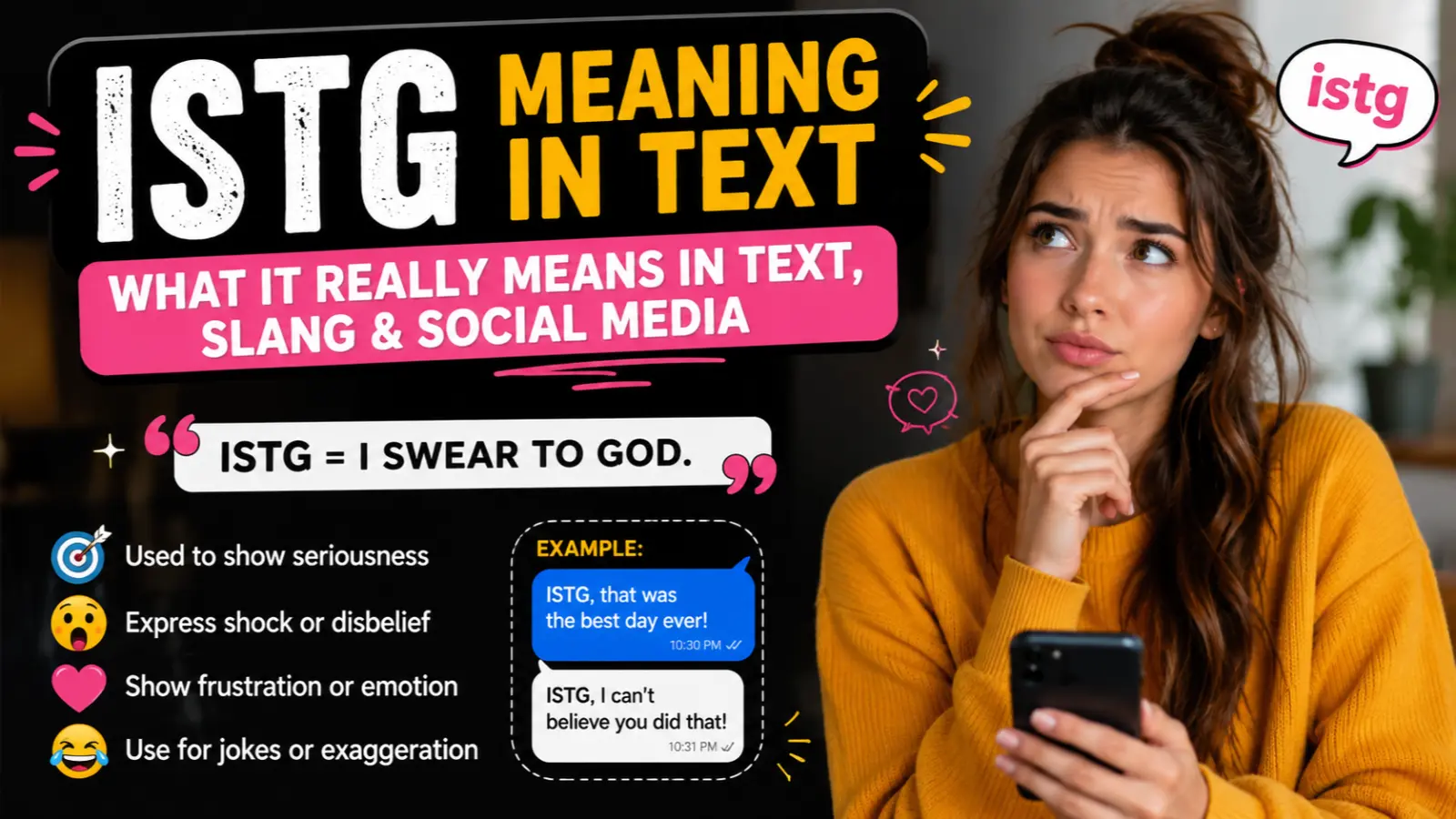
istg meaning in text is one of those internet slang terms that almost everyone has seen but not everyone fully understands. Imagine receiving a message that says, “ISTG, if you’re late again, I’m leaving without you!” Or maybe you’ve noticed someone commenting, “ISTG this song is stuck in my head.”
At first glance, it can feel confusing. Is the person angry? Are they joking? Or are they simply trying to emphasize how strongly they feel?
That’s exactly why so many people search for ISTG meaning in text. Modern conversations move fast, and abbreviations often carry much more emotion than the words themselves.
A single acronym can express frustration, excitement, disbelief, sincerity, or even playful exaggeration depending on the situation.
Unlike many internet abbreviations that only save typing time, ISTG communicates emotion. It tells the reader, “I’m being serious,” even if the message is humorous.
So, what does it actually mean, where did it come from, and why do millions of people use it every day?
Let’s break it down in a way that actually makes sense.
Quick Definition
ISTG stands for “I Swear To God.”
People use it to add emphasis, show honesty, express strong emotions, or make their statement sound more believable. While the literal phrase refers to making a serious promise, today’s internet users often use it much more casually.
ISTG Meaning: Expressing Seriousness
Sometimes people use ISTG because they genuinely want others to believe them.
Example
“ISTG I didn’t touch your fries.”
The speaker wants to sound completely truthful.
ISTG Meaning: Showing Frustration
One of the most common uses is expressing annoyance.
Example
“ISTG this Wi-Fi stops working every five minutes.”
Here, ISTG strengthens the complaint.
ISTG Meaning: Reacting to Something Shocking
People often use it when they’re surprised or can’t believe something happened.
Example
“ISTG I just saw my teacher at the gym.”
It adds emotional intensity.
ISTG Meaning: Making a Funny Exaggeration
Internet users love dramatic humor.
Example
“ISTG if one more mosquito bites me, I’m moving to Antarctica.”
Nobody expects this literally—it’s simply exaggerated for laughs.
ISTG Meaning: Showing Excitement
Sometimes it highlights positive emotions.
Example
“ISTG this is the best pizza I’ve ever had.”
The phrase emphasizes enthusiasm.
ISTG Meaning: Emotional Expression
People also use ISTG during emotional conversations to show sincerity.
Example
“ISTG I really care about you.”
In this case, it reassures the other person.
The Core Emotional Meaning
At its heart, ISTG means “I Swear To God,” but emotionally it tells readers:
- Believe me.
- I’m serious.
- I’m overwhelmed.
- I’m not joking.
- This really matters to me.
What Does ISTG Mean in Text?
In texting, ISTG almost always means “I Swear To God.”
However, the exact meaning depends entirely on the conversation.
If your friend texts:
“ISTG you’re hilarious.”
They’re giving a compliment.
If someone writes:
“ISTG I’m done.”
They’re probably frustrated or emotionally exhausted.
If someone says:
“ISTG that’s the cutest puppy ever.”
They’re expressing excitement.
This flexibility explains why ISTG has become one of the internet’s favorite emotional shortcuts.
Origin & Background
The full phrase “I swear to God” has existed in spoken English for centuries. Traditionally, people used it as a solemn promise to prove honesty.
As texting became more popular during the early SMS era, people started shortening common expressions into acronyms to save time. Just like LOL, OMG, and BRB, ISTG naturally emerged.
Its popularity exploded with the rise of:
- Twitter (now X)
- Snapchat
- TikTok
- Discord
- Online gaming communities
TikTok especially helped normalize ISTG among Gen Z users. Short videos often feature captions like:
“ISTG this trend lives rent-free in my head.”
Memes also pushed the phrase into everyday internet culture because it perfectly fits dramatic, relatable humor.
Online language evolves incredibly fast. Words that once sounded serious can become playful, sarcastic, or emotional simply because millions of users adopt them in new ways every day.
Real-Life Conversations
WhatsApp Chat
A: Are you coming?
B: ISTG I’m only five minutes away.
Here, ISTG reassures the friend that they’re telling the truth.
Instagram DM
Friend: Did you finish the whole series already?
You: ISTG I couldn’t stop watching.
The phrase expresses excitement and enthusiasm.
TikTok Comment
ISTG this creator never misses.
This means the commenter believes every video is amazing.
Text Message
Mom: Did you clean your room?
Teen: ISTG I’m doing it right now.
Whether that’s true… only the room knows.
Group Chat
Friend 1: Who ate the last slice?
Friend 2: ISTG it wasn’t me.
A classic example of defending yourself.
Across all these conversations, ISTG signals emotion more than information. It tells readers how strongly someone feels rather than simply what they’re saying.
Emotional & Psychological Meaning
Why do people say ISTG instead of simply saying, “I’m serious”?
Because online communication lacks facial expressions and voice tone.
When people text, they lose body language, eye contact, and vocal emphasis. Acronyms like ISTG help replace those missing emotional signals.
Psychologically, using ISTG often communicates:
- sincerity
- urgency
- excitement
- frustration
- vulnerability
- confidence
- playful exaggeration
Imagine you’re telling your best friend about an embarrassing moment.
You text:
“ISTG I waved at someone who wasn’t waving at me.”
Instantly, the story feels more emotional, more relatable, and more human.
In dating, ISTG often adds reassurance.
“ISTG I wasn’t ignoring you.”
Among coworkers chatting casually, it can soften awkward situations.
“ISTG my alarm never went off.”
Online identity also plays a role. Internet slang helps people sound relatable and socially aware. Using ISTG naturally signals familiarity with digital culture without needing long explanations.
That’s the deeper psychology behind it.
Usage in Different Contexts
Social Media
On TikTok, Instagram, and X, ISTG usually adds dramatic emphasis.
Example:
“ISTG this recipe changed my life.”
Creators often use it because emotional wording attracts attention and engagement.
Friends & Relationships
Among friends, ISTG creates closeness.
Example:
“ISTG you’re my favorite person.”
It feels sincere without sounding overly formal.
In romantic conversations, it can reassure, comfort, or express affection.
Work or Professional Settings
Professional emails, business meetings, and workplace chats generally aren’t the right place for ISTG.
Instead of saying:
“ISTG I finished the report.”
It’s better to write:
“I’ve completed the report.”
Formal communication values clarity over internet slang.
Casual vs. Serious Tone
The same acronym changes meaning depending on context.
Casual
“ISTG this coffee is amazing.”
Serious
“ISTG I never shared your secret.”
One expresses excitement; the other communicates honesty and trust.
Context always shapes interpretation.
When NOT to Use ISTG
Although ISTG is common in online conversations, it isn’t appropriate everywhere. Like many internet slang terms, its meaning depends heavily on the audience and situation.
Formal Environments
Avoid using ISTG in professional emails, business presentations, academic papers, or official documents.
Instead of writing:
“ISTG I’ll finish the project today.”
Write:”I will complete the project today.”
Professional communication values clarity and professionalism over internet slang.
During Emotional Conflicts
Because ISTG can sound emotionally intense, it may accidentally make an argument worse.
For example:
“ISTG you’re never listening.”
Even if frustration is understandable, the phrase can make the conversation feel more confrontational.
Around Older Audiences
Not everyone recognizes texting abbreviations.
Parents, grandparents, teachers, or coworkers may misunderstand ISTG or interpret it differently.
When communicating across generations, plain language usually avoids confusion.
Cross-Cultural Conversations
Since ISTG literally includes the phrase “I Swear To God,” some cultures or religions may view it more seriously than internet users intend.
If you’re talking with someone from a different cultural or religious background, consider whether another phrase would communicate your point more respectfully.
Context protects meaning.
Common Misunderstandings About ISTG
Despite its popularity, ISTG is often misunderstood.
Misunderstanding 1: It Always Means Anger
Not true.
Someone might say:
“ISTG this puppy is adorable.”
That’s excitement, not frustration.
Misunderstanding 2: It’s Always Religious
Originally, yes.
Today, most internet users treat ISTG as a casual expression for emphasis rather than a religious statement.
Misunderstanding 3: It’s Always Serious
Ironically, ISTG is often used sarcastically.
Example:
“ISTG if my phone freezes one more time, I’m throwing it into space.”
Nobody expects that to happen.
Misunderstanding 4: It’s Rude
By itself, ISTG isn’t rude.
The surrounding words determine whether the message feels friendly, funny, dramatic, or offensive.
ISTG vs Similar Internet Expressions
| Expression | Meaning | Tone | Common Usage |
|---|---|---|---|
| ISTG | I Swear To God | Serious, emotional, dramatic | Texting, social media, chats |
| OMG | Oh My God | Surprise or excitement | Everyday online conversations |
| TBH | To Be Honest | Honest opinion | Opinions and conversations |
| NGL | Not Gonna Lie | Honest admission | Storytelling and reactions |
| FR | For Real | Agreement or emphasis | Casual texting |
| IDC | I Don’t Care | Indifference | Informal chats |
Although these expressions all add emotion, ISTG usually carries the strongest feeling of sincerity or emphasis. It often makes a statement sound more personal and emotionally charged.
Variations & Types of ISTG
Like most internet slang, ISTG has evolved into several playful versions.
Lowercase “istg”
Many people simply type:
“istg you’re so funny.”
Using lowercase makes the message feel casual and relaxed.
ALL CAPS: ISTG
Writing in all capitals increases emotional intensity.
Example:
“ISTG THAT WAS THE BEST CONCERT EVER!”
It signals excitement or strong feelings.
Sarcastic ISTG
Sometimes people intentionally exaggerate.
“ISTG my laptop waits until deadlines to stop working.”
The humor comes from dramatic overstatement.
Emotional ISTG
Used during heartfelt conversations.
“ISTG I’m proud of you.”
This version communicates genuine sincerity.
Meme Version
Memes often combine ISTG with absurd humor.
Example:
“ISTG my cat pays rent emotionally.”
Internet culture thrives on exaggerated, relatable jokes like this.
How to Respond When Someone Uses ISTG
Matching the other person’s tone helps conversations feel natural.
Casual Replies
- “I believe you.”
- “Fair enough.”
- “Same here.”
- “You’re probably right.”
Funny Replies
- “Proof or it didn’t happen.”
- “That’s oddly specific.”
- “You’re being dramatic again.”
- “I can’t stop laughing.”
Mature Replies
- “Thanks for being honest.”
- “I understand what you mean.”
- “I appreciate you telling me.”
Respectful Replies
- “I hear you.”
- “That makes sense.”
- “Let’s figure it out together.”
Good conversations aren’t just about the words—they’re about matching the emotional energy behind those words.
Regional & Cultural Usage
Western Culture
In North America, the UK, and Australia, ISTG is widely recognized among younger internet users. It’s common across texting apps, gaming communities, and social media platforms.
Asian Culture
Many English-speaking internet users across Asia understand ISTG through TikTok, Instagram, YouTube, and online gaming. However, local slang is often mixed with English abbreviations.
Middle Eastern Culture
Usage varies depending on language, age, and cultural background. Some users embrace global internet slang, while others avoid expressions involving religious wording.
Global Internet Usage
The internet has made slang nearly borderless.
A teenager in Canada, a gamer in Pakistan, and a creator in the Philippines may all use ISTG—even if they speak different native languages.
That’s one of the fascinating ways social media shapes modern communication.
Generational Differences
Gen Z
Gen Z uses ISTG naturally in daily texting.
For many, it has become part of normal online language rather than a special abbreviation.
Millennials
Millennials understand ISTG but often mix it with older internet slang like LOL, BRB, and TBH.
Older Generations
Many older adults either don’t recognize the acronym or interpret it literally.
This difference highlights how language reflects changing digital identities.
Each generation creates expressions that help define its online culture.
Is ISTG Safe for Kids?
Generally, ISTG is considered a harmless piece of internet slang.
Most young people use it simply to emphasize their feelings.
However, parents should still teach children that:
- words have emotional impact
- context matters
- internet slang isn’t suitable everywhere
- respectful communication always comes first
Like any expression, ISTG becomes positive or negative depending on how it’s used.
Frequently Asked Questions
What does ISTG mean in text?
ISTG stands for “I Swear To God.” It’s used to emphasize honesty, strong emotions, surprise, excitement, or frustration.
Is ISTG considered rude?
No. ISTG isn’t rude on its own. The overall sentence and tone determine whether it sounds friendly, funny, or offensive.
Why do people say ISTG on TikTok?
TikTok creators use ISTG because it makes captions and comments sound more emotional, relatable, and dramatic.
Can ISTG be used in professional messages?
It’s best to avoid it. Professional communication usually benefits from complete sentences instead of internet abbreviations.
Do Millennials and Gen Z use ISTG differently?
Both understand it, but Gen Z tends to use it more frequently in everyday texting and social media conversations.
Does ISTG always mean someone is telling the truth?
Not necessarily. Many people use it humorously or sarcastically. Context always determines whether it’s literal or playful.
Conclusion
Understanding the istg meaning in text is about more than learning an acronym. ISTG means “I Swear To God,” but in today’s digital world, it has become a powerful way to express sincerity, excitement, frustration, surprise, humor, and emotional intensity.
From WhatsApp chats and TikTok comments to Instagram DMs and group conversations, ISTG helps people communicate feelings that might otherwise be lost through a screen. It reflects how internet culture continuously reshapes language, turning simple abbreviations into emotionally meaningful expressions.
The next time you see ISTG in a message, don’t just read the words—pay attention to the emotion behind them. In modern online communication, understanding feelings is often just as important as understanding the language itself.

I’m Zara Winkwell, a playful writer who loves blending wit, charm, and creativity into every pun I craft. I find inspiration in everyday moments that can turn into clever wordplay. Making people grin through humor and smart twists of language is my passion. With every line, I aim to turn simple words into a reason to smile.