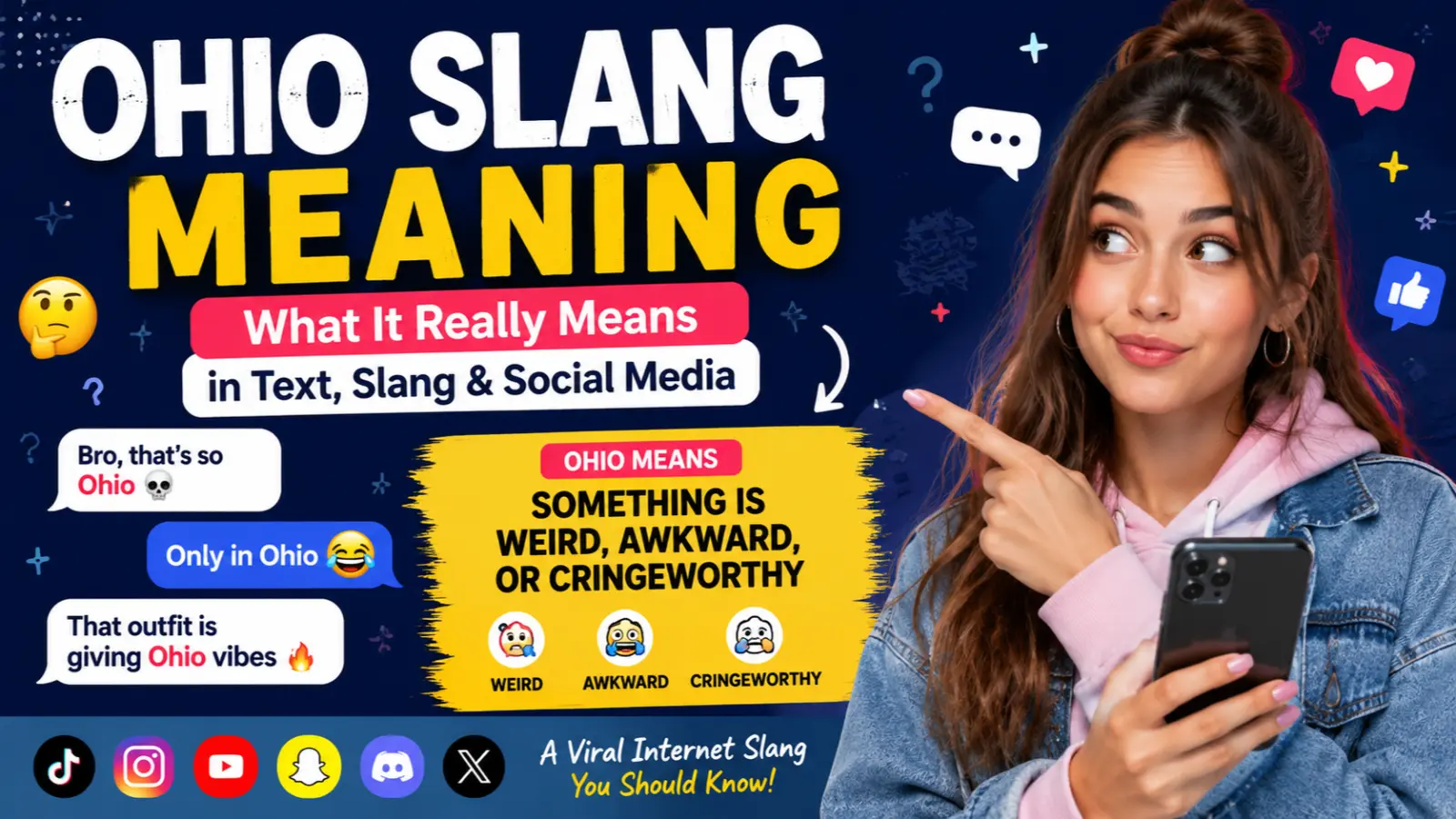
Ohio slang meaning has become one of the internet’s favorite ways to call something weird, awkward, cringeworthy, or completely absurd. Imagine scrolling through TikTok and seeing someone comment, “Bro, that’s so Ohio 💀.” Or your friend texts, “That outfit is giving Ohio vibes.”
If you’ve never seen the meme before, it can feel confusing. Why Ohio? What does an entire U.S. state have to do with something being strange?
This confusion is exactly why so many people search for ohio slang meaning. The phrase doesn’t actually criticize the state itself. Instead, it’s an internet meme that evolved into shorthand for anything that feels bizarre, cursed, embarrassing, or unreal.
If you spotted it on TikTok, Instagram, YouTube Shorts, Discord, Snapchat, or in a group chat, understanding the phrase means understanding modern meme culture. The internet constantly creates new inside jokes, and “Ohio” is one of the biggest examples of how a normal word can gain an entirely different meaning online.
Let’s break it down in a way that actually makes sense.
Quick Definition
In modern internet slang, Ohio usually means something weird, awkward, cringeworthy, bizarre, cursed, or so unusual that it feels unreal.
The meaning changes slightly depending on the conversation and the speaker’s tone.
It can be used when someone is:
- noticing something strange
- reacting with disbelief
- joking about an awkward moment
- lightly insulting something
- exposing embarrassing behavior
- exaggerating a situation for comedy
- teasing friends
- expressing second-hand embarrassment
Example
“That dance move was so Ohio.”
Meaning: It looked awkward or incredibly strange.
“Only in Ohio.”
Meaning: Something unbelievably weird happened.
At its core, the slang is less about geography and more about internet humor. It’s a playful way of saying, “This is weird enough to become a meme.”
Ohio Slang Meaning as a Reaction
One of the most common uses is simply reacting to something unexpected.
Someone falls off a chair during a livestream.
Comment:
“Ohio moment.”
The comment isn’t meant literally. It’s a humorous reaction saying the situation feels ridiculous.
Ohio Slang Meaning as an Insult
Friends often use “Ohio” as a playful insult.
Example:
Friend 1:
“I still wear socks with sandals.”
Friend 2:
“Bro… that’s Ohio.”
Nobody is actually angry. The goal is friendly teasing rather than hurting someone’s feelings.
Ohio Slang Meaning as a Joke
Internet users love exaggeration.
Instead of saying something is merely weird, they dramatically label it “Ohio.”
Example:
“That AI-generated cat has six legs.”
Reply:
“Average Ohio animal.”
The joke works because everyone understands the exaggeration.
Ohio Slang Meaning as Cringe
Sometimes “Ohio” simply replaces the word cringe.
Example:
“His pickup line was pure Ohio.”
The speaker means it felt awkward enough to make everyone uncomfortable.
Ohio Slang Meaning as Something Weird
This is probably the most accurate everyday definition.
If something feels:
- bizarre
- unnatural
- cursed
- random
- impossible
people may simply call it “Ohio.”
Ohio Slang Meaning as Meme Humor
Many TikTok creators intentionally make videos look chaotic.
Comments often include:
- “Ohio energy.”
- “Most normal day in Ohio.”
- “Only in Ohio.”
These aren’t serious observations. They’re shared internet jokes that build community among meme lovers.
Ohio Slang Meaning as Exaggeration
The phrase is also used for comedic exaggeration.
Someone spills water.
Friend:
“Ohio disaster.”
Obviously, spilling water isn’t a disaster. The exaggeration creates humor.
Ohio Slang Meaning in Text Messages
In texting, the slang usually appears as a quick reaction.
Examples:
Alex: I accidentally wore two different shoes today.
Ryan: That’s Ohio 😂
Or:
Emma: Look at this weird picture.
Sarah: So Ohio.
The message instantly communicates surprise mixed with humor.
What Does Ohio Slang Meaning Mean in Text?
In text messages, Ohio generally means:
- That’s weird.
- That’s awkward.
- That’s embarrassing.
- That’s ridiculous.
- That’s unbelievable.
- That’s meme-worthy.
Unlike traditional slang, it doesn’t have one fixed definition. Instead, its meaning depends on the emotional tone of the conversation.
For example:
“That’s Ohio.”
could mean:
- “That’s hilarious.”
- “That’s unbelievably strange.”
- “That’s painfully awkward.”
- “That’s so random.”
This flexibility explains why the phrase spread so quickly across social media. It allows people to express several emotions using just one word.
Origin & Background
The story behind Ohio slang is surprisingly interesting.
The meme didn’t begin because unusual things actually happen in Ohio more than anywhere else. Instead, internet creators started making absurd videos with captions like:
“Only in Ohio.”
These videos often showed edited monsters, impossible events, strange animals, or intentionally fake disasters. The humor came from pretending these bizarre events were somehow normal in Ohio.
Soon, TikTok users joined the joke.
Creators began uploading increasingly ridiculous edits:
- giant floating fish
- oversized spiders
- impossible weather
- surreal AI images
- cursed animations
Every strange video received the same response:
“Average day in Ohio.”
Eventually, people stopped referring to the actual location altogether.
“Ohio” transformed into internet shorthand for anything bizarre.
This is how meme language evolves.
First comes an inside joke.
Then millions of users repeat it.
Finally, the original meaning fades, leaving behind a completely new slang expression.
TikTok played the biggest role in making the meme viral. Short videos spread the joke rapidly, while YouTube Shorts, Instagram Reels, Discord communities, Twitch streams, and gaming forums helped keep it alive. Gamers, content creators, and meme pages adopted the phrase because it instantly communicated absurdity without needing a long explanation.
Today, someone can post a strange AI image, an awkward dance, a confusing fashion choice, or a bizarre life hack, and hundreds of comments may simply read:
“Ohio.”
That single word now carries layers of meaning shaped by meme culture, sarcasm, and shared online experiences.
It’s also a reminder that internet language changes incredibly fast. Words that once had only literal meanings can become emotional shortcuts understood by millions of people worldwide. Staying familiar with slang like Ohio helps you understand not just the words people use, but also the humor, identity, and creativity that define today’s online culture.
Real-Life Conversations
Seeing Ohio slang in action is the easiest way to understand how people actually use it. The phrase isn’t limited to one app or one type of conversation. It’s everywhere—from private texts to viral TikTok comments.
WhatsApp Chat
Ali: I accidentally joined the wrong Zoom meeting.
Ahmed: Bro… that’s so Ohio 😂
Here, “Ohio” means the situation was awkward but funny.
Instagram DM
Sara: Look at this guy wearing three watches.
Emma: That’s peak Ohio.
The reply jokingly calls the outfit strange and over-the-top.
TikTok Comments
Video: A cat wearing sunglasses rides a tiny bicycle.
Comments:
- “Average Ohio pet.”
- “Only in Ohio.”
- “This is beyond Ohio 💀”
The comments exaggerate the weirdness to make the joke even funnier.
Text Message
Jake: I waved at someone who wasn’t waving at me.
Chris: Ohio moment 😭
This shows sympathy mixed with playful teasing.
Group Chat
Friend: I forgot my backpack at home… again.
Everyone: Certified Ohio behavior.
In friend groups, this phrase creates laughter instead of embarrassment. It softens awkward moments and turns small mistakes into shared jokes.
The emotional pattern behind these conversations is simple. People use Ohio to laugh with someone, not necessarily at them. It often helps reduce embarrassment by making the situation feel like a funny internet meme instead of a serious mistake.
Emotional & Psychological Meaning
At first glance, Ohio looks like a random meme. Underneath the humor, though, it reflects how people communicate emotions online.
Modern internet slang isn’t only about definitions. It’s about creating shared emotional experiences.
Calling something “Ohio” can express:
- surprise
- disbelief
- second-hand embarrassment
- playful criticism
- social awareness
- ironic humor
- emotional connection
Instead of saying,
“That was incredibly awkward.”
someone simply says,
“That’s Ohio.”
One word communicates an entire emotional reaction.
Think about a group of friends watching someone confidently walk into the wrong classroom. Nobody wants to embarrass the person, but everyone recognizes the awkwardness.
One friend quietly laughs and says,
“Bro… that’s Ohio.”
Everyone smiles.
Nobody feels attacked.
The joke becomes a shared emotional release.
The same thing happens in dating.
Imagine someone sends an overly dramatic pickup line like,
“Are you Wi-Fi? Because I feel a connection.”
Instead of writing a long response, someone replies,
“That’s Ohio.”
The slang gently points out the cringe while keeping the conversation playful.
This reflects something bigger about internet culture.
People today often hide emotions behind humor.
Rather than directly saying something feels uncomfortable, they wrap the feeling inside memes.
It feels safer.
It feels lighter.
Creates belonging.
Using modern slang also signals that someone understands online culture. It’s almost like speaking a digital dialect shared by millions of users.
That’s the deeper psychology behind it.
Usage in Different Contexts
Social Media
This is where the slang appears most often.
You’ll commonly see comments like:
- “Only in Ohio.”
- “Ohio energy.”
- “Certified Ohio moment.”
These phrases usually react to bizarre videos, AI-generated images, awkward dancing, or impossible situations.
Friends & Relationships
Among friends, the slang is playful.
Example:
“You forgot your own birthday? That’s Ohio.”
Among close friends, this usually strengthens humor instead of causing offense.
Work or Professional Settings
Using Ohio slang at work isn’t usually a good idea.
Many coworkers, clients, or managers may not understand meme culture.
Instead of sounding funny, it may sound confusing or unprofessional.
Casual vs Serious Tone
In casual conversations:
“That’s Ohio.”
sounds funny.
During serious conversations about emotions, arguments, or personal struggles, the same phrase may feel dismissive.
Context completely changes how people receive internet slang.
When NOT to Use It
Although the phrase is harmless most of the time, there are situations where it isn’t the best choice.
Avoid using it:
- during serious emotional conversations
- in professional emails
- while talking with teachers or supervisors
- when someone is genuinely upset
- in formal presentations
- with people unfamiliar with internet slang
- during cross-cultural conversations where memes may not translate well
Someone discussing anxiety or personal loss probably doesn’t want their situation compared to a meme.
Likewise, an older family member may simply wonder why you’re talking about the state of Ohio.
The internet moves fast, but not everyone follows the same online trends.
Context protects meaning.
Common Misunderstandings
Many people misunderstand Ohio slang because they only see short clips online.
Here are the biggest misconceptions.
“It literally means Ohio.”
No.
In slang, the state usually serves as a meme symbol rather than a real location.
“It’s always an insult.”
Not at all.
Friends often use it affectionately.
Sometimes it’s simply playful teasing.
“It’s always rude.”
Tone matters.
A smiling emoji changes everything.
“So Ohio 😂”
feels very different from
“You’re Ohio.”
“Everyone uses it the same way.”
Different online communities give the meme slightly different meanings.
Some emphasize weirdness.
Others focus on cringe.
Some simply use it whenever something feels random or surreal.
Comparison Table
| Expression | Meaning | Tone | Usage Context |
|---|---|---|---|
| Ohio | Weird, awkward, bizarre | Funny | Memes, chats, TikTok |
| Cringe | Embarrassing | Critical | Everyday conversations |
| Sus | Suspicious | Playful | Gaming and texting |
| NPC | Acting robotic or generic | Sarcastic | Gaming and social media |
| Delulu | Unrealistically optimistic | Humorous | Dating and fandom culture |
| Weird | Unusual | Neutral | General conversations |
Although these expressions overlap, Ohio carries a stronger meme culture identity. It isn’t just describing weirdness—it’s celebrating internet absurdity in a humorous way.
Variations & Types
Like many internet memes, Ohio slang has evolved into several playful variations. Each version adds a slightly different tone while keeping the same core idea of something being weird, awkward, or hilariously absurd.
Only in Ohio
This is the most famous version.
People use it when something looks impossible or unbelievably strange.
Example:
“A goat is riding on top of a car.”
Comment: “Only in Ohio.”
It exaggerates the situation for comedic effect rather than making a factual statement.
Average Day in Ohio
This variation suggests that bizarre events are somehow normal.
Example:
“A giant inflatable dinosaur is chasing people at a festival.”
Comment: “Average day in Ohio.”
It’s a classic meme format that instantly tells viewers not to take the video seriously.
Ohio Energy
This phrase describes a person, object, or situation that gives off chaotic or awkward vibes.
Example:
“That haircut has Ohio energy.”
The focus is on the feeling rather than the event itself.
Certified Ohio Moment
Adding “certified” makes the joke feel more dramatic.
It implies that the situation perfectly fits the meme.
Peak Ohio
People use this when something reaches a new level of weirdness.
Example:
“A fish wearing sunglasses? Peak Ohio.”
Matching the variation to the situation makes your jokes feel more natural and keeps the meme fresh.
How to Respond When Someone Uses It
If someone calls a situation “Ohio,” your reply depends on the mood of the conversation.
Casual Replies
- “Honestly, you’re right.”
- “I can’t even argue with that.”
- “That was pretty weird.”
- “Fair enough!”
These responses keep the conversation relaxed.
Funny Replies
- “Certified Ohio behavior.”
- “I’ll take that as a compliment.”
- “Guess I’m the main character today.”
- “Only happens to me 😂”
Matching the other person’s humor helps the conversation flow naturally.
Mature Replies
Sometimes someone uses “Ohio” to tease you about a mistake.
Instead of getting defensive, you can reply:
- “Yeah, that was awkward.”
- “Lesson learned!”
- “I definitely walked into that one.”
A little self-awareness often earns more respect than arguing.
Respectful Replies
If you’re unsure whether the comment was playful, respond politely.
- “Haha, I know what you mean.”
- “That’s one way to describe it.”
- “Thanks for keeping it light.”
Matching the other person’s energy matters socially. Responding with the right tone helps avoid misunderstandings and keeps conversations enjoyable.
Regional & Cultural Usage
Although the meme started in English-speaking internet communities, it quickly spread across the world.
Western Culture
In countries like the United States, Canada, the United Kingdom, and Australia, the meme is widely recognized by Gen Z and frequent social media users.
People immediately associate “Ohio” with chaotic meme humor rather than the actual state.
Asian Culture
TikTok, YouTube Shorts, and gaming communities helped introduce the phrase across many Asian countries.
Some users understand it instantly, while others simply recognize it as a funny internet trend without knowing its full background.
Middle Eastern Culture
English-speaking social media users in the Middle East often use the slang in memes, gaming chats, and comment sections.
However, outside online communities, many people may not recognize the expression.
Global Internet Usage
The internet has removed geographical boundaries from slang.
A teenager in Pakistan, Brazil, Germany, or Japan can understand the same meme because platforms like TikTok, Instagram, Discord, and YouTube spread internet culture almost instantly.
This global sharing is one reason modern slang evolves so quickly.
Generational Differences
Language often reflects identity, and “Ohio” is a great example.
Gen Z
Gen Z uses the phrase naturally.
For many young users, saying “Ohio” is faster and funnier than saying “weird” or “cringe.”
Millennials
Many Millennials understand the meme because they spend time on social media.
However, they may use it less frequently than Gen Z.
Older Generations
Older adults are less likely to recognize the slang.
If they hear someone say, “That’s Ohio,” they may assume the conversation is actually about the U.S. state.
These differences show how internet culture creates new forms of communication that are closely tied to age, online habits, and shared digital experiences.
Is It Safe for Kids?
Overall, Ohio slang is considered harmless.
Most children and teenagers use it simply to describe something funny, awkward, or unusual.
However, parents should still encourage respectful communication.
Repeatedly calling someone’s appearance, personality, or interests “Ohio” could become teasing or mild bullying if used with the intention of making someone feel embarrassed.
Teaching kids that humor should never come at someone else’s expense helps them use internet slang responsibly.
Like many memes, the phrase is safest when everyone involved understands it’s just a joke.
Frequently Asked Questions
What does Ohio slang mean?
In internet slang, Ohio usually means something weird, awkward, bizarre, cringeworthy, or absurd. It’s a meme expression rather than a literal reference to the state.
Is calling something “Ohio” rude?
Usually not. Most people use it as playful humor among friends. However, the tone and context determine whether it feels funny or insulting.
Why is Ohio used in TikTok comments?
The phrase became popular through viral memes featuring strange or impossible situations captioned with expressions like “Only in Ohio” or “Average day in Ohio.”
Can I use Ohio slang in text messages?
Yes. It’s commonly used in casual texts, group chats, and social media conversations. It’s best avoided in formal or professional communication.
Which generation uses Ohio slang the most?
Gen Z uses it most frequently because they actively participate in meme culture and short-form social media platforms.
Should I use Ohio slang at work?
Generally, no. Many coworkers or clients may not understand the meme, making your message unclear or unprofessional.
Conclusion
Understanding ohio slang meaning is about more than learning another internet phrase. It offers a glimpse into how online communities create shared humor, express emotions, and build connections through memes.
Today, ohio slang meaning usually refers to something weird, awkward, cringeworthy, bizarre, or hilariously absurd rather than the actual U.S. state. What started as a viral meme has grown into a widely recognized expression across TikTok, Instagram, YouTube Shorts, Discord, and countless group chats.
The popularity of this slang shows how modern internet culture transforms ordinary words into emotional shortcuts. A single comment like “That’s so Ohio” can communicate surprise, embarrassment, sarcasm, and humor all at once.
As online language continues to evolve, understanding expressions like ohio slang meaning helps you connect more naturally with digital conversations and internet culture. Sometimes, one funny meme says more than an entire paragraph—and that’s exactly why this phrase continues to thrive online.

I’m Grace Punston, a playful writer with a passion for clever puns and joyful wordplay. I love crafting witty lines that make readers grin and giggle. My goal is to spread laughter through smart, lighthearted writing. Every pun I share is a little spark of fun meant to brighten your day.