niche meaning in text often confuses people because it can sound technical in one conversation and completely casual in another.
Imagine receiving messages like:
- “Your content is really niche.”
- “That’s such a niche meme.”
- “This creator has a niche audience.”
- “Your music taste is so niche.”
At first glance, you might wonder whether it’s a compliment, a criticism, or simply an observation.
Is someone saying you’re unique? Are they hinting that your interests aren’t mainstream? Or are they praising you for standing out?
That’s exactly why thousands of people search for the meaning of this word in texting, social media, and online conversations. Depending on the tone, niche meaning in text can express admiration, humor, exclusivity, identity, or even playful teasing.
Let’s break it down in a way that actually makes sense.
Quick Definition
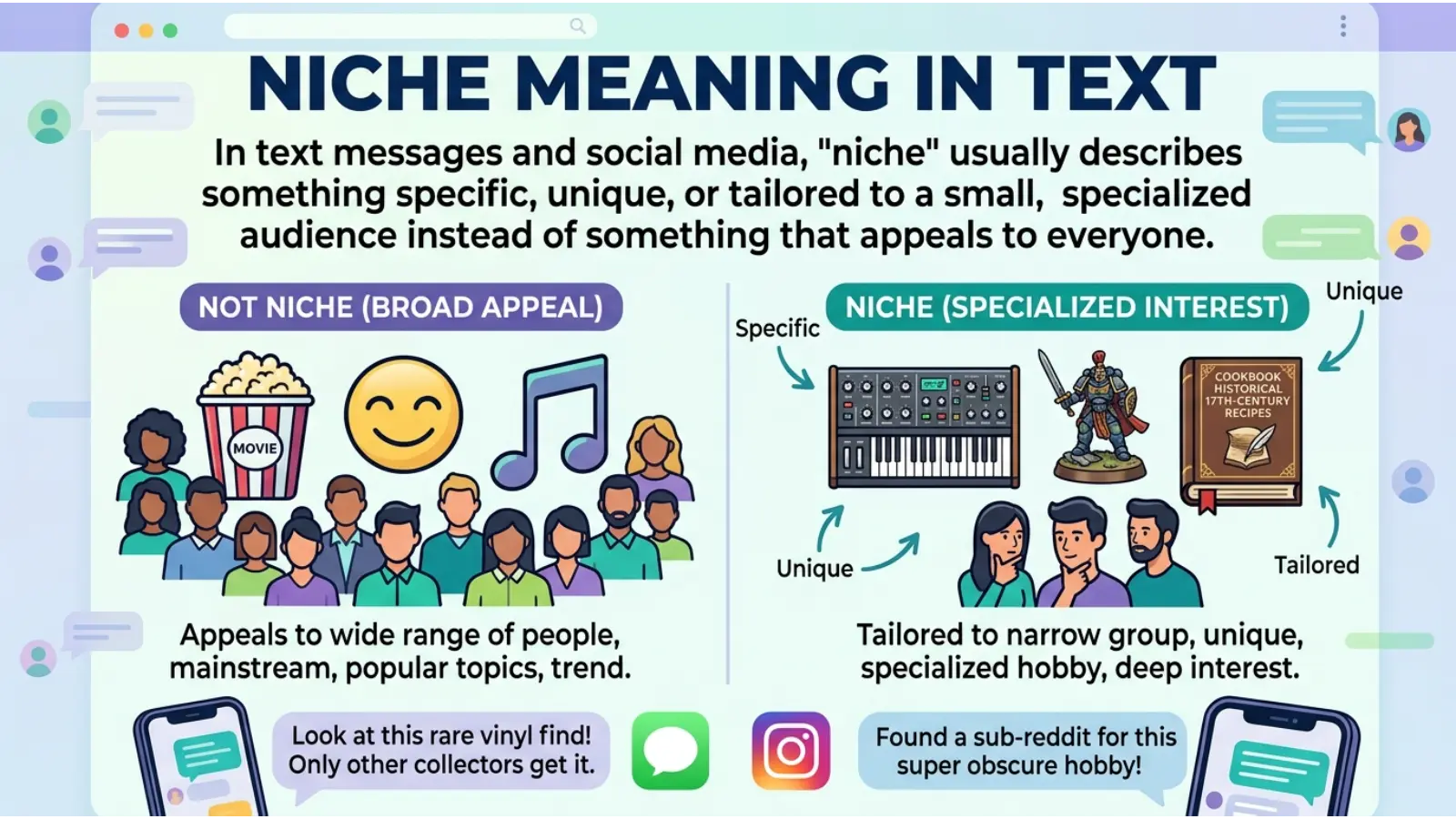
In text messages and social media, niche usually describes something specific, unique, or tailored to a small, specialized audience instead of something that appeals to everyone.
People often use it to describe:
- Interests
- Hobbies
- Humor
- Communities
- Content creators
- Fashion styles
- Music
- Online personalities
Example:
“That’s such a niche reference.”
Meaning: Only a certain group of people will understand it.
Unlike many internet slang terms, “niche” changes meaning based on context and tone.
Its emotional message is often:
- “You’re different.”
- “Only certain people get this.”
- “This isn’t mainstream.”
- “You’re speaking to your people.”
At its core, niche celebrates individuality and specialized interests.
Niche Meaning as Noticing Something Unique
Sometimes people use niche simply to notice something unusual.
Example:
“That’s a pretty niche hobby.”
They’re recognizing that the hobby isn’t common.
The tone is usually neutral or curious.
Niche Meaning as a Compliment
Being called niche is often a compliment online.
Example:
“Your page has such a niche aesthetic.”
This suggests your style feels original instead of copied.
Many creators actually work hard to become known for a niche.
Niche Meaning as a Joke
Friends sometimes joke about someone’s unusual interests.
Example:
“Only you would know that niche meme.”
The humor comes from recognizing someone’s very specific internet knowledge.
Niche Meaning as Light Criticism
Occasionally, niche can suggest limited appeal.
Example:
“Your jokes are too niche.”
Here it means many people probably won’t understand the joke.
The speaker isn’t necessarily insulting you—they’re commenting on accessibility.
Niche Meaning in Flirting
Surprisingly, niche can even appear in dating conversations.
Example:
“You have such a niche music taste, and I love it.”
This often communicates attraction toward someone’s individuality.
Niche Meaning as Emotional Expression
Many people proudly describe themselves as niche because it reflects authenticity.
Instead of trying to fit in, they’re embracing what makes them different.
What Does niche mean in text?
In texting, niche generally means something that appeals to a small, specific group rather than the general public.
People commonly use it when talking about:
- Interests
- Communities
- Online humor
- Fandoms
- Businesses
- Fashion
- Gaming
- Music
- Books
- Social media content
Examples:
Friend: “This podcast is super niche.”
Meaning: It has a specialized audience.
Instagram DM:
“Your account has found its niche.”
Meaning: Your content now attracts the right people.
TikTok Comment:
“This is such niche humor.”
Meaning: Only certain viewers will understand the joke.
The word usually carries positive or neutral feelings, although tone always matters.
Origin & Background
The word niche existed long before social media.
Originally, it referred to a specialized position or place. In business and marketing, companies used “niche” to describe products designed for a particular audience rather than everyone.
As online communities grew, the internet transformed the word.
Forums, Reddit communities, YouTube channels, and later TikTok encouraged people to build audiences around very specific interests instead of trying to attract everyone.
Suddenly, niche became part of everyday online conversations.
Instead of saying:
“I like obscure historical documentaries.”
People simply say:
“I’m into really niche content.”
TikTok accelerated this trend by rewarding creators who focused on very specific communities. Meme culture also helped spread phrases like:
- niche humor
- niche interests
- niche audience
- niche creator
- niche aesthetic
Internet language changes incredibly fast, and words like niche prove that ordinary vocabulary can develop entirely new social meanings online.
Real-Life Conversations
A: “Why are you watching videos about abandoned shopping malls?”
B: “It’s my niche.”
Instagram DM
A: “Your photography style feels so niche.”
B: “That’s exactly what I’m going for.”
TikTok Comments
“This joke is way too niche.”
Meaning:
Only certain viewers understand it.
Text Message
A: “Nobody at work understands my movie references.”
B: “Your taste has always been niche.”
Group Chat
Friend 1:
“I collect vintage keyboards.”
Friend 2:
“That’s incredibly niche.”
Across these examples, the emotional pattern stays consistent.
People use niche to recognize individuality, specialized knowledge, or uncommon interests.
Emotional & Psychological Meaning
Calling something niche goes beyond describing popularity.
It often communicates identity.
Many people secretly want to belong while also wanting to feel unique.
That’s where niche becomes powerful.
Imagine someone who loves old Japanese city-pop music.
Most classmates don’t understand it.
But one stranger online comments:
“Finally someone with niche taste.”
That simple sentence creates an instant feeling of belonging.
The word signals:
- Recognition
- Shared identity
- Curiosity
- Respect
- Individuality
- Authenticity
Sometimes niche also acts as emotional protection.
Instead of saying:
“People don’t like my interests.”
Someone might proudly say:
“My interests are just niche.”
The wording shifts attention away from rejection and toward uniqueness.
Think about a designer who creates artwork inspired by forgotten video games. Friends don’t always understand the style, but a small online community loves every post.
Rather than chasing everyone, the artist discovers people who truly appreciate the work.
That’s the deeper psychology behind it.
Usage in Different Contexts
Social Media
People constantly describe:
- niche memes
- niche creators
- niche audiences
- niche fashion
- niche humor
Example:
“This account has found its niche.”
Friends & Relationships
Friends use niche playfully.
Example:
“You have such niche taste in movies.”
Partners may even admire someone’s unique personality through their interests.
Work or Professional Settings
Professionals commonly discuss:
- niche markets
- niche products
- niche industries
- niche customers
Here the word sounds more formal and strategic.
Casual vs Serious Tone
Casual:
“That’s niche.”
Professional:
“We’re targeting a niche audience.”
Same word.
Different purpose.
When NOT to Use It
Avoid using niche when speaking with people unfamiliar with internet culture.
It may also confuse:
- Older family members
- Formal business communication
- Emotional arguments
- Cross-cultural conversations
- Academic writing without explanation
If someone misunderstands the word, they may think you’re saying something is unimportant rather than specialized.
Context protects meaning.
Common Misunderstandings
Misunderstanding 1
“Niche means weird.”
Not necessarily.
It simply means specialized.
Misunderstanding 2
“Niche is always a compliment.”
It depends on tone.
Sometimes it suggests limited popularity.
Misunderstanding 3
“Niche means unpopular.”
Many niche communities are extremely passionate and successful.
Misunderstanding 4
“Niche content can’t become viral.”
Many viral trends actually begin inside niche communities.
Comparison Table
| Expression | Meaning | Tone | Usage Context |
|---|---|---|---|
| Niche | Specialized, unique | Neutral to positive | Interests, audiences, hobbies |
| Mainstream | Popular with everyone | Neutral | Entertainment, trends |
| Obscure | Hardly known | Neutral | Facts, media, history |
| Exclusive | Limited access | Positive | Brands, clubs, events |
| Underrated | Better than people realize | Positive | Music, movies, creators |
Although these words overlap, niche focuses more on serving a specific audience than on popularity alone.
Variations & Types
Common versions include:
- niche audience
- niche market
- niche creator
- niche content
- niche hobby
- niche meme
- niche humor
- niche aesthetic
- super niche
- incredibly niche
- oddly niche
People often exaggerate online by saying:
“That’s the most niche reference ever.”
The exaggeration adds humor while emphasizing just how specific something feels.
How to Respond When Someone Uses It
Casual Replies
- “Yeah, I know.”
- “That’s kind of my thing.”
- “I like unique stuff.”
Funny Replies
- “I’m collecting niche hobbies now.”
- “Someone has to keep the internet interesting.”
Mature Replies
- “I prefer quality over popularity.”
- “Small communities can be amazing.”
Respectful Replies
- “That’s actually interesting.”
- “Tell me more about it.”
Matching the other person’s energy usually creates the best conversation.
Regional & Cultural Usage
Western Culture
People frequently discuss niche creators, niche podcasts, and niche hobbies as positive signs of originality.
Asian Culture
Anime, gaming, fashion, and fandom communities often embrace niche interests as badges of identity.
Middle Eastern Culture
The word appears more often among younger social media users, especially when discussing online creators, technology, gaming, and entertainment.
Global Internet Usage
Platforms like TikTok, Instagram, YouTube, Discord, Reddit, and X have made niche a global internet word.
Regardless of country, users increasingly celebrate communities built around shared interests instead of mass popularity.
Generational Differences
Gen Z
Uses niche constantly to describe humor, aesthetics, creators, and online identity.
Millennials
Often use niche in business, marketing, and hobbies while also adopting newer social media meanings.
Older Generations
Usually understand niche in its traditional business sense but may not recognize its internet slang usage.
Language constantly evolves because every generation reshapes communication to reflect its culture.
Is It Safe for Kids?
Yes.
“Niche” is generally harmless.
However, children should understand that calling someone’s interests niche shouldn’t become teasing or exclusion.
Used respectfully, the word encourages individuality.
Used sarcastically, it can make someone feel isolated.
Teaching context is more important than teaching vocabulary.
FAQs
What does niche mean in text?
It usually means something specific, unique, or designed for a small specialized audience.
Is niche a compliment?
Often yes. It usually praises originality or specialized interests.
Is niche rude?
Not normally. Tone determines whether it feels positive, neutral, or lightly critical.
Why do people say niche on TikTok?
Creators use it to describe specific humor, aesthetics, communities, and audiences that only certain viewers understand.
Do Gen Z use niche differently?
Yes. Gen Z often uses it casually to describe online identity, memes, interests, and internet culture.
Can niche be used at work?
Absolutely. In professional settings, it commonly refers to specialized markets, industries, products, or customer groups.
Conclusion
Understanding niche meaning in text helps you recognize far more than a simple vocabulary word. Today, it represents something specific, unique, or tailored to a small, specialized audience, but it also reflects identity, belonging, creativity, and authenticity.
Whether someone is talking about a niche hobby, a niche meme, a niche creator, or a niche community, they’re usually highlighting the value of individuality over mass appeal.
Modern internet culture constantly reshapes everyday language, and niche is a perfect example of how one ordinary word can carry emotional, social, and cultural meaning.
In a world where everyone is trying to be seen, sometimes the strongest connections are built by speaking directly to the people who truly understand your niche.

I’m Jake Punman, a humor writer who lives for clever wordplay and laugh-out-loud puns. I love crafting witty lines that turn simple moments into bursts of laughter. My passion is making people smile through creative twists of language. With every pun I write, I aim to add a little more fun to your day.