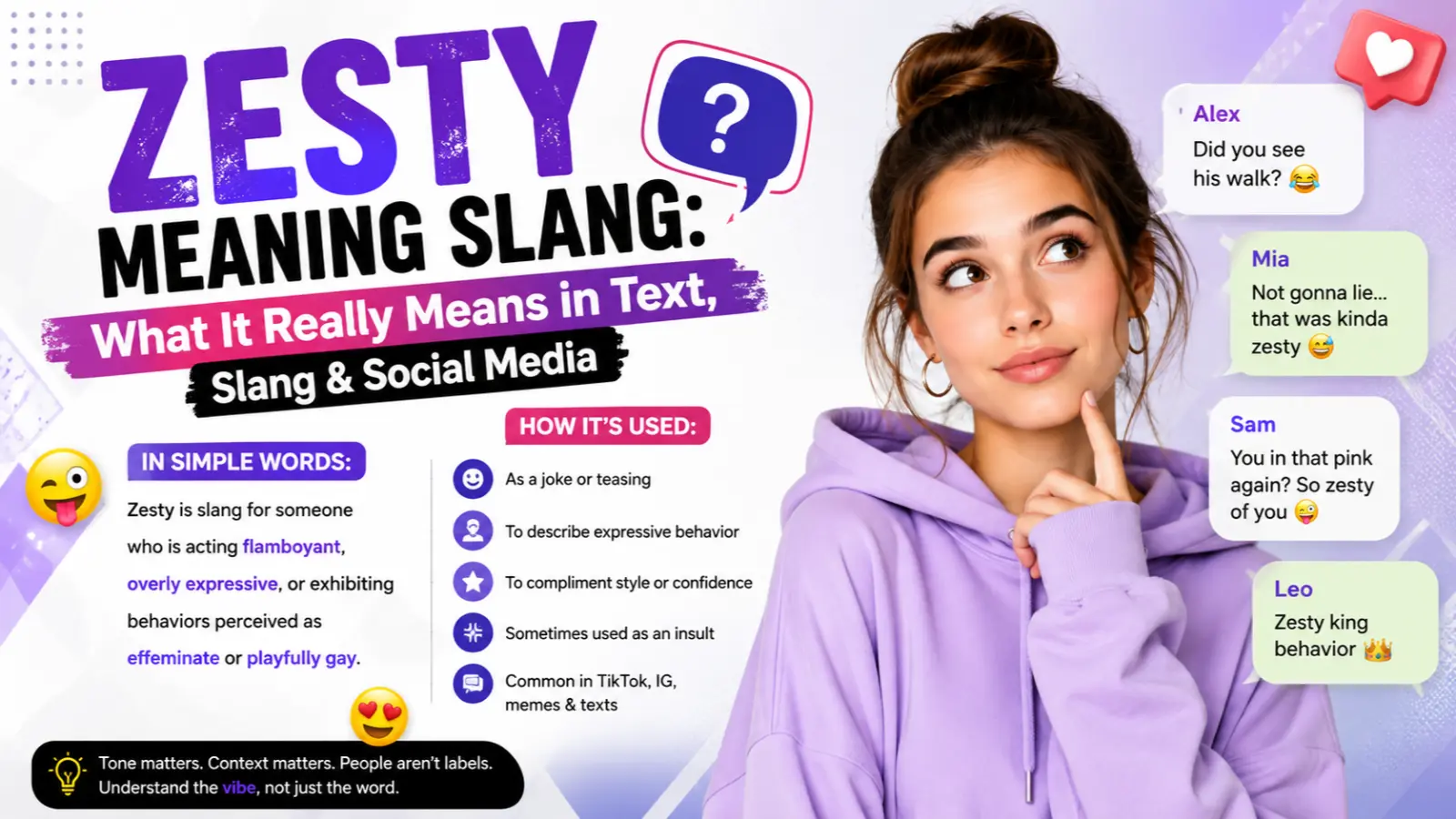
Zesty meaning slang has become one of those internet phrases that can completely change the mood of a conversation. Imagine scrolling through TikTok comments and seeing someone write:
“Bro is so zesty 😂”
Or maybe your friend texts:
Alex: “Did you see how he walked into the room?”
Mia: “Not gonna lie… that was kinda zesty.”
If you’re wondering whether it’s a compliment, an insult, a joke, or something in between, you’re definitely not alone. The word seems simple, yet its meaning shifts depending on who’s saying it, where it’s posted, and even the emojis that come with it.
People search for zesty meaning slang because they’ve seen it everywhere—from TikTok videos and Instagram Reels to gaming chats, memes, and group conversations. Sometimes it’s playful, sometimes it’s teasing, and sometimes it’s used in ways that spark debates about stereotypes and online humor.
So what does it actually mean? And why has one ordinary adjective become such a viral piece of internet culture?
Let’s break it down in a way that actually makes sense.
Quick Definition
In modern internet slang, zesty usually describes someone who is acting flamboyant, overly expressive, dramatic, stylish, or exhibiting behavior that others perceive as effeminate or playfully gay. The meaning is often humorous rather than literal, although context matters a lot.
Zesty Meaning Slang as Noticing Behavior
Sometimes people simply use “zesty” because they notice someone’s energetic body language or expressive personality.
Example
“His dance moves are so zesty.”
The speaker is pointing out expressive behavior.
Zesty Meaning Slang as a Joke
Many friends jokingly call each other zesty without any serious intention.
Example
“You ordered the pink drink again? That’s zesty.”
The goal is humor between friends.
Zesty Meaning Slang as Playful Teasing
The term often appears as light teasing among close friends.
Example
“Bro waved with both hands… that’s zesty.”
It’s usually playful rather than hostile.
Zesty Meaning Slang as an Insult
Unfortunately, some people use “zesty” to mock or stereotype men who behave in ways they consider feminine.
Example
“Stop acting so zesty.”
Here the word becomes more negative and can be offensive.
Zesty Meaning Slang as a Compliment
In some communities, being called zesty is actually positive.
It can suggest someone has confidence, style, personality, or expressive charm.
Example
“His fashion sense is so zesty—in the best way.”
Zesty Meaning Slang While Flirting
Sometimes people describe someone as zesty because they’re playful, charismatic, or confidently expressive.
Example
“He’s kinda zesty but honestly attractive.”
Zesty Meaning Slang as Emotional Expression
Some people use it simply to describe someone who shows emotions openly instead of acting reserved.
At its core, zesty usually signals that someone stands out because of their expressive, dramatic, colorful, or flamboyant behavior.
What Does Zesty Mean in Text?
In text messages, “zesty” is usually shorthand for saying someone is acting extra expressive or flamboyant.
Examples include:
- “Why are you walking like that? 😂 You’re so zesty.”
- “That outfit is low-key zesty.”
- “This whole friend group is getting zesty today.”
Tone is everything.
Among friends, it’s often harmless humor.
With strangers, it may come across as mocking.
Without context, people may misunderstand the intent completely.
Origin & Background
Originally, zesty simply described something full of flavor or energy, like citrus fruit or spicy food.
Over time, internet culture transformed the word into a personality descriptor.
Around the early 2020s, TikTok creators, meme pages, livestreams, and gaming communities started using “zesty” to describe exaggerated gestures, expressive dancing, fashionable outfits, theatrical reactions, and behavior perceived as feminine.
Soon the word spread everywhere:
- TikTok comment sections
- YouTube Shorts
- Instagram Reels
- Twitch streams
- Discord servers
- X (formerly Twitter)
Its popularity exploded because creators enjoyed replacing harsher words with something that sounded funny and less direct.
Instead of saying someone looked feminine, people simply commented:
“Bro is zesty.”
Like many internet expressions, its meaning evolved through memes more than dictionaries.
Online language changes incredibly fast, and “zesty” is a perfect example of how communities reshape ordinary words into cultural slang.
Real-Life Conversations
WhatsApp Chat
Sam: Did you see Jake dancing?
Leo: Bro was unbelievably zesty 😂
Instagram DM
Emma: Look at this outfit.
Sara: Honestly… kinda zesty but he pulled it off.
TikTok Comments
“That walk is the zestiest thing I’ve seen today.”
Text Messages
Ryan: Why are you posing like that?
Chris: Let me live 😂
Group Chat
Alex: New haircut.
Friends: Looking extra zesty today.
These conversations reveal an important emotional pattern.
People usually aren’t discussing someone’s identity.
They’re reacting to a moment, a gesture, or a vibe. That playful exaggeration is exactly what makes the slang spread so quickly.
Emotional & Psychological Meaning
Language is rarely just about words.
Calling someone “zesty” often reflects social observation.
Sometimes it signals amusement.
Admiration.
Discomfort.
Insecurity.
In many friend groups, “zesty” works as harmless teasing because everyone understands the joke.
But in other situations, it can reinforce stereotypes about masculinity and femininity.
Imagine this situation.
A group of coworkers goes bowling after work.
One coworker celebrates every strike with dramatic dance moves.
Everyone laughs.
Someone says,
“You’re getting pretty zesty tonight.”
If the group shares that humor, everyone laughs together.
If someone doesn’t know the slang—or feels targeted—the same comment suddenly feels uncomfortable.
That’s why emotional intelligence matters more than the word itself.
The deeper psychology is that people use “zesty” to label behavior that feels socially unexpected, expressive, or outside traditional gender expectations.
That’s the deeper psychology behind it.
Usage in Different Contexts
Social Media
TikTok and Instagram use “zesty” mostly for comedy.
Examples:
- “That entrance was zesty.”
- “The comments are getting zesty.”
The tone is usually exaggerated.
Friends & Relationships
Friends often use it affectionately.
Example:
“I knew you’d order the fancy drink—you’ve always been zesty.”
Work or Professional Settings
Avoid using it professionally.
Many coworkers won’t understand the slang, while others may find it inappropriate.
Casual vs Serious Tone
Casually:
“Bro is zesty 😂”
Seriously:
“That comment sounded disrespectful.”
The exact same word changes meaning depending on tone, relationship, and audience.
When NOT to Use It
Avoid using “zesty” when:
- speaking in professional meetings
- emailing clients
- discussing serious emotional issues
- talking with people unfamiliar with internet slang
- communicating across different cultures
- describing someone’s identity without knowing them
Because the term can imply stereotypes about gender expression or sexuality, it’s worth considering how the other person may interpret it.
Context protects meaning.
Common Misunderstandings
It Always Means Someone Is Gay
Not true.
Most people use it to describe expressive behavior rather than sexual orientation.
It’s Always an Insult
Also false.
Many friends use it affectionately.
It Literally Means Spicy
Historically yes.
As slang, no.
Everyone Understands It
Older audiences or people outside social media may have no idea what it means.
It’s Always Harmless
Not necessarily.
Depending on tone, it can become offensive or reinforce stereotypes.
Comparison Table
| Expression | Meaning | Tone | Usage Context |
|---|---|---|---|
| Zesty | Flamboyant, expressive, playful | Humorous | TikTok, texting |
| Extra | Overly dramatic | Funny | Everyday conversation |
| Dramatic | Emotionally expressive | Neutral | General speech |
| Camp | Deliberately theatrical or exaggerated | Cultural | Fashion, entertainment |
| Sassy | Bold, witty attitude | Playful | Friends, social media |
| Fabulous | Stylish and confident | Positive | Fashion, compliments |
Although these expressions overlap, “zesty” uniquely carries internet culture and meme energy that makes it instantly recognizable online.
Variations & Types
Popular variations include:
- Zesty
- Extra zesty
- Zesty energy
- Zesty behavior
- Zesty walk
- Zesty pose
- Certified zesty
- Maximum zest
- Zesty king
- Zest overload
Each version increases the level of exaggeration while keeping the playful internet tone.
How to Respond When Someone Uses It
Casual Replies
- “I’ll take that as a compliment.”
- “That’s just my personality.”
- “Maybe I am.”
Funny Replies
- “Certified fresh zest.”
- “Maximum flavor activated.”
- “Built different.”
Mature Replies
- “What do you mean by that?”
- “Can you explain what you meant?”
Respectful Replies
- “Let’s avoid labeling people.”
- “Everyone expresses themselves differently.”
Matching the other person’s energy often determines whether the conversation stays playful or becomes awkward.
Regional & Cultural Usage
Western Culture
The slang is extremely common among Gen Z, especially on TikTok and meme pages.
Asian Culture
Many young users learn the word through global social media rather than local slang.
Its meaning may be copied without fully understanding its cultural background.
Middle Eastern Culture
Usage exists mainly among English-speaking internet users.
Interpretations vary depending on cultural attitudes toward gender expression.
Global Internet Usage
Thanks to TikTok, YouTube Shorts, gaming communities, and memes, “zesty” has become recognizable across countries.
However, cultural sensitivity remains important because humor doesn’t always translate equally.
Generational Differences
Gen Z
Uses “zesty” naturally in memes, comments, and jokes.
Millennials
Usually understand the joke but may use it less frequently.
Older Generations
Many still associate “zesty” only with food or flavor.
This difference shows how internet language reflects identity, community, and evolving online culture.
Is It Safe for Kids?
Generally, “zesty” is relatively mild compared with many internet slang terms.
However, parents and educators should know that:
- it can be harmless joking
- it can become teasing
- repeated labeling may hurt someone’s feelings
- children may repeat it without understanding the implications
Teaching respectful communication is more valuable than simply banning the word.
Frequently Asked Questions
What does zesty mean in slang?
It usually describes someone acting flamboyant, expressive, dramatic, stylish, or playfully effeminate, often as a joke.
Is calling someone zesty rude?
Not always. It depends on tone, relationship, and context. Friends may use it playfully, while strangers could make it sound insulting.
What does zesty mean in texting?
It usually comments on someone’s expressive behavior, fashion, gestures, or personality in a humorous way.
Why is zesty popular on TikTok?
TikTok memes helped transform an ordinary adjective into internet slang that describes exaggerated or flamboyant behavior.
Do older people understand zesty slang?
Many don’t. They often associate “zesty” with food or energetic flavor rather than internet culture.
Should you use zesty at work?
Generally no. Professional settings require clearer and more respectful language that avoids slang or potentially misunderstood labels.
Conclusion
Understanding zesty meaning slang is about much more than memorizing a viral word. It reflects how internet culture constantly reinvents everyday language to describe personality, humor, confidence, and social behavior. Today, zesty most commonly refers to someone who is acting flamboyant, overly expressive, or exhibiting behaviors perceived as effeminate or playfully gay, but its emotional impact depends entirely on context, tone, and relationship.
As online communities continue shaping modern communication, words like zesty remind us that slang isn’t just about being funny—it’s about identity, belonging, and how people interpret each other’s personalities.
The smartest internet users don’t just know what a word means—they know when, why, and how to use it with empathy.

I’m Lila Wordsmith, a writer who finds magic in clever wordplay and heartfelt expressions. I love crafting puns, wishes, and quotes that make people feel connected and inspired. Every line I write is designed to bring a smile or spark a thought. Through my words, I hope to turn simple moments into something truly memorable.