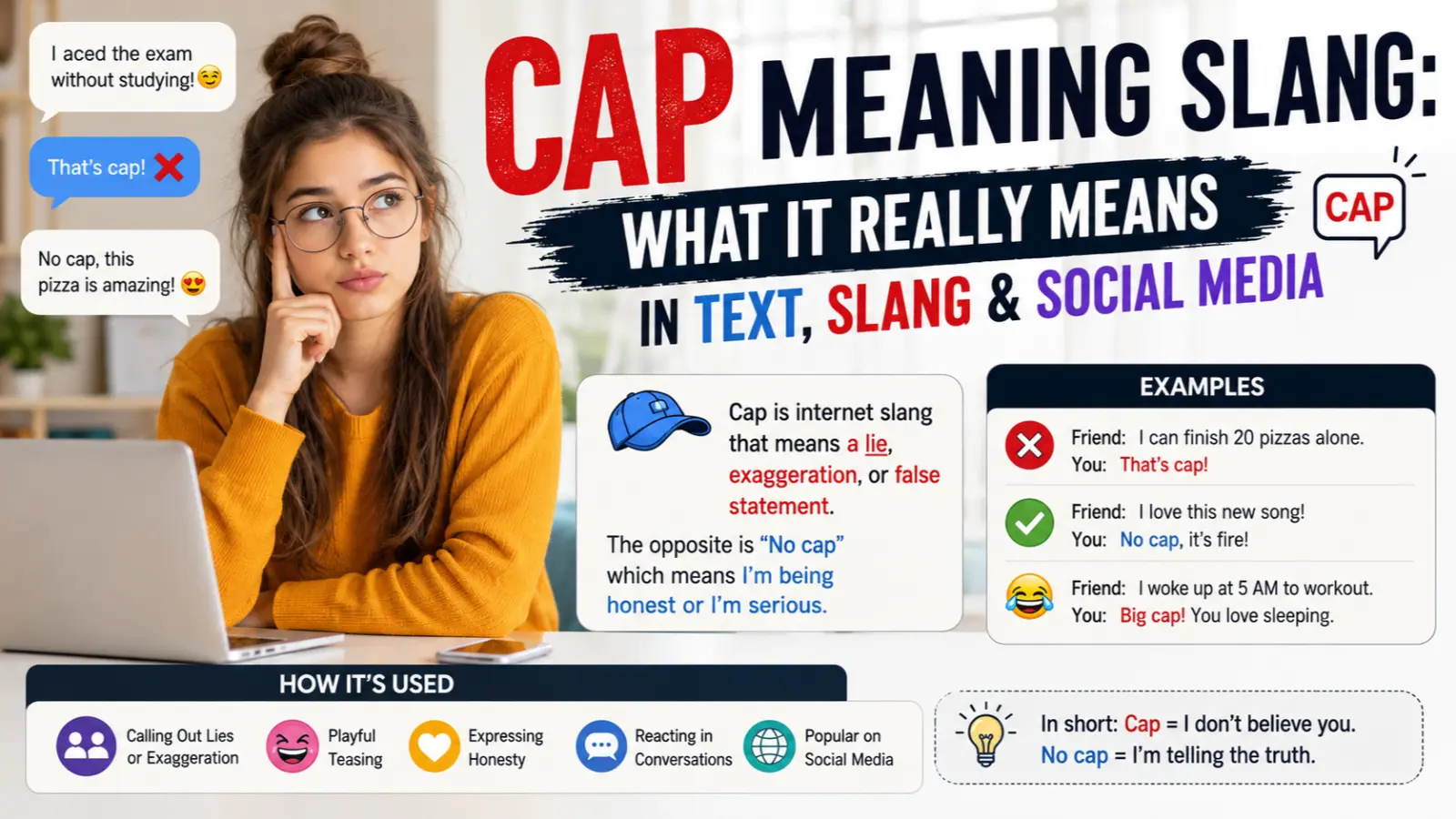
Cap meaning slang is one of those internet phrases you’ve probably seen in a text, TikTok comment, or Instagram Reel. Imagine opening your group chat and seeing messages like:
Friend 1: “I scored 100% without studying.”
Friend 2: “Bro… that’s cap.”
Or maybe someone comments:
“No cap, this is the best burger I’ve ever had.”
If you’re wondering why people suddenly call something “cap” instead of simply saying “that’s a lie,” you’re not alone. The phrase has become a huge part of online conversations, yet many people still feel confused the first time they see it.
Is it an insult? A joke? A playful way to challenge someone? Or does it mean something deeper about trust and honesty online?
People search for cap meaning slang because they want to understand not only the definition but also the emotion behind the word. Internet language changes fast, and keeping up can feel like learning an entirely new dialect.
Let’s break it down in a way that actually makes sense.
Quick Definition
Cap is modern internet slang that means a lie, false claim, or exaggeration. When someone says “That’s cap,” they’re saying they don’t believe what’s being said.
The opposite phrase is “No cap,” which means “I’m telling the truth” or “I’m being completely honest.”
Cap Meaning Slang as Calling Out a Lie
The most common meaning is exposing a lie.
Example
“I met Drake yesterday.”
“That’s cap.”
Here, the speaker believes the statement is false.
Cap Meaning Slang as Exaggeration
Sometimes people exaggerate for fun.
“I can finish 20 pizzas alone.”
“Cap.”
The listener knows it’s probably an overstatement.
Cap Meaning Slang as a Joke
Friends often use “cap” playfully.
“I’m the smartest person alive.”
“Major cap 😂”
Nobody is offended because everyone understands the joke.
Cap Meaning Slang as Friendly Teasing
Someone brags about something unbelievable.
“I never lose at FIFA.”
“Cap.”
The word becomes playful banter instead of criticism.
Cap Meaning Slang in Arguments
During disagreements, “cap” becomes a direct challenge.
“You never text first.”
“That’s cap.”
It questions someone’s version of events.
Cap Meaning Slang in Flirting
Even flirting includes playful disbelief.
“I wasn’t thinking about you.”
“Cap 😏”
The reply suggests the other person is hiding their real feelings.
Core emotional meaning: calling out something that feels dishonest, exaggerated, or unbelievable.
What Does Cap Meaning Slang Mean in Text?
In texting, cap usually means:
- That’s a lie.
- I don’t believe you.
- You’re exaggerating.
- Stop pretending.
- Be honest.
Examples:
A: “I’m not jealous.”
B: “Cap.”
A: “This movie made me cry.”
B: “No cap?”
A: “No cap, you did amazing today.”
Here, “no cap” emphasizes genuine honesty.
In text conversations, one tiny word communicates skepticism, humor, honesty, and social awareness all at once.
Origin & Background
The slang cap didn’t appear overnight.
Its modern meaning comes from African American English (AAE), where “cap” has long been connected with boasting, exaggerating, or lying. Over time, younger internet users adopted it into mainstream online culture, and phrases like “no cap” became widely recognized as expressions of honesty.
Platforms like TikTok, X (formerly Twitter), Instagram, Twitch, YouTube, and meme pages accelerated its popularity. Short-form videos made it easy for creators to react with just one word—”Cap!”—instead of explaining why they disagreed.
Today, the slang appears everywhere from gaming streams to celebrity interviews.
Online language evolves quickly. A single word can go from niche community slang to global everyday vocabulary within just a few years.
Real-Life Conversations
WhatsApp Chat
Ali: I finished the project in ten minutes.
Sara: Cap 😂
Instagram DM
Alex: I wasn’t checking your profile.
Emma: Cap lol.
TikTok Comments
“This recipe only takes one minute.”
“Cap.”
Text Message
“I’m not mad.”
“Cap.”
Group Chat
“I’m quitting social media forever.”
“Cap. See you tomorrow.”
Across all these conversations, the emotional pattern is similar. People use cap to challenge unbelievable statements without starting a serious argument. It’s often humorous, casual, and socially playful rather than openly hostile.
Emotional & Psychological Meaning
Why not simply say “You’re lying“?
Because internet slang carries emotion differently.
Calling something cap softens the confrontation. It lets people question someone without making the conversation feel overly aggressive.
Sometimes it’s teasing.
Sometimes it’s skepticism.
It’s playful flirting.
Sometimes it’s a way of protecting yourself from believing something too quickly.
Imagine your friend constantly claims impossible achievements. Instead of accusing them directly, everyone simply replies:
“Cap.”
The conversation stays light, everyone laughs, and the message is understood.
The word also reflects internet culture’s obsession with authenticity. Social media encourages people to present perfect lives, so users have become quicker to question exaggerated stories.
Using “cap” often signals:
- Social awareness
- Healthy skepticism
- Confidence
- Humor
- Emotional intelligence
- Familiarity with internet culture
It has also become part of online identity. Knowing when to say “cap” shows you understand modern digital conversations and their unwritten social rules.
That’s the deeper psychology behind it.
Usage in Different Contexts
Cap Meaning Slang on Social Media
On platforms like TikTok, Instagram, X, and Snapchat, cap is often used in comments to challenge unbelievable content.
Example:
Creator: “I made $10,000 in one day.”
Comment: “Cap.”
Sometimes it’s genuine skepticism, while other times it’s simply part of internet humor. Calling out “cap” has become a quick way to participate in online conversations without writing a long explanation.
Cap Meaning Slang Among Friends & Relationships
Friends use cap constantly because it keeps conversations playful.
Example:
Friend: “I totally forgot your birthday.”
Reply: “Cap. You just didn’t buy a gift.”
In relationships, it can even become flirtatious.
“I wasn’t waiting for your text.”
“Cap. You replied in five seconds.”
The tone feels teasing instead of confrontational.
Cap Meaning Slang at Work or in Professional Settings
Avoid using cap in emails, meetings, business presentations, or professional messages.
Instead of saying:
“That’s cap.”
Say:
“I don’t think that’s accurate.”
Professional communication values clarity over internet slang.
Casual vs Serious Tone
Context completely changes the feeling.
Casual
“Bro, that’s cap 😂”
Feels funny.
Serious
“That’s cap.”
Without emojis or context, it may sound like a direct accusation.
Always pay attention to the relationship, platform, and conversation before using it.
When NOT to Use It
Although cap is common online, it isn’t appropriate everywhere.
Avoid using it:
- During serious family discussions.
- In workplace emails.
- With teachers or clients.
- During emotional arguments.
- With people unfamiliar with internet slang.
- In cross-cultural conversations where the meaning may be misunderstood.
Someone unfamiliar with the phrase may think you’re being disrespectful instead of playful.
Context protects meaning.
Common Misunderstandings
Many people misunderstand cap because of its unusual wording.
| Misunderstanding | Reality |
|---|---|
| Cap means a hat. | In slang, it means a lie or exaggeration. |
| It’s always rude. | Often it’s playful banter. |
| No cap means wearing no hat. | It actually means “I’m serious.” |
| Only Gen Z uses it. | Millennials and many online communities use it too. |
| Cap always starts arguments. | Most of the time it creates humorous conversations. |
Understanding tone is more important than memorizing the definition.
Comparison Table
| Expression | Meaning | Tone | Usage Context |
|---|---|---|---|
| Cap | A lie or exaggeration | Skeptical | Texting, social media |
| No Cap | I’m telling the truth | Honest | Everyday conversation |
| Facts | That’s true | Supportive | Friends, comments |
| For Real | Seriously? | Curious | Texting |
| You’re Lying | Direct accusation | Strong | Serious conversations |
| Fake | Not genuine | Critical | Online discussions |
The biggest difference is emotional intensity. Saying “cap” usually sounds lighter than directly calling someone a liar.
Variations & Types
Internet slang constantly evolves, and cap has several popular variations.
No Cap
Means “I’m completely honest.”
Example
“No cap, that’s the best pizza I’ve ever eaten.”
Big Cap
Used for an obvious or massive exaggeration.
“You’re the richest person in the city?”
“Big cap.”
Stop the Cap
Means “stop lying.”
Usually appears in memes or funny videos.
Capping
Describes someone who keeps exaggerating.
“He’s capping again.”
Cap Emoji Culture
Many users pair the word with 😂, 💀, 🤣, or 🧢 to make the conversation feel more humorous.
Small changes like these create different emotional tones while keeping the same core meaning.
How to Respond When Someone Uses It
Casual Replies
- “Maybe a little.”
- “Believe what you want.”
- “I’m serious though.”
Funny Replies
- “No cap, I brought receipts.”
- “You’ll see soon.”
- “Ask everyone else.”
Mature Replies
- “I understand why you’d think that.”
- “Let me explain.”
Respectful Replies
- “Fair enough.”
- “I can see why it sounds unbelievable.”
Matching the other person’s energy is often more important than the words themselves.
Regional & Cultural Usage
Western Culture
In the United States and Canada, cap is deeply connected to youth culture, music, sports, and social media.
Asian Culture
Many young English-speaking users learned the slang through TikTok, YouTube, gaming, and K-pop communities.
Middle Eastern Culture
English internet slang often mixes with Arabic conversations, especially among younger users who spend time on Instagram and Snapchat.
Global Internet Usage
Today, cap is recognized by millions of internet users regardless of their native language. Social media spreads slang much faster than traditional dictionaries ever could.
Generational Differences
Gen Z
Uses cap naturally in everyday conversations.
Millennials
Most understand it, although they may use it less frequently.
Older Generations
Some may confuse it with its literal meaning—a hat—or simply not recognize the slang.
Language often reflects identity. Every generation creates expressions that help define its online culture.
Is It Safe for Kids?
Generally, yes.
Cap is considered harmless slang because it usually means “that’s a lie” or “that’s an exaggeration.”
However, parents should remind children that repeatedly calling others “cap” can sound dismissive or disrespectful if used in serious conversations.
Teaching kids about tone and context is just as important as teaching vocabulary.
FAQs
What does cap mean in slang?
It means a lie, false statement, or exaggeration.
What does “that’s cap” mean?
It means “I don’t believe you” or “that’s not true.”
What does “no cap” mean?
It means “I’m being honest” or “I’m serious.”
Is cap rude?
Not usually. Among friends, it’s often playful, but in serious conversations it can feel accusatory.
Why is cap so popular on TikTok?
Short videos and memes helped spread the phrase because it’s a quick and funny way to react to unbelievable claims.
Can I use cap at work?
It’s better to avoid it in professional communication and use more formal language instead.
Conclusion
Understanding cap meaning slang is about more than learning a trendy internet word. It reveals how people express doubt, humor, honesty, and social awareness in today’s digital world.
Whether someone comments “That’s cap“ or confidently says “No cap,” they’re communicating much more than simple agreement or disagreement. They’re sharing emotion, personality, and online identity in just a few words.
As internet culture continues to evolve, new expressions will always appear. But cap meaning slang—a lie or exaggeration—has already become one of the most recognizable parts of modern online communication.
Sometimes one small slang word says more than an entire paragraph ever could.

I’m Grace Punston, a playful writer with a passion for clever puns and joyful wordplay. I love crafting witty lines that make readers grin and giggle. My goal is to spread laughter through smart, lighthearted writing. Every pun I share is a little spark of fun meant to brighten your day.