IMO Meaning in Text is one of those internet phrases you’ve probably seen dozens of times without thinking much about it. Imagine you’re scrolling through a group chat and someone types:
“IMO, that movie was way better than the original.”
Or maybe you see a comment on social media saying:
“IMO, this is the best phone of 2026.”
At first glance, it looks simple. But what does it actually mean? Why do people use it instead of just sharing their opinion directly? And why has this tiny abbreviation become such a common part of digital communication?
The confusion gets even bigger because IMO can appear in text messages, social media comments, gaming chats, online forums, and even on the popular messaging and video calling application IMO. Sometimes people are referring to the slang abbreviation, while other times they’re talking about the app itself.
If you’ve ever wondered whether IMO sounds polite, confident, sarcastic, friendly, or passive-aggressive, you’re not alone.
Let’s break it down in a way that actually makes sense.
Quick Definition
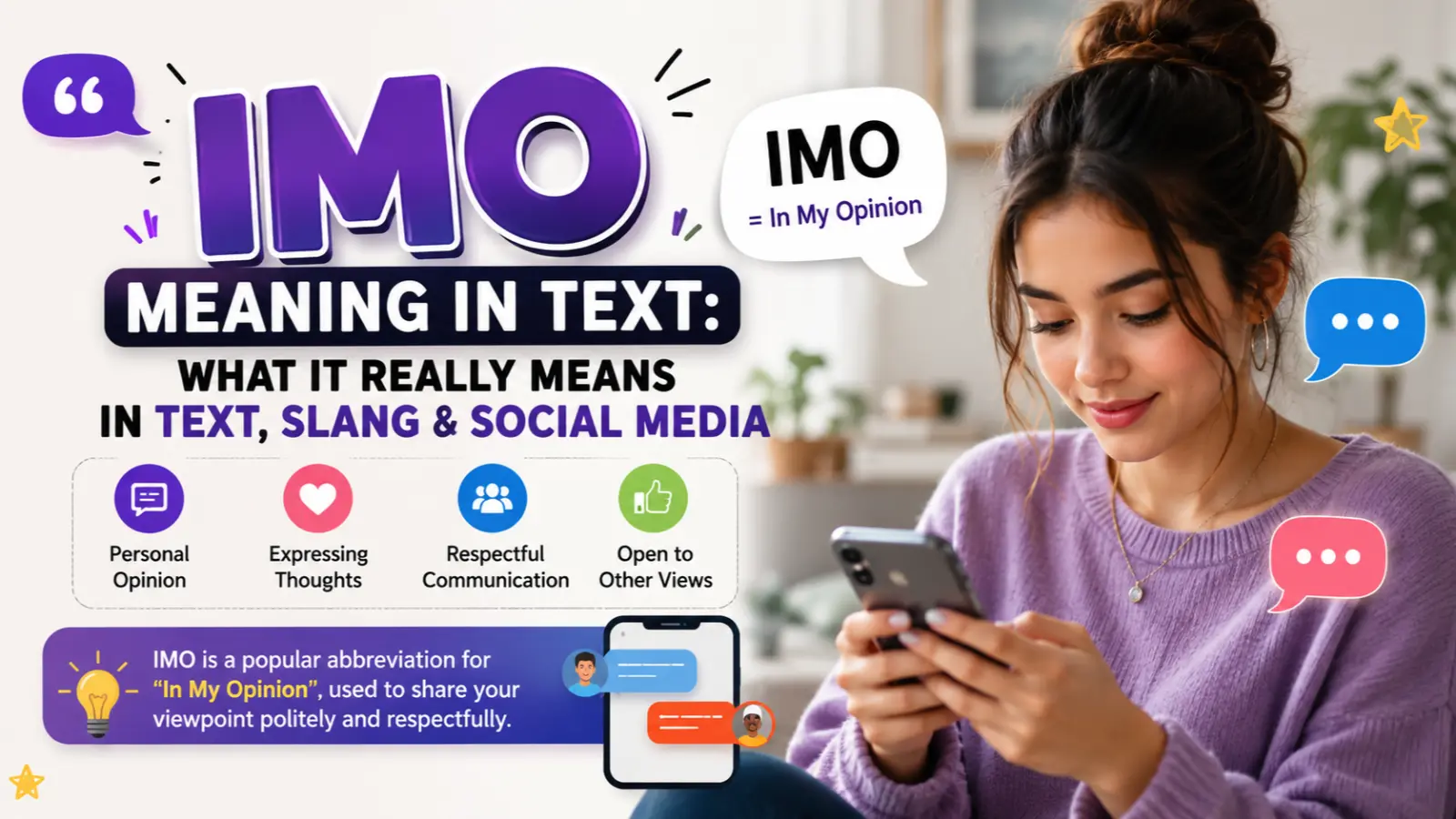
IMO stands for “In My Opinion.”
People use it when sharing a personal viewpoint, belief, preference, or judgment.
IMO Meaning as a Personal Opinion
The most common use is expressing a viewpoint.
Example:
“IMO, summer is better than winter.”
Meaning:
“This is my personal opinion.”
IMO Meaning as a Polite Disclaimer
Many people use IMO to soften statements.
Example:
“IMO, the website design could be improved.”
This makes criticism sound less aggressive.
IMO Meaning as a Friendly Suggestion
Sometimes IMO introduces advice.
Example:
“IMO, you should take a short break before making that decision.”
IMO Meaning as a Debate Tool
Online discussions often use IMO to avoid sounding overly authoritative.
Example:
“IMO, both sides have valid arguments.”
IMO Meaning as a Humble Expression
Adding IMO signals that someone recognizes others may disagree.
Example:
“IMO, that’s the best restaurant in town.”
IMO Meaning as Subtle Confidence
Interestingly, people often use IMO before expressing strong opinions.
Example:
“IMO, that was the worst update they’ve ever released.”
The phrase softens the statement while still delivering a clear judgment.
IMO Meaning as a Social Buffer
Internet users frequently use IMO to reduce conflict.
Example:
“IMO, we’re focusing on the wrong problem.”
The emotional purpose is often more important than the literal meaning.
At its core, IMO tells people:
“This is how I see things, but I’m open to other perspectives.”
What Does IMO Mean in Text?
In texting, IMO means “In My Opinion.”
It’s used to express personal thoughts without presenting them as absolute facts.
For example:
- “IMO, that outfit looks great.”
- “IMO, this game deserves more attention.”
- “IMO, you’re overthinking the situation.”
The abbreviation helps conversations feel less confrontational while allowing people to express themselves honestly.
Origin & Background
IMO originated in the early days of internet communication.
Long before TikTok trends and viral memes, users on online forums, message boards, IRC chatrooms, and discussion groups needed faster ways to communicate. Typing full phrases repeatedly was inconvenient, so abbreviations became part of internet culture.
That’s where IMO emerged.
The phrase became especially popular in:
- Online forums
- Gaming communities
- Chat rooms
- Email discussions
- Social media platforms
As internet culture evolved, IMO remained relevant because opinions became central to online interaction.
Then came social media.
Platforms like Instagram, TikTok, X, Reddit, and YouTube transformed everyday users into constant commentators. Suddenly everyone had opinions about movies, celebrities, relationships, fashion, politics, and trends.
IMO became the perfect shortcut.
Modern internet culture moves incredibly fast. New slang appears every month, but IMO has survived because human beings naturally want to share opinions while avoiding unnecessary conflict.
That’s why this abbreviation continues to thrive.
Real-Life Conversations
WhatsApp Chat
Friend 1:
“Should I buy the new phone?”
Friend 2:
“IMO, wait for the next version.”
Instagram DM
Person A:
“How do these photos look?”
Person B:
“IMO, the second one is your strongest.”
TikTok Comment
“IMO, this creator deserves way more followers.”
Text Message
“I’ve watched both shows, and IMO the original is better.”
Group Chat
“IMO, we should leave earlier to avoid traffic.”
Messaging and Video Calling Application Context
Sometimes people say:
“I’ll message you on IMO.”
Here, they’re referring to the IMO messaging and video calling application, not the abbreviation.
Context matters.
The emotional pattern behind all these examples is simple:
People want to contribute their thoughts without sounding bossy, aggressive, or overly certain.
Emotional & Psychological Meaning
On the surface, IMO means “In My Opinion.”
Psychologically, it means much more.
When people use IMO, they’re often managing social dynamics.
They want to:
- Share ideas
- Protect relationships
- Reduce conflict
- Sound respectful
- Maintain credibility
Imagine a friend says:
“IMO, I think you’re being too hard on yourself.”
That’s not just an opinion.
It’s emotional support disguised as casual conversation.
Similarly, in online debates, people often use IMO as emotional armor.
Instead of saying:
“You’re wrong.”
They say:
“IMO, there’s another way to look at it.”
The second version feels safer.
A coworker once disagreed with a project proposal during a meeting.
Instead of attacking the idea directly, he said:
“IMO, we might get better results with a different approach.”
The room stayed calm because the wording created space for discussion.
That’s the deeper psychology behind it.
Usage in Different Contexts
Social Media
Social media thrives on opinions.
Examples:
- “IMO, this trend is overrated.”
- “IMO, she’s the best artist right now.”
Tone often feels casual and conversational.
Friends & Relationships
Among friends, IMO creates softer communication.
Example:
“IMO, you deserve someone who appreciates you more.”
The phrase feels caring rather than judgmental.
Work or Professional Settings
Professional use exists but should be limited.
Example:
“IMO, this strategy may improve efficiency.”
In formal business writing, full wording is usually preferred.
Casual vs Serious Tone
Casual:
“IMO, pizza beats burgers.”
Serious:
“IMO, communication issues are causing the conflict.”
The abbreviation stays the same, but emotional weight changes dramatically.
When NOT to Use It
Avoid IMO in:
Formal Business Documents
Professional reports should generally avoid slang abbreviations.
Emotional Arguments
Someone upset may interpret IMO as dismissive.
Academic Writing
Formal writing requires complete language.
Older Audiences
Not everyone recognizes internet abbreviations.
Cross-Cultural Communication
Different regions may interpret abbreviations differently.
Context protects meaning.
Common Misunderstandings
Mistake 1: Thinking IMO Is Rude
It’s usually intended to be polite.
Mistake 2: Assuming It Means Fact
IMO specifically indicates personal opinion.
Mistake 3: Confusing It With the IMO App
Sometimes people mean the messaging application instead of the slang.
Mistake 4: Missing Sarcasm
Tone can completely change meaning.
“IMO, that was a brilliant idea.”
Could be genuine.
Could be sarcasm.
Context matters.
Comparison Table
| Expression | Meaning | Tone | Usage Context |
|---|---|---|---|
| IMO | In My Opinion | Polite | General opinions |
| IMHO | In My Humble Opinion | Softer | Friendly discussions |
| TBH | To Be Honest | Direct | Honest statements |
| FYI | For Your Information | Informative | Sharing facts |
| IDC | I Don’t Care | Dismissive | Casual conversations |
| IMOF | In My Own Feeling | Emotional | Personal discussions |
The biggest difference is that IMO focuses on personal perspective while leaving room for disagreement.
Variations & Types
IMHO
“In My Humble Opinion”
Softer and more polite.
IMOO
“In My Own Opinion”
Adds extra emphasis.
Strong IMO
“IMO, absolutely.”
Shows confidence.
Sarcastic IMO
“IMO, that’s definitely not suspicious.”
Often used humorously.
Meme Versions
- “Just my IMO.”
- “Big IMO energy.”
- “Elite IMO take.”
Internet humor constantly creates new variations.
How to Respond When Someone Uses It
Casual Replies
- “Fair point.”
- “I can see that.”
- “Good opinion.”
Funny Replies
- “Strong take.”
- “Bold opinion alert.”
- “Internet jury agrees.”
Mature Replies
- “I respect your perspective.”
- “That’s an interesting viewpoint.”
Respectful Replies
- “Thanks for sharing.”
- “I understand where you’re coming from.”
Matching energy matters socially.
Regional & Cultural Usage
Western Culture
IMO is extremely common in online discussions and debates.
Asian Culture
Users frequently mix English abbreviations like IMO into local-language conversations.
Middle Eastern Culture
Young internet users often use IMO in multilingual chats.
Global Internet Usage
Social media platforms have made IMO a globally recognized abbreviation.
The internet has essentially created a shared slang vocabulary across cultures.
Generational Differences
Gen Z
Uses IMO naturally alongside modern slang.
Example:
“IMO, that’s low-key iconic.”
Millennials
Grew up during the rise of internet abbreviations.
IMO feels familiar and practical.
Older Generations
May recognize it less often or prefer writing full sentences.
Language often reflects digital identity.
The generation you belong to influences how comfortable you feel using internet shorthand.
Is It Safe for Kids?
Generally, yes.
IMO is considered harmless.
Benefits include:
- Encouraging personal expression
- Teaching respectful disagreement
- Building communication skills
Potential concerns include:
- Misunderstood sarcasm
- Online arguments
- Peer pressure in social discussions
Overall, IMO is one of the safest and most positive internet abbreviations.
FAQs
What does IMO mean in text?
IMO stands for “In My Opinion.”
Is IMO rude?
Usually no. It often makes opinions sound more polite.
What does IMO mean on TikTok?
It means “In My Opinion” and is used in comments, captions, and discussions.
Can IMO be used in professional communication?
Occasionally, but writing the full phrase is usually better.
Do Gen Z users still use IMO?
Yes. It’s still widely used across social media platforms.
Is IMO the same as IMHO?
They’re similar, but IMHO sounds slightly more humble.
Conclusion
Understanding imo meaning in text helps you understand far more than a simple abbreviation. The phrase “In My Opinion“ represents a unique form of modern communication where people share thoughts, preferences, advice, and criticism while trying to remain respectful and socially aware.
Whether you see it in a text message, TikTok comment, group chat, online debate, or even while discussing the IMO messaging and video calling application, context reveals the intended meaning.
In today’s digital world, tiny phrases often carry surprisingly large emotional signals. And IMO is a perfect example of how internet culture has learned to balance honesty, confidence, and empathy in just three letters.
Sometimes the smallest abbreviations say the most about how people connect online.

I’m Grace Punston, a playful writer with a passion for clever puns and joyful wordplay. I love crafting witty lines that make readers grin and giggle. My goal is to spread laughter through smart, lighthearted writing. Every pun I share is a little spark of fun meant to brighten your day.