You’re scrolling through messages late at night. Someone texts:
“idt that’s a good idea…”
Or maybe:
“idt he likes you like that 😭”
And you pause.
Wait… what does “idt” mean in text? Is it serious? Rude? Honest? Passive-aggressive?
That tiny three-letter phrase can carry a lot of emotional weight depending on how it’s used. it’s soft. Sometimes it’s blunt. Sometimes it’s hiding something deeper.
If you’ve ever felt confused reading it, or unsure how to use it, you’re not alone.
👉 Let’s break it down in a way that actually makes sense.
Quick Answer:
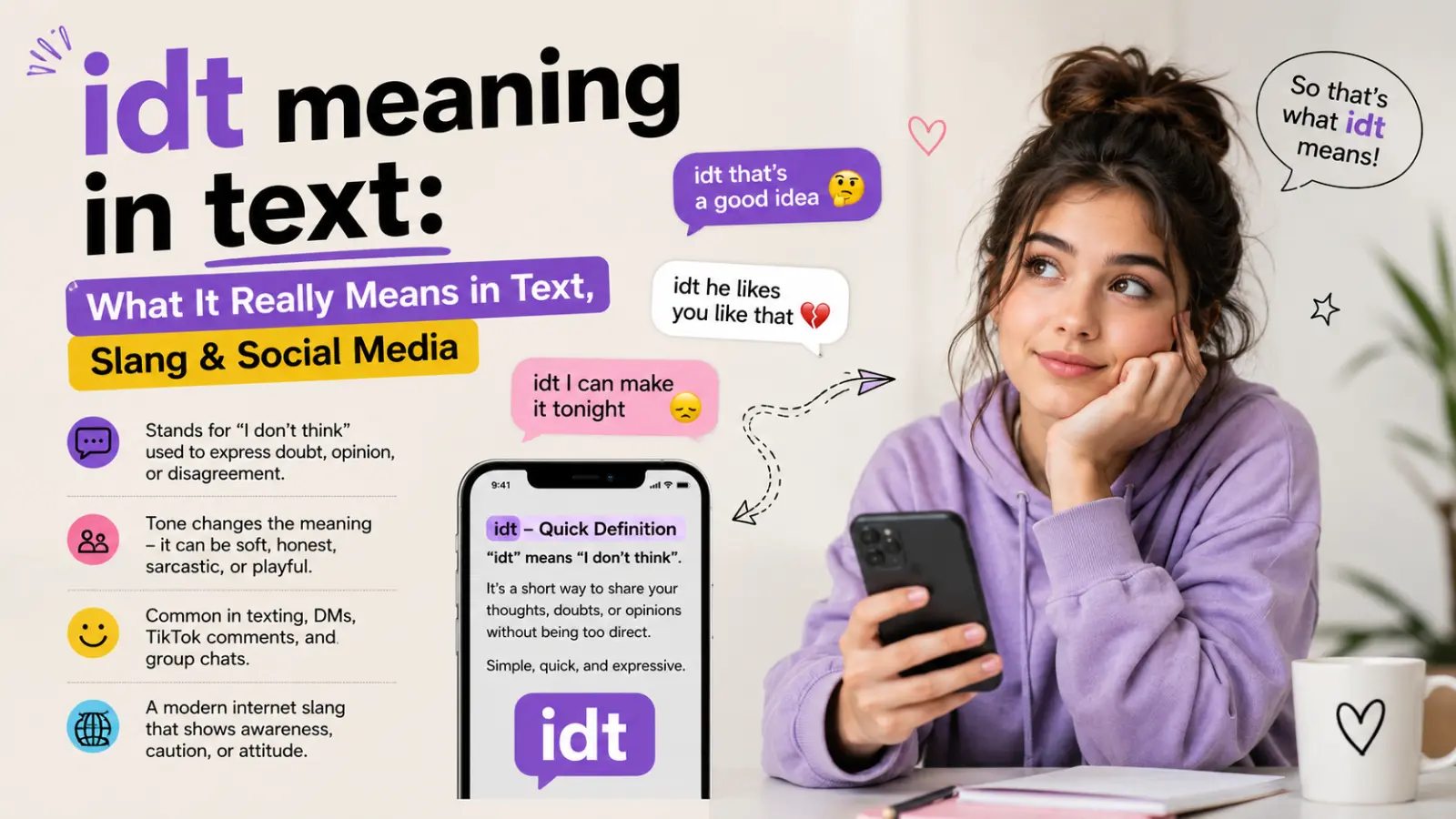
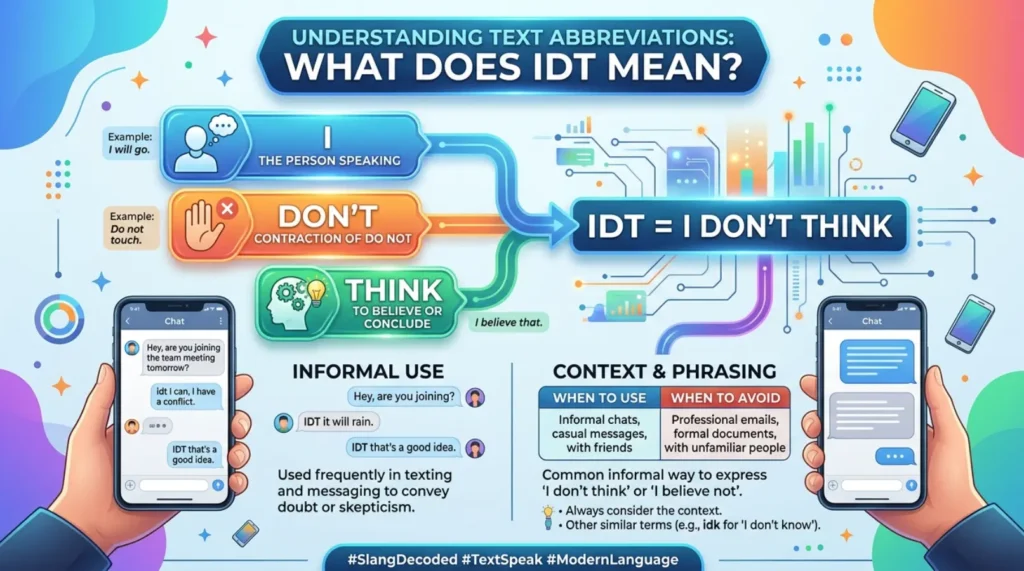
“idt” means “I don’t think.”
It’s a casual, shortened way people express doubt, disagreement, or uncertainty in texting and online conversations.
But here’s where it gets interesting…
“idt” isn’t just about thinking. It’s about how you feel while saying it.
Depending on tone, it can mean:
- Soft disagreement → “idt that’s true”
- Gentle honesty → “idt he’s the one for you”
- Subtle rejection → “idt I can make it tonight”
- Playful doubt → “idt you can beat me 😏”
- Low-key sarcasm → “idt that was your best idea…”
Simple examples:
- “idt that movie was that good”
- “idt she meant it like that”
- “idt this is gonna work 😬”
👉 At its core, “idt” expresses uncertainty mixed with personal opinion—usually in a softer, less confrontational way.
What does idt mean in text
In everyday texting, “idt” simply means “I don’t think”, but it carries emotional tone based on context.
It often signals:
- hesitation
- quiet disagreement
- emotional caution
- indirect communication
Instead of saying something directly, people use “idt” to soften the impact.
For example:
- “idt that’s a good idea” → sounds less harsh than “that’s a bad idea”
- “idt he likes you” → feels gentler than stating it as fact
It’s not just language—it’s social strategy.
Origin & Background
“idt” comes from early internet shorthand culture—back when typing fast mattered more than perfect grammar.
Think:
- SMS texting limits
- early chatrooms
- MSN Messenger / Yahoo chats
People started shortening common phrases:
- idk → I don’t know
- imo → in my opinion
- idt → I don’t think
Over time, platforms like:
- TikTok
- Instagram DMs
- Snapchat
…helped push “idt” into everyday digital language.
What’s fascinating is how it evolved.
It didn’t just stay a shortcut—it became a tone tool.
👉 Online language doesn’t just change fast—it adapts to emotion faster than anything else.
Real-Life Conversations
Here’s how “idt” actually shows up in real life:
WhatsApp Chat
- A: “Should I text him again?”
- B: “idt you should… let him come to you”
Instagram DMs
- “idt that outfit is your best tbh”
TikTok Comments
- “idt y’all understand how iconic this is 😭”
Group Chat
- “idt we’re making it on time guys 💀”
Text Message
- “idt I can come tonight, I’m exhausted”
After reading enough of these, you notice something:
👉 People use “idt” when they want to say something honest without sounding too harsh.
It’s emotional cushioning.
Emotional & Psychological Meaning
“idt” is low-key powerful.
It reflects:
- Awareness → thinking before speaking
- Emotional caution → avoiding conflict
- Social intelligence → softening opinions
- Insecurity (sometimes) → not wanting to sound too direct
- Confidence (other times) → calmly stating disagreement
Let’s make it real.
You’re with friends. One friend says:
“I think he’s really into me.”
You pause and say:
“idt he is…”
You’re not just giving an opinion—you’re:
- protecting their feelings
- choosing softer wording
- balancing honesty with care
That’s emotional intelligence in action.
Or in dating:
Someone texts:
“Do you think we’ll work out?”
You reply:
“idt so…”
That hits differently than:
“No.”
👉 “idt” creates emotional distance between the speaker and the statement.
That’s the deeper psychology behind it.
Usage in Different Contexts
Social Media
On platforms like TikTok or Instagram:
- “idt y’all ready for this”
- “idt this is getting enough attention”
Tone: playful, expressive, sometimes dramatic.
Friends & Relationships
- “idt he’s treating you right”
- “idt you should go back to them”
Tone: caring, protective, honest.
Work or Professional Settings
Rare, but possible in casual chats:
- “idt this approach will work”
Tone: cautious, professional-lite.
(Not ideal in formal emails.)
Casual vs Serious Tone
- Casual: “idt that’s funny 😂”
- Serious: “idt this is a good decision”
Same phrase. Completely different emotional weight.
👉 Context changes everything.
When NOT to Use It
Avoid “idt” in:
- Formal emails
- Job applications
- Serious arguments
- Sensitive emotional situations
- Talking to older or non-internet-savvy audiences
Why?
Because it can sound:
- vague
- dismissive
- unclear
In serious moments, clarity matters more than softness.
👉 Context protects meaning.
Common Misunderstandings
Misunderstanding 1: It always sounds rude
Not true. It’s often used to reduce harshness.
Misunderstanding 2: It means the speaker is unsure
Sometimes—but often it’s just polite disagreement.
Misunderstanding 3: It’s always casual
Mostly yes, but tone can make it serious.
4: It’s emotionless
Actually, it’s emotion-aware communication.
Comparison Table
| Expression | Meaning | Tone | Usage Context |
|---|---|---|---|
| idt | I don’t think | Soft, cautious | Casual chats |
| idk | I don’t know | Neutral, uncertain | General texting |
| imo | In my opinion | Assertive but polite | Discussions |
| nah | No | Direct, blunt | Informal |
| probably not | Likely no | Balanced | Semi-formal |
Insight:
“idt” sits right in the middle—less harsh than “no,” more thoughtful than “idk.”
Variations & Types
You’ll see “idt” evolve depending on tone:
- idt tbh → more honesty
- idttt → emotional emphasis
- IDT → stronger or louder tone
- idt lol → playful disagreement
- idt fr → serious honesty
These small tweaks change how the message feels.
How to Respond When Someone Uses It
Casual Replies
- “yeah maybe you’re right”
- “hmm fair”
Funny Replies
- “idt you know what you’re talking about 😭”
- “idt you just said that 💀”
Mature Replies
- “why do you think that?”
- “I get your point”
Respectful Replies
- “I understand your perspective”
- “thanks for being honest”
👉 Matching energy matters more than the words.
Regional & Cultural Usage
Western Culture
Very common in texting and casual conversations. Seen as normal and emotionally aware.
Asian Culture
Used by younger audiences, especially online. Tone tends to stay more respectful.
Middle Eastern Culture
Less common in formal communication, but widely used among youth on social media.
Global Internet Usage
Thanks to TikTok and memes, “idt” is now globally understood.
Generational Differences
Gen Z
Uses it naturally. Understands tone instantly.
Millennials
Use it, but slightly less frequently.
Older Generations
May find it confusing or too informal.
👉 Language shows identity—and “idt” is very Gen Z-coded.
Is It Safe for Kids
Yes—mostly.
It’s harmless in meaning, but:
- Can be used in teasing
- May carry emotional weight
- Depends on tone and context
Parents should understand it rather than fear it.
FAQs
1. What does idt mean in texting?
It means “I don’t think,” used to express doubt or disagreement.
2. Is idt rude?
Not usually. It’s often softer than direct disagreement.
3. How is idt used on TikTok?
Mostly in comments to express opinions or reactions casually.
4. Can I use idt in formal writing?
No. It’s too informal for professional communication.
5. Does idt mean uncertainty?
Sometimes—but often it’s just polite honesty.
6. Why do people use idt instead of full sentences?
Speed, tone control, and modern texting habits.
Conclusion
“idt meaning in text” isn’t just “I don’t think.”
It’s a small phrase doing a big job—balancing honesty, emotion, and social awareness in just three letters.
In a world where messages are quick but feelings are complex, “idt” helps people say what they mean… without saying it too harshly.
And maybe that’s why it sticks.
👉 Because sometimes, “I don’t think” isn’t just about thinking—it’s about feeling your way through what to say next.

I’m Jake Punman, a humor writer who lives for clever wordplay and laugh-out-loud puns. I love crafting witty lines that turn simple moments into bursts of laughter. My passion is making people smile through creative twists of language. With every pun I write, I aim to add a little more fun to your day.