You’re scrolling through your messages, half-awake, half-curious…
And then you see it:
“ws bro?”
“ws 🔥🔥”
“ws… you really did that?”⏮️Previously on punnszone: AWL Mean in Text? Easy Meaning
Now you pause.
Wait… what does “ws” even mean here?
Is it “What’s up”?
Is it someone hyping you?
Or are they low-key calling something out?
That tiny two-letter slang suddenly feels bigger than it looks. And honestly, that’s how modern internet language works — short, fast, and loaded with emotion.
If you’ve ever searched this because you didn’t want to reply awkwardly or misunderstand someone’s tone… you’re not alone.
👉 Let’s break it down in a way that actually makes sense.
Quick aswer:
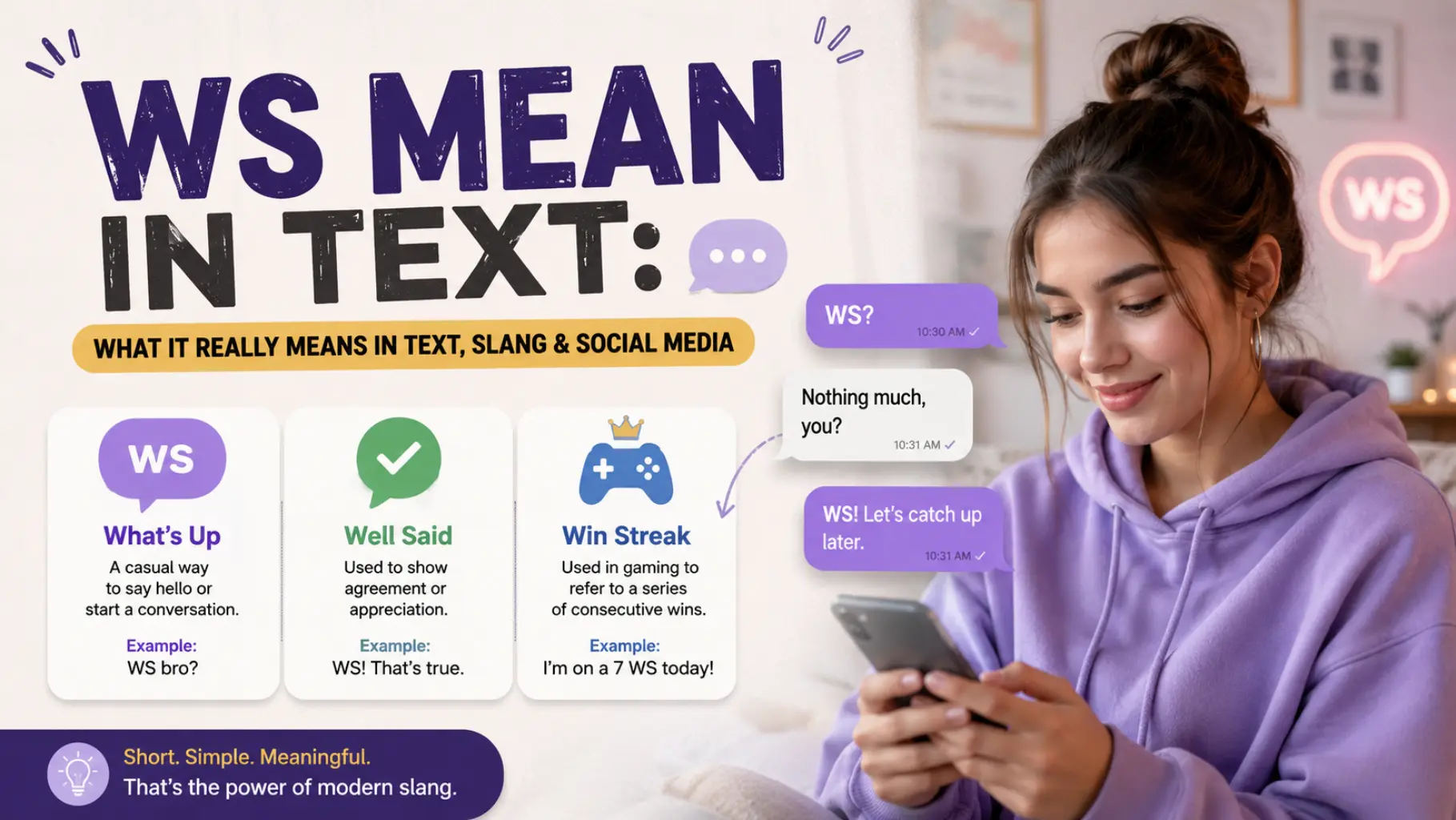
“WS” is a flexible internet slang abbreviation that can mean different things depending on context, tone, and platform.
Most common meanings include:
- “What’s Up” → casual greeting
“ws bro, long time no see” - “Well Said” → agreement or respect
“ws 👏 that’s exactly what I meant” - “Win Streak” → gaming or competitive success
“I’m on a 7 ws right now 😤”
But here’s where it gets interesting…
Depending on tone, “ws” can also feel like:
- A subtle compliment
- A quick reaction
- A low-effort reply (sometimes lazy, sometimes chill)
- A confident flex
- Or even a slightly sarcastic acknowledgment
👉 At its core, “ws” is about acknowledgment — noticing something and responding quickly without overthinking.
What Does WS Mean in Text?
In texting, “ws” acts like a shortcut for emotional response.
Instead of typing full sentences, people use it to:
- Start a conversation
- React instantly
- Show agreement without explaining
- Keep things casual and low-pressure
For example:
- “ws, you free?” → starting a chat
- “ws 🔥” → reacting positively
- “ws… interesting” → possibly sarcastic
It’s not just about words. It’s about tone, speed, and social vibe.
Origin & Background
“WS” didn’t come from one clear origin. It evolved — like most internet slang — through shortening language for speed.
- Early texting culture pushed abbreviations (like lol, brb, idk)
- Gamers started using “WS” for “win streak”
- Social media platforms like TikTok and Instagram made short replies more popular
- Comment culture rewarded fast, punchy reactions
Over time, “ws” became context-driven rather than fixed.
TikTok especially played a big role. Quick comments like:
- “ws 🔥”
- “ws facts”
- “ws fr”
…made it feel natural, even stylish.
👉 The truth? Internet language evolves faster than dictionaries can keep up.
👉 Real-Life Conversations
Let’s look at how “ws” actually shows up in everyday chats.
WhatsApp Chat
- A: “ws bro”
- B: “nothing much, you?”
Instagram DMs
- A: “just dropped a new post”
- B: “ws 🔥🔥”
TikTok Comments
- “ws that’s actually deep”
Gaming Chat
- “we on a ws tonight boys 😎”
Group Chat
- “ws… y’all really went without me??”
After reading these, you can feel it:
👉 “ws” is less about meaning… and more about energy.
It mirrors how people feel in the moment — quick, reactive, and socially aware.
Emotional & Psychological Meaning
This is where things get deeper.
When someone uses “ws,” they’re not just saving time…
They’re managing social energy.
Using “ws” can signal:
- Confidence → “I don’t need to say much”
- Awareness → “I see what’s happening”
- Emotional distance → “I’m responding, but not deeply engaging”
- Casual comfort → “We’re cool enough to keep it simple”
Sometimes it even acts as emotional protection.
Instead of saying too much, people say just enough.
Mini Story
Imagine this:
You post something vulnerable online.
A close friend replies:
“ws.”
At first, it feels small… maybe even dismissive.
But depending on your relationship, it could mean:
- “I see you”
- “I agree”
- “I’m here, just not overreacting”
That’s the complexity of modern slang.
It’s not always loud — sometimes it’s quiet, but meaningful.
👉 That’s the deeper psychology behind it.
Usage in Different Contexts
Social Media
“ws” is quick and expressive.
- “ws 🔥” = hype
- “ws facts” = agreement
Short, fast, and public.
Friends & Relationships
More casual and flexible.
- “ws bro” = greeting
- “ws… really?” = playful disbelief
Tone depends on closeness.
Work or Professional Settings
Not ideal.
- Can feel lazy or unclear
- Might confuse people
Better to avoid it here.
Casual vs Serious Tone
- Casual: “ws lol”
- Serious: “ws… that matters”
Even tiny changes shift meaning.
When NOT to Use It
Avoid “ws” when:
- You’re in formal conversations
- Someone is sharing something emotional
- You need clear communication
- You’re talking to older or non-internet users
- Cross-cultural misunderstanding is possible
👉 Context protects meaning.
Common Misunderstandings
- Thinking it always means “What’s up”
- Assuming it’s rude or dismissive
- Missing sarcasm or tone
- Confusing it with something negative
Truth is, “ws” is neutral — tone decides everything.
Comparison Table
| Expression | Meaning | Tone | Usage Context |
|---|---|---|---|
| WS | What’s up / Well said / Win streak | Flexible | Casual chats, gaming |
| W | Win / approval | Positive, hype | TikTok, gaming |
| FR | For real | Agreement | Social media |
| LOL | Laughing | Light, playful | Everywhere |
| OK | Acknowledgment | Neutral or cold | General use |
👉 “WS” sits in a unique space — it’s multi-meaning and tone-dependent, unlike more fixed slang.
Variations & Types
You’ll often see:
- ws fr → stronger agreement
- ws 🔥 → hype reaction
- big ws → major win
- ws lol → playful tone
- ws?? → questioning or surprised
Each variation slightly shifts emotion.
That’s how internet language adds personality without adding words.
How to Respond When Someone Uses It
Casual Replies
- “nothing much, you?”
- “just chilling”
Funny Replies
- “ws? everything and nothing 😌”
- “ws? life bro 😂”
Mature Replies
- “appreciate that”
- “glad you think so”
Respectful Replies
- “thanks, that means a lot”
👉 Matching energy matters more than matching words.
Regional & Cultural Usage
Western Culture
Common in gaming and social media slang.
Asian Culture
Used more in online communities, less in daily texting.
Middle Eastern Culture
Growing through TikTok and global trends.
Global Internet Usage
Slang like “ws” spreads fast — borders don’t matter anymore.
Everyone adapts it differently.
Generational Differences
- Gen Z → uses it naturally, fluid meanings
- Millennials → understand but use less
- Older generations → may find it confusing
Language is identity now.
And slang is part of that identity.
Is It Safe for Kids?
Mostly yes.
- It’s harmless in most contexts
- But tone can still affect meaning
- Kids may use it without fully understanding emotional impact
So awareness matters more than restriction.
FAQs
1. Does WS always mean “What’s up”?
No. It can also mean “Well said” or “Win streak,” depending on context.
2. Is WS rude in texting?
Not inherently. Tone and situation decide that.
3. What does WS mean on TikTok?
Usually agreement or hype, like “Well said” or “That’s a win.”
4. Can I use WS in professional messages?
It’s better not to. It may seem unclear or informal.
5. Is WS popular among Gen Z?
Yes, especially in fast, casual conversations.
6. How do I know what WS means in a message?
Look at the context, tone, emojis, and relationship with the sender.
Conclusion
“WS” might look like just two letters…
But in reality, it’s a perfect example of how modern communication works.
Fast.
Layered.
Emotionally subtle.
It’s not just about what you say anymore —
It’s about how little you can say… while still being understood.
And maybe that’s the real shift in internet language.
👉 Sometimes, the shortest messages carry the most meaning.

I’m Lila Wordsmith, a writer who finds magic in clever wordplay and heartfelt expressions. I love crafting puns, wishes, and quotes that make people feel connected and inspired. Every line I write is designed to bring a smile or spark a thought. Through my words, I hope to turn simple moments into something truly memorable.