Myf meaning in text is something many people search after spotting it in a message like:
- Person 1: “Oops, I sent the wrong file. MYF 😅”
- Person 2: “No worries!”
Or maybe you’ve seen:
- “Miss you already… MYF ❤️”
- “Can’t wait to see you again. MYF.”
At first glance, those three letters can be confusing. Does MYF mean someone is apologizing? Is it romantic? Is it a typo? Or is it another fast-moving piece of internet slang?
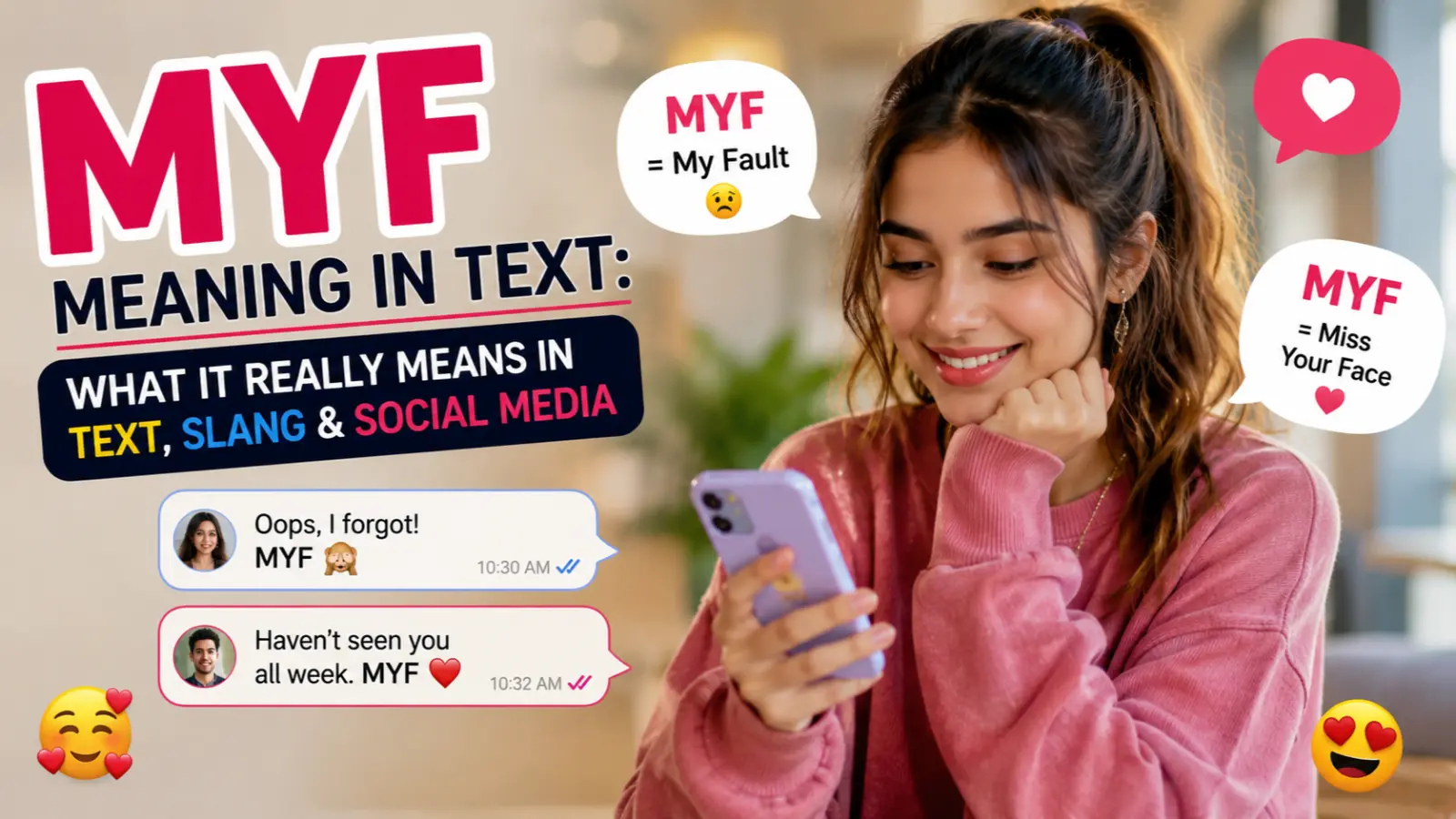
The answer depends entirely on the conversation. In modern texting, MYF commonly stands for “My Fault,” while in more personal conversations, it can also mean “Miss Your Face.” One expresses responsibility, while the other expresses affection.
That’s exactly why so many people search for the meaning. Internet slang changes quickly, and the same abbreviation can carry completely different emotions depending on the situation.
Let’s break it down in a way that actually makes sense.
Quick Definition
MYF is a texting abbreviation with two popular meanings:
- My Fault – used to admit responsibility or apologize.
- Miss Your Face – used to tell someone they’re missed in a warm, affectionate way.
Although these are the most common meanings, the emotional tone changes depending on context.
MYF Meaning in Text: “My Fault”
When someone types MYF, they may simply be admitting they made a mistake.
Examples:
- “MYF. I forgot your birthday.”
- “Oops, MYF. I read the schedule wrong.”
Here, the phrase replaces longer expressions like:
- My mistake
- Sorry
- I messed up
The emotional intent is honesty and accountability.
MYF Meaning in Text: “Miss Your Face”
In close friendships or romantic relationships, MYF often means “Miss Your Face.”
Examples:
- “Haven’t seen you all week. MYF ❤️”
- “Come home soon. MYF.”
This version feels affectionate, playful, and emotionally warm.
The emotional intent is connection and closeness.
Can MYF Express Other Emotions?
Depending on tone, MYF can also indirectly communicate:
- admitting responsibility
- reacting emotionally
- joking with friends
- showing affection
- repairing misunderstandings
- expressing vulnerability
- playful flirting
- emotional reassurance
Ultimately, MYF is less about the letters themselves and more about the feeling behind them.
What Does Myf Mean in Text?
The meaning of MYF depends on the conversation.
If someone accidentally causes a problem, MYF almost always means “My Fault.”
If two people are emotionally close and talking about missing each other, it usually means “Miss Your Face.”
Reading the surrounding messages is the easiest way to understand which meaning is intended.
Origin & Background
Unlike older abbreviations like LOL or BRB, MYF never became one universal slang term. Instead, it developed naturally inside texting culture.
“My Fault” became common as texting encouraged shorter replies. Rather than writing “That was my fault,” people began using quick abbreviations.
Meanwhile, “Miss Your Face” appeared more often among couples and close friends who enjoyed creating playful expressions that felt personal rather than formal.
Social media accelerated both meanings.
Platforms like TikTok, Snapchat, Instagram, and WhatsApp reward fast communication. Users constantly shorten phrases to save time while still expressing emotion.
Memes also helped normalize quick emotional expressions.
One interesting thing about internet language is that people rarely wait for dictionaries. Communities create meanings first, and everyone else catches up later.
That’s why online language evolves so quickly.
Real-Life Conversations
Emma: You waited for me?
Lucas: MYF. I forgot to text.
Instagram DM
Friend: You’re never online anymore.
You: MYF 😂 Been busy with work.
TikTok Comments
User 1: You disappeared!
Creator: MYF 😂 Life got hectic.
Romantic Text
Alex: Can’t wait until Friday.
Taylor: MYF ❤️
Group Chat
Friend: Who forgot the tickets?
Jake: MYF 😭
Across these conversations, MYF communicates either responsibility or affection.
The emotion changes with the relationship, not the abbreviation itself.
Emotional & Psychological Meaning
Internet slang often says much more than its literal definition.
When someone says MYF (My Fault), they’re signaling accountability. Instead of making excuses, they’re taking ownership.
That simple admission can reduce tension immediately.
On the other hand, MYF (Miss Your Face) communicates emotional closeness without sounding overly dramatic.
Rather than saying “I’m lonely,” someone chooses a lighter, more playful phrase.
Imagine this situation.
Two college friends move to different cities.
One sends:
“MYF.”
Only three letters—but they carry memories, shared experiences, and genuine affection.
That’s why internet slang feels so powerful.
It compresses emotion into tiny pieces of language.
Whether someone is protecting a friendship, flirting with a crush, or repairing a mistake, MYF becomes emotional shorthand.
That’s the deeper psychology behind it.
Usage in Different Contexts
Social Media
MYF appears in captions, comments, reels, and stories.
Examples:
- “MYF everyone ❤️”
- “Oops… MYF 😂”
Tone is usually casual.
Friends & Relationships
Among friends, MYF often softens apologies.
Among couples, it frequently means “Miss Your Face.”
Examples:
- “MYF. Let’s hang out soon.”
- “MYF ❤️”
Work or Professional Settings
Avoid MYF in business emails.
Instead write:
- My apologies.
- That was my mistake.
- I appreciate your patience.
Professional communication values clarity.
Casual vs Serious Tone
Casually:
MYF 😂
Seriously:
My fault. I’m sorry.
Small wording changes create very different emotional impressions.
When NOT to Use It
Avoid MYF in situations like:
- formal emails
- workplace reports
- customer support
- legal discussions
- emotionally sensitive conflicts
- conversations with people unfamiliar with internet slang
- cross-cultural communication where abbreviations may confuse readers
Sometimes spelling everything out shows greater respect.
Context protects meaning.
Common Misunderstandings
Many people misunderstand MYF.
Misconception 1: It always means “My Fault.”
Actually, it can also mean “Miss Your Face.”
Misconception 2: It’s always romantic.
Not necessarily.
Friends often use “Miss Your Face.”
Misconception 3: It’s rude.
No.
Its tone depends on context.
Misconception 4: Everyone understands it.
Many people—especially older users—may not recognize the abbreviation.
Comparison Table
| Expression | Meaning | Tone | Usage Context |
|---|---|---|---|
| MYF | My Fault | Responsible | Mistakes, apologies |
| MYF | Miss Your Face | Affectionate | Friends, dating, family |
| MB | My Bad | Casual | Minor mistakes |
| Oops | Small mistake | Playful | Everyday texting |
| Sorry | Apology | Serious | Universal communication |
| IMY | I Miss You | Emotional | Relationships and friendships |
The biggest difference is emotional flexibility. MYF can either repair a conversation or strengthen an emotional connection depending on context.
Variations & Types
Internet users often adapt slang creatively.
Some variations include:
MYF ❤️
Adds warmth and affection.
MYF 😂
Makes the apology playful.
MYFFF
Extra letters exaggerate emotion.
BIG MYF
Used when admitting a major mistake.
MYF 😭
Shows regret or embarrassment.
Miss Your Face So Much
A longer emotional version.
Tiny changes like emojis or repeated letters dramatically shift the emotional tone.
How to Respond When Someone Uses It
Casual Replies
- No worries.
- It happens.
- You’re good.
Funny Replies
- I’ll forgive you this time 😂
- You owe me coffee.
- Lucky I’m nice.
Mature Replies
- Thanks for taking responsibility.
- I appreciate the apology.
- Let’s move forward.
Respectful Replies
- I miss you too.
- Can’t wait to see you.
- Hope we meet soon.
Matching the other person’s emotional energy usually creates the most natural conversation.
Regional & Cultural Usage
Western Culture
MYF appears most often in texting between friends, couples, and social media users.
Asian Culture
Young internet users recognize many English abbreviations, especially on TikTok and Instagram, although local slang is often mixed in.
Middle Eastern Culture
English texting abbreviations are common among bilingual users, particularly younger generations online.
Global Internet Usage
Thanks to social media, abbreviations travel across countries almost instantly.
A phrase created in one community can become global within weeks.
Generational Differences
Gen Z
Uses MYF naturally alongside emojis, GIFs, and memes.
Millennials
Recognize both meanings but may prefer full sentences in important conversations.
Older Generations
May not immediately understand MYF and often appreciate clearer wording.
Language has become a way of expressing digital identity as much as communication.
Is It Safe for Kids?
Generally, yes.
MYF is considered harmless.
However, parents should still encourage children to understand context.
“My Fault” teaches accountability.
“Miss Your Face” encourages positive emotional expression.
Like any slang, problems arise only when people misunderstand the intended meaning.
Teaching digital communication skills is more valuable than simply banning abbreviations.
Frequently Asked Questions
What does MYF mean in text?
It most commonly means “My Fault” or “Miss Your Face,” depending on the conversation.
Is MYF rude?
No. It’s generally polite and friendly. Tone determines how it is received.
What does MYF mean on TikTok?
On TikTok, it usually means “My Fault” in humorous videos or “Miss Your Face” in emotional posts.
Can MYF be used while texting friends?
Absolutely. Friends often use it to apologize casually or express affection.
Which generation uses MYF the most?
Gen Z and younger Millennials tend to use it most frequently because they’re comfortable with evolving internet slang.
Should I use MYF at work?
It’s better to avoid it in professional communication. Writing the full phrase is clearer and more appropriate.
Conclusion
Understanding myf meaning in text is about more than memorizing an abbreviation. Whether it stands for “My Fault“ or “Miss Your Face,” the phrase reflects how modern digital conversations balance speed with emotion.
These three letters can admit responsibility, repair a misunderstanding, strengthen a friendship, or remind someone they’re deeply missed. That’s why context matters so much in today’s online communication.
As internet language continues to evolve, abbreviations like MYF show how people pack meaningful emotions into the smallest possible messages. Behind every short text is a real person trying to connect, apologize, or simply let someone know they care.

I’m Lila Wordsmith, a writer who finds magic in clever wordplay and heartfelt expressions. I love crafting puns, wishes, and quotes that make people feel connected and inspired. Every line I write is designed to bring a smile or spark a thought. Through my words, I hope to turn simple moments into something truly memorable.