You’re texting someone… maybe a friend, maybe someone you really like. The conversation is flowing, replies are quick, energy feels right… and suddenly:
“Hey, going DND for a bit.”
Wait,what?
Did they get mad? Are they ignoring you? Is this a polite way of saying “leave me alone”? Or is it just… normal?
If you’ve ever paused mid-chat wondering about dnd meaning in text (“Do Not Disturb”), you’re not alone. It’s one of those phrases that feels simple on the surface but carries a lot of emotional weight depending on how it’s used.
And honestly? The meaning isn’t just about notifications. It’s about boundaries, mood, and sometimes… silent signals.
Let’s break it down in a way that actually makes sense.
Quick Answer
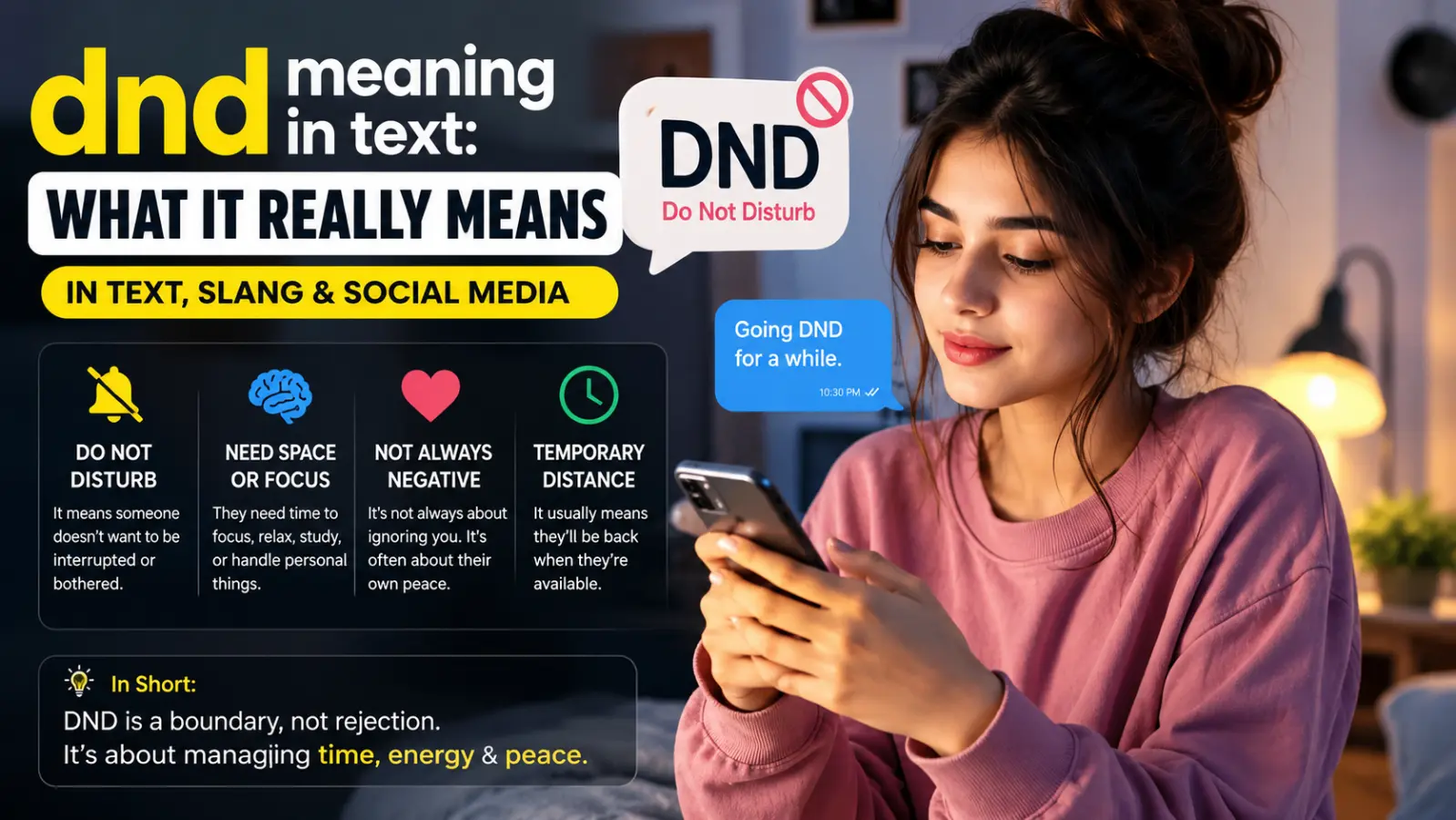
At its core, DND means “Do Not Disturb.”
It’s used when someone doesn’t want to be interrupted—digitally or emotionally.
But in texting culture, it can mean more than just muting notifications. Depending on tone and context, it can signal:
• “I need quiet time”
• “I’m busy right now”
• “I don’t want to talk at the moment”
• “I’m focusing on something important”
• “I need space”
• “I’ll reply later”
Simple Examples:
• “Going DND for study time” → Focus mode
• “Put my phone on DND, talk later” → Not available
• “I’m DND today 😴” → Mentally checked out
Core emotional meaning:
DND isn’t rejection—it’s temporary distance with intention.
what does dnd mean in text
When someone uses DND in a message, they’re usually saying:
👉 “I’m choosing not to engage right now.”
But here’s the nuance:
It’s not always about you—it’s often about them.
It can mean:
• Mental overload
• Social fatigue
• Work or study focus
• Emotional reset
• Avoiding distractions
In modern texting culture, DND is a soft boundary—less harsh than ignoring, but clearer than delayed replies.
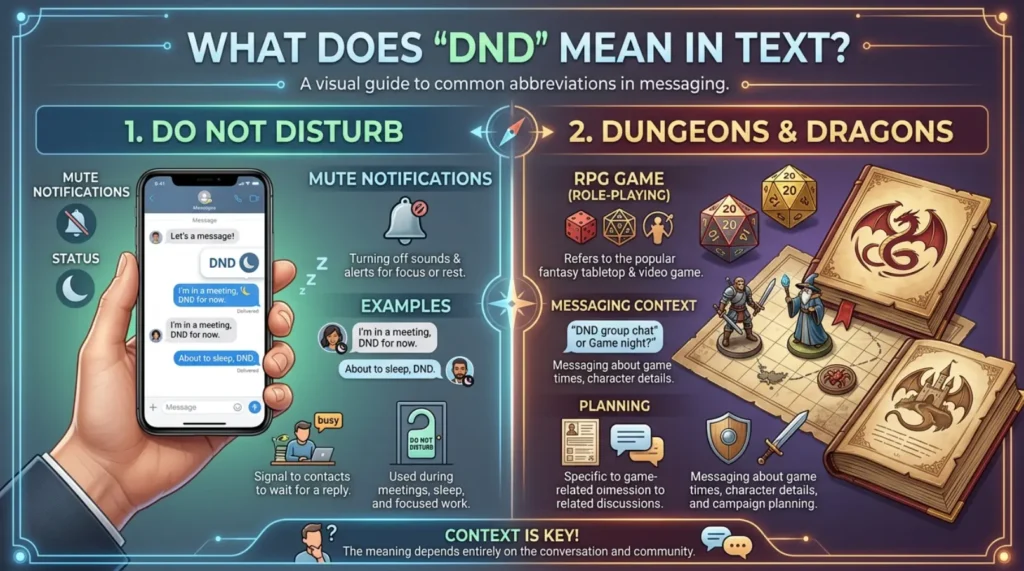
Do Not Disturb (Primary Meaning)
This is the most direct and widely used meaning.
When someone says “DND,” they are literally or metaphorically activating a Do Not Disturb mode—either on their phone or in their life.
Example:
“Phone’s on DND, I’ll reply later.”
This version is neutral, practical, and often respectful. It signals responsibility, not avoidance.
But tone matters.
Add a period → serious
Add an emoji → softer
Add nothing → slightly cold
That’s where things get interesting.
Origin & Background
“Do Not Disturb” didn’t start as slang—it started as a feature.
Think back to early smartphones. The DND setting was introduced so users could silence notifications during sleep, meetings, or focus time.
But like everything on the internet, it evolved.
Social media—especially platforms like TikTok and Instagram—turned it into a behavioral statement.
Suddenly:
• “I’m on DND” became a vibe
• People flexed emotional independence
• Silence became intentional, not accidental
Memes started framing DND as:
“Protecting your peace”
“Not replying is self-care”
“Silence is power”
And just like that, a phone feature became a social signal.
Online language moves fast. What starts as a setting becomes a personality trait.
Real-Life Conversations
Let’s see how this actually plays out.
WhatsApp Chat
“Bro I’m going DND, exam tomorrow.”
→ Focus + responsibility
Instagram DM
“Don’t think I’m ignoring you, just DND rn 😭”
→ Reassurance + emotional awareness
Text Message
“I’ll go DND for a bit, need to clear my head.”
→ Emotional reset
Group Chat
“Y’all too loud, DND activated 💀”
→ Playful escape
TikTok Comment
“Me putting my life on DND after one bad day”
→ Relatable humor + exaggeration
Emotional Pattern
Across all examples, one thing stays consistent:
👉 DND is about controlling access to yourself.
Not shutting people out permanently—just pausing the world for a moment.
Emotional & Psychological Meaning
This is where DND gets deeper.
Using “DND” isn’t just about silence—it’s about boundaries.
In a world where everyone expects instant replies, saying “I’m on DND” is quietly powerful.
It can signal:
• Self-respect
• Emotional awareness
• Need for control
• Social exhaustion
• Inner overwhelm
• Independence
A Mini Story
Imagine this:
You’ve had a long day. Messages keep coming in. Notifications don’t stop. Your brain feels crowded.
Instead of ghosting everyone, you send:
“Going DND for a bit.”
That one line does a lot:
• It protects your space
• It communicates without over-explaining
• It keeps relationships intact
That’s emotional intelligence in action.
👉 That’s the deeper psychology behind it.
Usage in Different Contexts
Social Media
DND often becomes aesthetic.
“On DND. Healing.”
“DND energy only.”
It’s less about literal silence and more about identity.
Friends & Relationships
Used casually:
“I’m DND, call you later.”
But tone matters:
Short = neutral
Explained = caring
Ignored context = confusing
Work or Professional Settings
More literal:
“On DND during meetings.”
Here, it’s about productivity, not emotion.
Casual vs Serious Tone
Casual:
“DND rn lol” → light
Serious:
“I’m on DND today.” → emotional distance
Context changes everything.
When NOT to Use It
Avoid using DND when:
• You’re in a serious emotional conversation
• Someone needs immediate support
• Professional communication requires clarity
• Talking to older or non-digital audiences
• Cross-cultural communication may confuse meaning
In the wrong moment, it can feel dismissive.
👉 Context protects meaning.
Common Misunderstandings
• “DND means they’re mad” → Not always
• “It’s rude” → Depends on tone
• “They’re ignoring me” → Often not true
• “It’s permanent distance” → Usually temporary
• “It’s cold behavior” → Sometimes it’s self-care
Understanding tone > assuming intent.
Comparison Table
| Expression | Meaning | Tone | Usage Context |
|---|---|---|---|
| DND | Do Not Disturb | Neutral to serious | Focus, space |
| BRB | Be Right Back | Light | Short absence |
| AFK | Away From Keyboard | Casual | Gaming/online |
| Ghosting | Ignoring completely | Negative | Avoidance |
| Silent Mode | Notifications off | Neutral | Tech-based |
Insight
DND is unique because it blends technology + emotion.
It’s not just absence—it’s intentional presence withdrawal.
Variations & Types
• “On DND” → Active state
• “Going DND” → Transition
• “Full DND mode” → Emphasis
• “Life on DND” → Dramatic / meme
• “DND energy” → Personality vibe
• “Permanent DND 😂” → Joke
Each version slightly shifts tone—from serious to playful.
How to Respond When Someone Uses It
Casual Replies
“Got it 👍 talk later”
“No worries”
Funny Replies
“DND? I’ll disturb later then 😏”
“Okay main character mode”
Mature Replies
“Take your time, I’m here when you’re back”
Respectful Replies
“Hope everything’s okay. Message when free.”
Matching energy matters. Respect builds trust.
Regional & Cultural Usage
Western Culture
Strong focus on boundaries and independence. DND = self-care.
Asian Culture
More subtle. Might be used less directly, more implied.
Middle Eastern Culture
Context-heavy. Tone matters more than words.
Global Internet Usage
Thanks to social media, DND is now universally understood—especially among younger users.
Generational Differences
Gen Z
Uses DND as identity:
“Protecting my peace.”
Millennials
Use it practically:
“Busy right now.”
Older Generations
May interpret it literally—or misunderstand tone.
Language reflects mindset.
Is It Safe for Kids
Mostly yes.
But:
• Can be used to avoid conversations
• May hide emotional withdrawal
• Needs balance between space and communication
Healthy when used with awareness.
FAQs
What does DND mean in texting?
It means “Do Not Disturb”—someone doesn’t want to be interrupted right now.
Is DND rude?
Not inherently. Tone and context decide that.
Does DND mean ignoring?
No—it usually means temporary unavailability.
Why do people use DND on social media?
To signal boundaries, focus, or emotional space.
Can DND be used in relationships?
Yes, but communication matters. It should feel respectful, not dismissive.
Is DND okay for work?
Yes, especially for focus—but clarity is important.
Conclusion
Understanding dnd meaning in text (“Do Not Disturb”) goes far beyond a simple phone setting.
It’s about:
• boundaries
• emotional control
• social awareness
• modern communication habits
In today’s always-online world, saying “DND” is one of the few ways people reclaim their attention.
It’s not silence.
It’s intention.
And sometimes… the quietest messages say the most.

I’m Grace Punston, a playful writer with a passion for clever puns and joyful wordplay. I love crafting witty lines that make readers grin and giggle. My goal is to spread laughter through smart, lighthearted writing. Every pun I share is a little spark of fun meant to brighten your day.