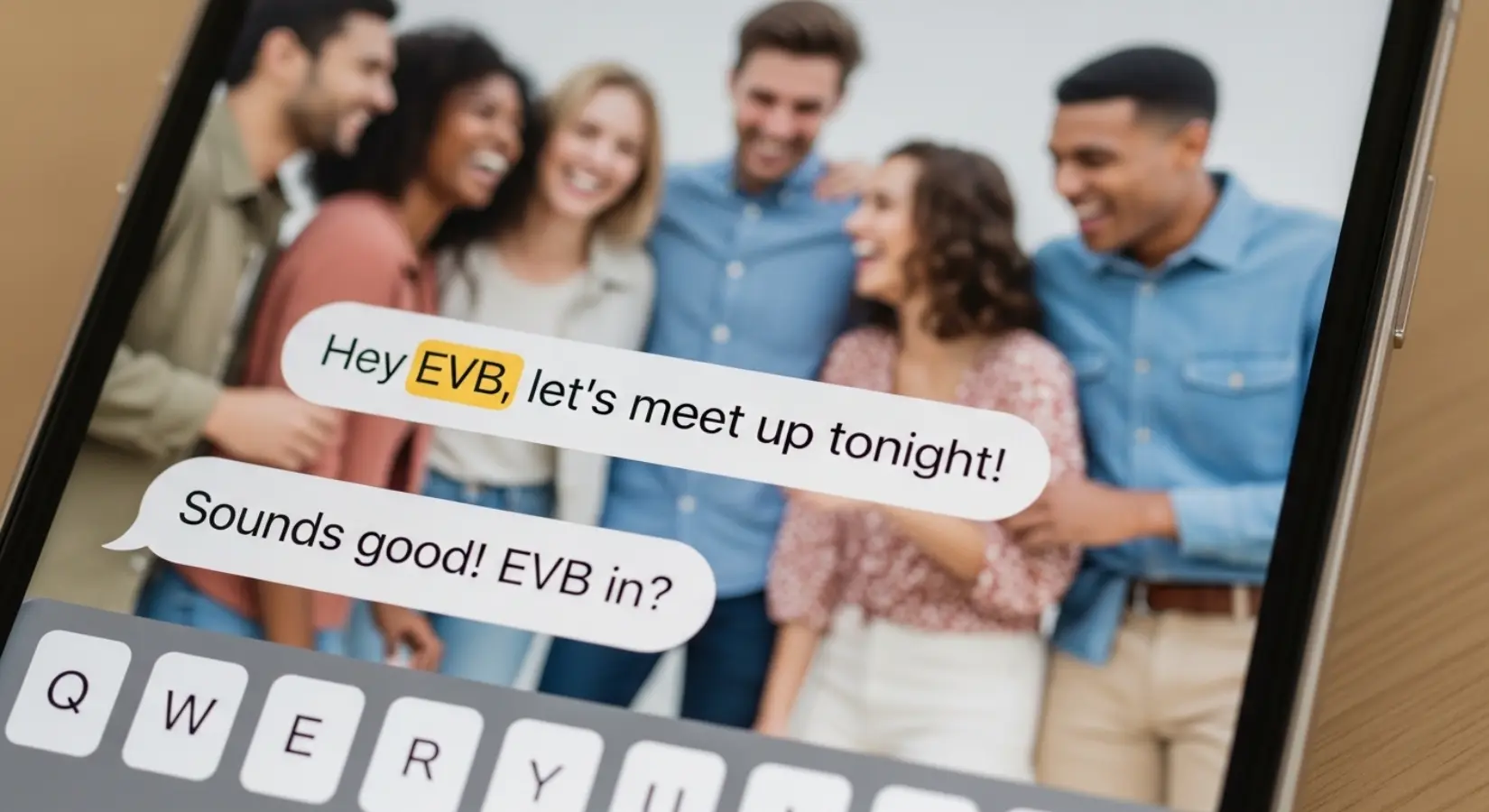
You’re scrolling through your chats, and suddenly someone drops:
“EVB already knows that 😭”
“Bro that fit is EVB level 🔥”
“Yeah… that situation was EVB 💀”
And you pause.
Wait… what does EVB even mean here? Is it praise? Shade? A joke? Or something deeper?
If you’ve searched EVB Meaning in Text, you’re not alone. This tiny acronym carries multiple meanings—and the vibe changes completely depending on context.
👉 Let’s break it down in a way that actually makes sense.
Quick Answer:
EVB is a flexible internet slang acronym that can mean:
- Everybody (most common)
- Extreme Very Bad
- Ever Been
But here’s the thing—it’s not just about the literal meaning. It’s about tone, timing, and emotional intent.
Depending on context, EVB can be used for:
- Calling out something obvious
- Reacting dramatically
- Complimenting or hyping
- Light teasing or joking
- Sharing emotional experiences
- Even subtle sarcasm
Simple Examples:
- “EVB knows you lying 😭” → Everyone knows (calling you out)
- “That movie was EVB” → Extremely bad
- “That’s the best trip I’ve EVB had” → Ever been
👉 At its core, EVB is about expression with attitude—it adds emotion to plain words.
What Does EVB Mean in Text
In texting, EVB acts like emotional shorthand.
Instead of writing full sentences, people use EVB to:
- Sound faster
- Feel more casual
- Add personality
- Express shared understanding
It’s less about grammar… and more about vibe.
EVB Meaning as “Everybody”
When EVB Means “Everybody”
This is the most common usage.
People use EVB instead of typing “everybody” to keep things quick and modern.
Examples:
- “EVB saw that post 💀”
- “EVB knows he’s toxic”
- “Why EVB acting weird today?”
Emotional Meaning
When someone uses EVB like this, they’re often:
- Highlighting something obvious
- Calling out behavior
- Creating a sense of group awareness
It’s not just “everyone”… it’s “everyone AND you should already know this.”
EVB Meaning as “Extreme Very Bad”
When EVB Means “Extreme Very Bad”
This one is more dramatic—and honestly, very internet-core.
Examples:
- “That haircut is EVB 😭”
- “The service there? EVB.”
- “That game update… EVB fr”
Emotional Meaning
This usage is:
- Exaggerated
- Slightly humorous
- Emotionally expressive
It’s not always serious criticism. Sometimes it’s just playful exaggeration.
👉 Think of it as dramatic storytelling, not pure negativity.
EVB Meaning as “Ever Been”
When EVB Means “Ever Been”
This is more subtle and often appears in sentences.
Examples:
- “Best place I’ve EVB to 🔥”
- “That’s the happiest I’ve EVB felt”
- “Worst experience I’ve EVB had”
Emotional Meaning
Here, EVB adds:
- Personal reflection
- Emotional depth
- Storytelling tone
It’s often used when someone is sharing a peak experience—good or bad.
Origin & Background
EVB didn’t come from a single moment. It evolved naturally from:
- Texting shortcuts
- Social media culture
- TikTok comment trends
- Meme language
As attention spans got shorter, people started compressing words:
- Everybody → EVB
- Ever been → EVB
Then internet creativity did the rest—turning it into expressions like “Extreme Very Bad.”
TikTok especially accelerated this. Comments needed to be:
- Quick
- Relatable
- Emotionally expressive
And EVB fits perfectly.
👉 Online language evolves fast, what starts as a shortcut often becomes a whole personality.
Real-Life Conversations
WhatsApp Chat
- A: “He said he changed 😭”
- B: “EVB knows that’s a lie”
Instagram DM
- “That outfit?? EVB staring fr 🔥”
TikTok Comment
- “This trend is EVB now 💀”
Group Chat
- “Why EVB ignoring me today 🤨”
Text Message
- “That’s the best food I’ve EVB had”
Emotional Pattern
Across all these, EVB shows:
- Shared awareness
- Emotional exaggeration
- Social connection
It’s less about the word—and more about how it feels in the moment.
Emotional & Psychological Meaning
Using EVB says a lot about a person.
It signals:
- Social awareness (“I see what’s happening”)
- Confidence (“I’m calling it out”)
- Humor (“I’m not taking this too seriously”)
- Emotional intelligence (“I understand the vibe”)
Sometimes, it’s also a shield.
Instead of saying something directly, people soften it with slang:
- “That’s bad” → harsh
- “That’s EVB 💀” → funny, less aggressive
Mini Story
You’re with friends. Someone tells a clearly fake story.
Instead of arguing, someone just says:
“Yeah… EVB knows that didn’t happen 😭”
Everyone laughs. No conflict. Message delivered.
👉 That’s the deeper psychology behind it.
Usage in Different Contexts
Social Media
- Fast, expressive, meme-driven
- “EVB knows this trend is dead 💀”
Friends & Relationships
- Playful, teasing
- “EVB knows you like her 😏”
Work or Professional Settings
- Rarely appropriate
- Might seem immature
Casual vs Serious Tone
- Casual: funny, exaggerated
- Serious: reflective (“best I’ve EVB felt”)
Context changes everything.
When NOT to Use It
Avoid EVB in:
- Formal emails
- Job conversations
- Serious emotional conflicts
- Talking to older audiences
- Cross-cultural communication
It can confuse or feel disrespectful.
👉 Context protects meaning.
Common Misunderstandings
- “EVB always means everybody” → Not true
- “It’s always rude” → Often playful
- “It’s clear in every situation” → Context matters
- “It’s negative slang” → Can be positive too
Understanding tone is key.
Comparison Table
| Expression | Meaning | Tone | Usage Context |
|---|---|---|---|
| EVB | Everybody / Extreme Very Bad / Ever Been | Flexible | Social media, chats |
| FR | For real | Affirming | Casual texting |
| NGL | Not gonna lie | Honest, soft | Confessions |
| IMO | In my opinion | Neutral | Discussions |
| SMH | Shaking my head | Disapproval | Reactions |
Insight:
EVB is more emotionally flexible than most slang—it adapts to mood quickly.
Variations & Types
- EVB fr → adds emphasis
- EVB knows → calling out truth
- EVB wild → exaggerated reaction
- EVB?? → confusion tone
- EVB 💀😭 → emotional layering
Each variation changes tone slightly.
How to Respond When Someone Uses It
Casual Replies
- “Fr tho 😂”
- “You not wrong”
Funny Replies
- “Don’t expose me like that 😭”
- “Relax EVB not ready for this convo”
Mature Replies
- “I get what you mean”
- “That’s actually true”
Respectful Replies
- “Yeah, I understand your point”
👉 Matching energy matters socially.
Regional & Cultural Usage
Western Culture
- Highly common in Gen Z slang
- Used in memes and TikTok
Asian Culture
- Growing via social media
- Often mixed with local slang
Middle Eastern Culture
- Used among English-speaking youth
- Blended with Arabic/Urdu texting
Global Internet Usage
Social media makes slang universal—but interpretation still depends on culture
Generational Differences
- Gen Z: Uses EVB naturally and creatively
- Millennials: Understand but use less
- Older Generations: Often confused
Language reflects identity—and EVB is very Gen Z-coded.
Is It Safe for Kids
Mostly yes.
But:
- Can be used for teasing
- Tone may be misunderstood
- Kids may copy exaggerated expressions
Healthy communication still matters.
FAQs
What does EVB mean in texting?
It usually means “everybody,” “extreme very bad,” or “ever been,” depending on context.
Is EVB rude?
Not necessarily. It’s often playful or expressive, not offensive.
How is EVB used on TikTok?
Mostly in comments to react, exaggerate, or call out obvious things.
Can EVB be positive?
Yes. Especially when used as “ever been” or in hype situations.
Do adults use EVB?
Mostly younger people use it, but others may understand it.
Can I use EVB at work?
It’s best to avoid it in professional communication.
Conclusion
EVB Meaning in Text isn’t just about definitions like “Everybody,” “Extreme Very Bad,” or “Ever Been.” It’s about how people express emotion, humor, and awareness in fast-moving digital conversations.
It’s shorthand—but with personality.
casual—but emotionally loaded.
simple—but socially powerful.
In a world where messages are short but feelings are big, slang like EVB helps people say more with less.
And honestly?
Sometimes one tiny word says what a whole sentence can’t.

I’m Zara Winkwell, a playful writer who loves blending wit, charm, and creativity into every pun I craft. I find inspiration in everyday moments that can turn into clever wordplay. Making people grin through humor and smart twists of language is my passion. With every line, I aim to turn simple words into a reason to smile.