What Does IMS Mean in Text? “I Am Sorry.” is one of those slang mysteries that makes you pause mid-chat and think, wait… did they just apologize or is this something else?
Imagine this:
You’re texting a friend after a small argument.
They suddenly reply:
“IMS 😔”
Or maybe in a lighter moment:
“ims lol didn’t mean that”
Now you’re stuck.
Is it serious?
Is it sarcastic?
Are they being emotionally vulnerable… or casually brushing it off?
This is exactly why people search for What Does IMS Mean in Text?—because modern texting isn’t just about words anymore. It’s about tone, emotion, and hidden meaning packed into three simple letters.
And honestly? One tiny abbreviation can carry guilt, humor, awkwardness, or even emotional softness depending on how it’s used.
👉 “Let’s break it down in a way that actually makes sense.”
Quick Answer:
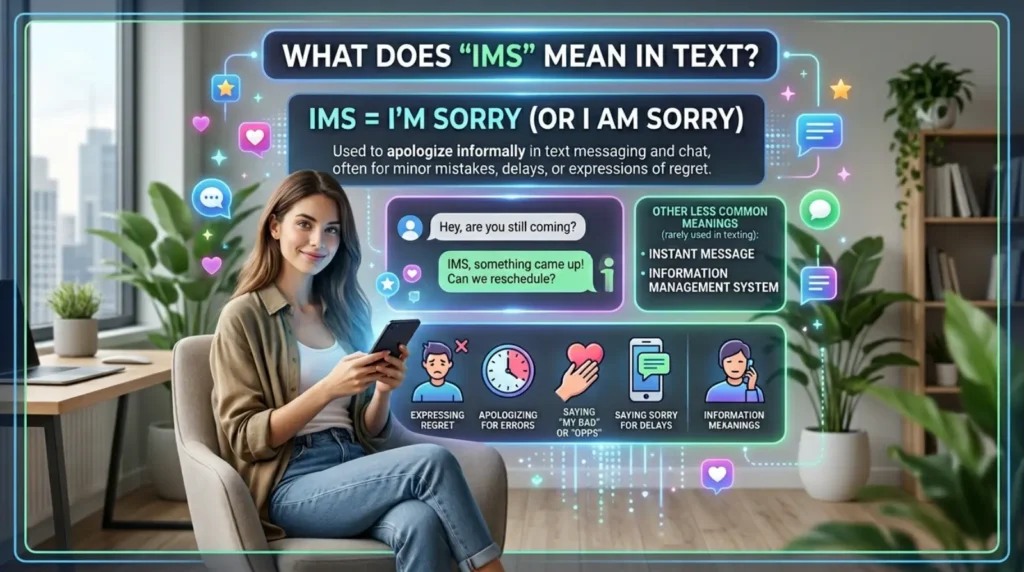
IMS in texting most commonly means “I’m sorry” or “I am sorry.”
But here’s where it gets interesting—it’s not just a straight apology.
Depending on context, IMS can express:
- genuine apology
- casual regret
- emotional guilt
- awkward acknowledgment
- soft humor
- passive sarcasm
- reconciliation attempt
- emotional vulnerability
Simple Examples:
- “IMS I didn’t see your message 😭” → genuine apology
- “IMS lol that was dumb of me” → casual regret
- “IMS?? why are you mad” → confusion + defensiveness
- “IMS for real, I messed up” → emotional sincerity
At its core, IMS is not just an apology—it’s a compressed emotional signal.
It’s how people say sorry… without making it feel too heavy.
👉 What Does IMS Mean in Text?
When someone types IMS in text, they are usually trying to do one of three things:
- Apologize quickly without overexplaining
- Soften emotional tension in a conversation
- Keep the chat casual even while admitting fault
Think of it like a “light apology shortcut.”
Instead of typing:
“I’m really sorry about what I said earlier, I didn’t mean it”
People just type:
“IMS”
It reflects how digital communication prioritizes speed over emotional elaboration—but still tries to keep feelings intact.
👉 Origin & Background
IMS didn’t come from formal language—it evolved from internet texting culture where abbreviations became emotional shortcuts.
It grew from:
- early SMS culture (limited characters)
- online chat rooms
- gaming communication
- WhatsApp shorthand evolution
- TikTok comment culture
- meme-style texting habits
As people started texting faster, emotional expressions got compressed.
Instead of long apologies, users began using short forms like:
- IDK
- BRB
- IMS
Then social media amplified it.
TikTok especially pushed emotional shorthand like IMS into everyday use, where captions and comments needed to be short but expressive.
And here’s the key insight:
👉 Internet language doesn’t just evolve—it shrinks emotions into symbols.
IMS is a perfect example of that transformation.
👉 Real-Life Conversations
💬 WhatsApp Chat
Friend 1: You ignored me yesterday
Friend 2: IMS I was sleeping 😭
💬 Instagram DM
You: That post was kinda rude lol
Them: IMS didn’t mean it like that
💬 TikTok Comment
“IMS but this is actually so funny 😂”
💬 Group Chat
User A: Bro leaked my photo 💀
User B: IMS I thought it was mine
Emotional Pattern Behind Usage
Across all these, IMS works as a softener—it reduces tension and keeps relationships smooth even after mistakes.
It’s not just apology.
It’s emotional maintenance.
👉 Emotional & Psychological Meaning
IMS is more than slang—it’s a psychological tool.
When someone uses IMS, they may be signaling:
- awareness of wrongdoing
- desire to avoid conflict
- emotional softness
- fear of escalation
- social intelligence
- need for acceptance
- subtle vulnerability
But here’s the deeper layer:
People often use IMS when they want to apologize without making the moment too intense.
It creates emotional balance—acknowledging fault while protecting ego.
Mini Story
Imagine two friends arguing over a misunderstanding in a group chat. One of them doesn’t want to “lose face” by writing a long apology.
So instead, they send:
“IMS bro 😭”
It’s small.
It’s light.
But it quietly says: I care enough to fix this, but I don’t want drama.
That’s modern digital emotion in action.
👉 “That’s the deeper psychology behind it.”
👉 Usage in Different Contexts
📱 Social Media
IMS is used casually in comments or captions to soften tone:
- “IMS but this is too relatable 💀”
👯 Friends & Relationships
Used frequently to repair small misunderstandings:
- “IMS I forgot your birthday 😭”
💼 Work or Professional Settings
Rarely appropriate. Too informal.
Better alternatives: “Sorry for the delay.”
🎭 Casual vs Serious Tone
- Casual: playful, short apology
- Serious: feels too weak for deep issues
Context completely changes impact.
👉 When NOT to Use It
IMS is not always suitable.
Avoid it in:
- formal emails
- serious emotional conflicts
- workplace communication
- sensitive conversations
- cross-cultural misunderstandings
- elder communication contexts
Why? Because IMS can feel too casual or emotionally insufficient.
👉 “Context protects meaning.”
👉 Common Misunderstandings
❌ “IMS is always rude”
Not true. It’s usually neutral or apologetic.
❌ “It means something sexual or slangy”
No—IMS is primarily “I’m sorry.”
❌ “It works everywhere”
It doesn’t. Formal settings need full words.
❌ “It has sarcasm only”
Tone depends entirely on context and emojis.
👉 Comparison Table
| Expression | Meaning | Tone | Usage Context |
|---|---|---|---|
| IMS | I’m sorry | Casual / emotional | Texting, social media |
| Sorry | Apology | Neutral | General use |
| My bad | Casual fault admission | Informal | Friends, chats |
| Apologies | Formal sorry | Professional | Workplace |
| I apologize | Strong formal apology | Serious | Official communication |
Insight
IMS sits in the emotional middle zone—not too formal, not too careless. That’s why it thrives in digital conversations.
👉 Variations & Types
IMS evolves depending on tone:
- “ims 😭” → emotional regret
- “ims lol” → light mistake
- “IMS??” → confusion or defense
- “ims fr” → serious apology
- meme IMS → sarcastic humor
- exaggerated IMS → playful drama
Each variation shifts emotional weight slightly.
👉 How to Respond When Someone Uses It
😌 Casual Replies
- “It’s okay lol”
- “Dw about it”
😂 Funny Replies
- “IMS accepted under one condition 😭”
- “You’re forgiven… this time”
🧠 Mature Replies
- “Thanks for apologizing, it’s fine”
- “Appreciate that, let’s move on”
💬 Respectful Replies
- “I understand, thank you for saying that”
- “No worries, it happens”
Matching energy keeps communication balanced.
👉 Regional & Cultural Usage
🌍 Western Culture
Common in texting, gaming, and social media slang.
🌏 Asian Culture
Often used in WhatsApp and Instagram casual chats.
🕌 Middle Eastern Culture
Used mainly among younger users online.
🌐 Global Internet Usage
Thanks to TikTok and memes, IMS is now widely recognized across borders.
👉 Generational Differences
Gen Z
Uses IMS casually, emotionally, and humorously.
Millennials
Use it but prefer full “sorry” in many cases.
Older Generations
Rarely use or understand it; prefer formal language.
Language reflects identity—and IMS is very Gen Z-coded communication.
👉 Is It Safe for Kids
Yes, IMS is generally harmless.
But:
- can be misused in teasing
- may confuse emotional tone
- depends on context awareness
Overall, it is safe but still a social nuance skill.
👉 FAQS:
1. What does IMS mean in texting?
It means “I’m sorry,” used in casual digital conversations.
2. Is IMS rude?
No, it’s usually polite or casual depending on tone.
3. Can IMS be used in professional chats?
No, it’s too informal for workplace communication.
4. Is IMS popular on TikTok?
Yes, it appears in comments and captions frequently.
5. Does IMS always mean apology?
Mostly yes, but tone can vary emotionally.
6. Do older people use IMS?
Rarely—it’s more common among younger internet users.
👉 Conclusion
What Does IMS Mean in Text? “I Am Sorry.” is more than just a digital abbreviation, it’s a reflection of how modern humans manage emotion in fast, compressed communication.
It shows how people try to stay connected, fix mistakes, and soften conflict… all within three simple letters.
In today’s internet culture, language isn’t just about meaning, it’s about emotion, speed, and social intelligence.
IMS captures that perfectly.
Because sometimes, even in a chaotic digital world, all it takes is three letters to say:
I still care enough to apologize.
And that’s what makes modern slang so human.

I’m Grace Punston, a playful writer with a passion for clever puns and joyful wordplay. I love crafting witty lines that make readers grin and giggle. My goal is to spread laughter through smart, lighthearted writing. Every pun I share is a little spark of fun meant to brighten your day.