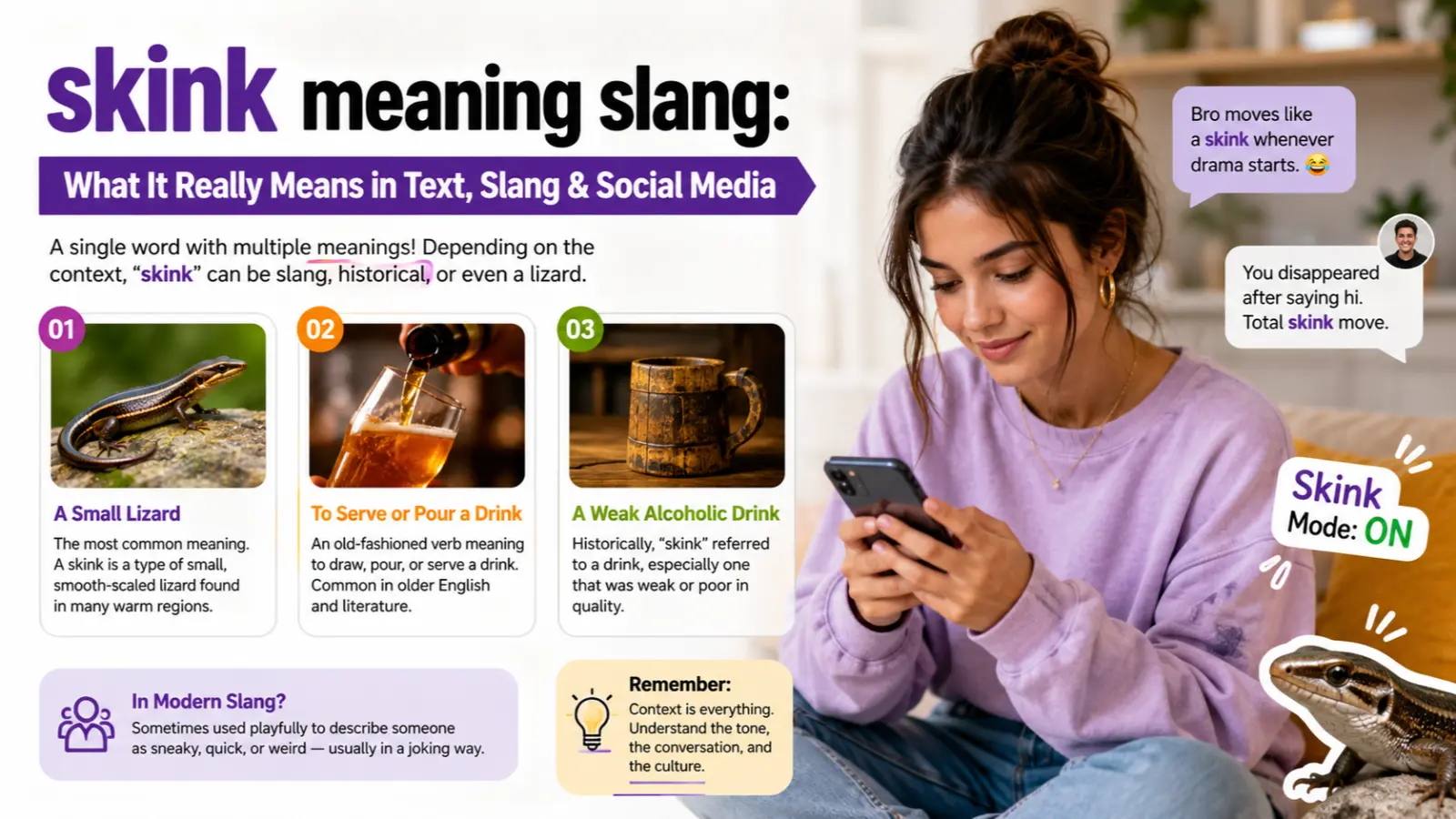
Skink meaning slang can be surprisingly confusing because the word has several meanings depending on where you encounter it. You might see someone comment, “That’s skink!”, read an old book mentioning “a skink of ale,” or come across discussions about a skink as a small lizard. So which meaning is correct?
The answer is that context matters. Historically, skink referred to serving or pouring a drink, and in some older dialects it could even mean a weak alcoholic drink.
In modern English, however, most people recognize skink as a type of small lizard found in warm regions. Online slang usage is much less common and usually depends on niche communities or jokes rather than mainstream internet culture.
Let’s break down each meaning.
Quick Definition
Skink does not have one universally accepted internet slang meaning.
Depending on context, it may refer to:
- A small lizard (the most common modern meaning).
- To pour or serve a drink (historical verb).
- An alcoholic drink, especially a weak or poor-quality one (archaic usage).
- Occasional playful slang in online conversations where users jokingly compare someone to a skink (meaning quick, sneaky, or tiny), though this isn’t an established dictionary slang term.
Skink Meaning as a Small Lizard
Today, the most recognized meaning of skink is a reptile.
Skinks are small lizards with smooth scales and relatively short legs. They live in many warm parts of the world and are known for their ability to move quickly through grass, sand, or leaf litter.
Example
“I saw a blue-tailed skink in my backyard.”
Skink Meaning as “To Serve or Pour a Drink”
In older English and Scots usage, to skink meant to pour, draw, or serve a drink.
Although this meaning has largely disappeared from everyday conversation, you’ll still find it in historical dictionaries and literature.
Example
“The innkeeper skinked ale for the travelers.”
Skink Meaning as a Weak Alcoholic Drink
Another historical meaning of skink refers to a drink itself, especially one considered weak or poor in quality.
This usage is now considered archaic and is rarely heard outside historical texts.
Example
“The tavern only offered a thin skink instead of strong ale.”
Skink Meaning in Modern Slang
Unlike internet abbreviations such as “FR,” “NPC,” or “Rizz,” skink is not a mainstream Gen Z or TikTok slang word.
Occasionally, people may use it jokingly to describe someone as:
- Fast
- Sneaky
- Tiny
- Weird in an affectionate way
These are creative, informal uses rather than widely accepted slang definitions.
Example
“Look at him running away like a little skink.”
What Does Skink Mean in Text?
If someone texts “skink,” don’t immediately assume it’s slang.
Ask yourself:
- Are they talking about reptiles?
- Are they quoting an old book?
- Are they making a joke?
The surrounding conversation usually makes the intended meaning clear.
Origin & Background
The word skink has a long history.
Historically, it appeared in older English and Scots with meanings connected to serving alcohol or a drink itself. Over time, those meanings became uncommon, while the zoological meaning—referring to a family of small lizards—became the standard definition used today.
This shift is a good reminder that language constantly evolves. Some words lose their original meanings, while others gain completely new ones through culture, media, and everyday conversation.
Real-Life Conversations
- A: “Who kept eating my snacks?”
- B: “Probably Jake. That little skink. 😂”
Instagram DM
- “You disappeared after saying hi. Total skink move.”
TikTok Comment
- “Bro moves like a skink whenever drama starts.”
Text Message
- A: “Why are you hiding?”
- B: “I’m in skink mode today.”
These examples show that when skink is used as slang, it’s usually playful rather than seriously offensive. It often describes someone as sneaky, odd, or quick.
Emotional & Psychological Meaning
Calling someone a skink often softens criticism with humor. Instead of expressing anger directly, people may use the term to tease a friend who is acting strangely or avoiding responsibility. This playful language helps maintain social bonds while still communicating frustration.
Usage in Different Contexts
- Social Media: Memes, jokes, and playful comments.
- Friends: Light teasing among close friends.
- Work: Best avoided because many people won’t understand the reference.
- Serious Conversations: Avoid using it during emotional discussions.
When NOT to Use It
Don’t use skink:
- In professional emails.
- During arguments.
- With older audiences unfamiliar with internet slang.
- In cross-cultural conversations where the joke may be misunderstood.
Context protects meaning.
Common Misunderstandings
| Misunderstanding | Reality |
|---|---|
| It always means a lizard | It can also be an old word for serving or drinking alcohol. |
| It’s a common Gen Z slang | It’s niche and not widely used. |
| It’s always insulting | Often it’s playful teasing. |
Comparison Table
| Expression | Meaning | Tone | Usage |
|---|---|---|---|
| Skink | Odd, sneaky, or quick | Playful | Friends, memes |
| Snake | Deceitful | Negative | Conflict |
| Goblin | Chaotic | Humorous | Internet jokes |
| Gremlin | Mischievous | Funny | Gaming & memes |
Variations & Types
- Skinking – joking about acting sneaky.
- Little skink – affectionate teasing.
- Skinky – playful nickname.
- Meme versions exaggerate the behavior for comedy.
How to Respond
Casual: “😂 Fair enough.”
Funny: “I’ll embrace my inner skink.”
Mature: “I wasn’t trying to be sneaky.”
Respectful: “Can you explain what you mean?”
Matching the other person’s tone usually keeps the conversation comfortable.
Regional & Cultural Usage
Western Culture: Mostly seen in humorous online spaces.
Asian Culture: Rare outside English-speaking communities.
Middle Eastern Culture: Generally unfamiliar.
Global Internet: Still a niche expression compared with mainstream slang.
Generational Differences
- Gen Z: May understand the joke if they’re active online.
- Millennials: Less likely to recognize it.
- Older Generations: Usually associate skink with the reptile instead of slang.
Is It Safe for Kids?
Generally yes, because it’s usually playful. However, repeated teasing—even with harmless words—can hurt feelings if used to mock someone.
FAQs
1. What does skink mean in slang?
It may describe someone as odd, sneaky, or unusual in a playful way.
2. Is skink a rude word?
Usually no. It depends on tone and relationship.
3. Does skink have an old English meaning?
Yes. Historically it referred to serving a drink or a weak alcoholic beverage.
4. Is skink popular on TikTok?
Not as a mainstream slang term.
5. Can I use skink at work?
It’s better to avoid it in professional settings.
6. What is the most common meaning today?
A small lizard found in warm regions.
Conclusion
Skink meaning slang is a great example of how one word can carry several meanings depending on context. It can refer to a playful internet nickname for someone acting odd or sneaky, an old term connected with serving or drinking alcohol, or—most commonly today—a small lizard.
Understanding skink meaning slang isn’t just about memorizing definitions; it’s about recognizing tone, culture, and the situation in which the word is used. As online language continues to evolve, words like skink remind us that communication is shaped as much by emotion and context as it is by vocabulary.

I’m Lila Wordsmith, a writer who finds magic in clever wordplay and heartfelt expressions. I love crafting puns, wishes, and quotes that make people feel connected and inspired. Every line I write is designed to bring a smile or spark a thought. Through my words, I hope to turn simple moments into something truly memorable.