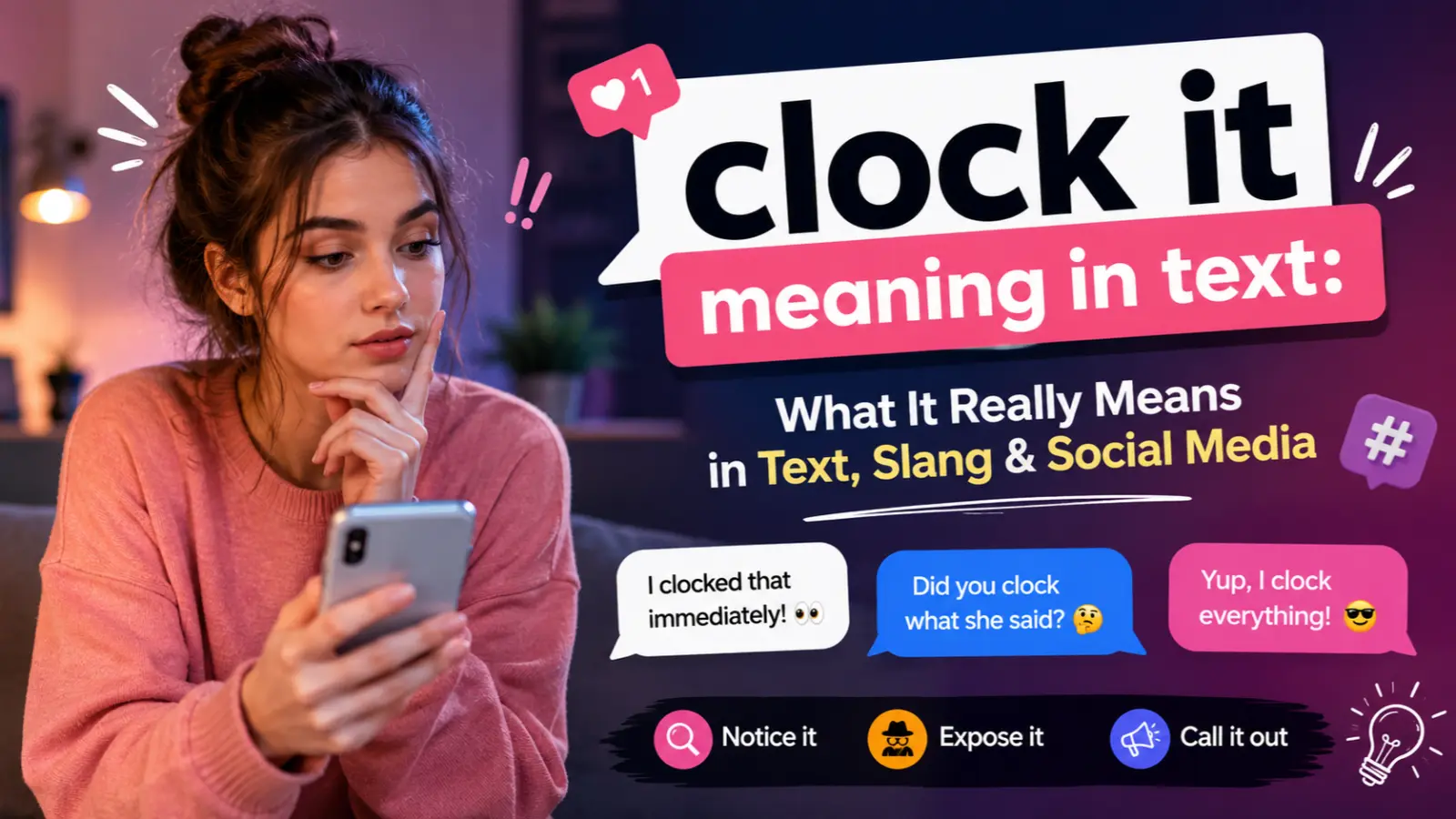
clock it meaning in text is one of those internet phrases that can leave you scratching your head the first time you see it. Imagine scrolling through TikTok comments and reading, “I clocked that immediately.”
Or maybe a friend texts, “Did you clock what she was really trying to say?” At first glance, it sounds like it has something to do with time or a clock—but that’s not what it means at all.
The phrase has become increasingly popular across social media, where people use it to point out hidden details, subtle behaviors, or truths that others may have missed. If it’s exposing fake behavior, noticing a secret glance, or catching a clever joke, “clock it” is all about being observant.
Many people search this slang because they’ve seen it on TikTok, Instagram, X, Snapchat, or in text messages and want to understand the real meaning behind it. Is it an insult? A compliment? A way of calling someone out? The answer depends on the situation and the tone.
Modern internet slang isn’t just about words—it reflects emotions, social awareness, and how people connect online. That’s exactly why this phrase has become so popular.
Let’s break it down in a way that actually makes sense.
Quick Definition
Clock it means to quickly notice, recognize, expose, or call out a hidden truth, subtle detail, or someone’s behavior. It often suggests that someone was paying close attention and understood something that wasn’t obvious to everyone else.
Depending on the conversation, the phrase can carry different emotional meanings.
Clock It Meaning as Noticing Something
One of the most common uses is simply noticing something before anyone else does.
Example:
Friend 1: “Did you clock his reaction when she mentioned the trip?”
Friend 2: “Yeah, he looked nervous.”
Here, “clock” means to notice a small but meaningful detail.
Clock It Meaning as Exposing the Truth
Sometimes the phrase is used when someone uncovers a hidden intention or calls out fake behavior.
Example:
“Everyone believed him, but she clocked the lie immediately.”
In this context, it means seeing through someone’s act.
Clock It Meaning as Reacting to a Situation
People also use “clock it” to acknowledge something surprising or obvious.
Example:
“The whole group clocked the awkward silence.”
Here, everyone recognized what was happening without anyone saying it aloud.
Clock It Meaning as a Compliment
Among friends, saying someone “clocked it” can praise their sharp observation skills.
Example:
“You clocked that so fast. I didn’t even notice.”
This suggests the person is perceptive and socially aware.
Clock It Meaning as an Insult
In some situations, “clock it” can sound critical or confrontational.
Example:
“She clocked his fake confidence in seconds.”
Rather than complimenting someone, it highlights their weaknesses or dishonesty.
Clock It Meaning as a Joke
Internet users often use the phrase playfully when teasing friends.
Example:
“You really clocked my snack stash before I even opened the bag.”
Nobody is upset—it’s simply humorous.
Clock It Meaning While Flirting
In dating conversations, the phrase can point out romantic interest or hidden attraction.
Example:
“She clocked that he couldn’t stop looking at her.”
It suggests someone noticed feelings that weren’t openly expressed.
Clock It Meaning as Emotional Awareness
Sometimes “clock it” refers to recognizing someone’s emotions without them saying anything directly.
Example:
“He clocked that I was upset even though I smiled.”
This use reflects empathy and emotional intelligence.
At its core, “clock it” means recognizing something meaningful before others do, whether it’s a hidden emotion, a subtle clue, or an unspoken truth.
What Does Clock It Mean in Text?
In texting, clock it usually means to notice something important, understand an unspoken message, or call attention to behavior that others might overlook.
Unlike many internet slang terms that have only one meaning, “clock it” changes slightly depending on the conversation.
For example:
Alex: “Did you clock that she ignored his question?”
Jamie: “I noticed it right away.”
Or:
Taylor: “You clocked exactly what I was thinking.”
In this case, it means someone understood another person’s thoughts or intentions without needing much explanation.
Texting removes facial expressions and body language, so phrases like “clock it” help people express awareness in just two simple words. It’s a quick way of saying, “I saw what really happened.”
Origin & Background
The expression “clock” has been used for decades in informal English to mean “to notice” or “to recognize.” Long before social media existed, people in certain communities used the word when talking about spotting someone’s appearance, behavior, or intentions.
The phrase became especially well known within LGBTQ+ communities, particularly in drag and ballroom culture, where “clocking” often referred to accurately noticing or identifying something about a person’s presentation. Over time, the meaning broadened beyond those communities and entered mainstream internet slang.
As platforms like Twitter (now X), TikTok, Instagram, and YouTube Shorts grew, creators began using “clock it” in reaction videos, commentary clips, celebrity discussions, and meme content. Viewers quickly adopted the phrase because it perfectly captured the feeling of catching a hidden detail that others missed.
TikTok played a major role in making the slang viral. Users frequently comment things like:
“She clocked that instantly.”
“Y’all finally clocked it.”
“He thought nobody would notice, but everyone clocked it.”
These comments reward sharp observation and encourage people to pay closer attention.
Internet slang evolves because online conversations move incredibly fast. Words that once belonged to small communities can become global expressions within months, changing slightly as different cultures and generations adopt them. That’s one of the fascinating reasons modern digital language never stays still.
Real-Life Conversations
WhatsApp Chat
Emma: “Did you clock Mom’s face when I mentioned moving out?”
Lily: “Yeah… she definitely wasn’t expecting that.”
Here, “clock” means noticing an emotional reaction that wasn’t spoken aloud.
Instagram DM
Alex: “I finally clocked why everyone’s obsessed with that creator.”
Jordan: “Same. Their videos are actually really creative.”
The phrase expresses a moment of realization.
TikTok Comments
Comment 1: “Nobody clocked the tiny detail in the background.”
Comment 2: “I paused the video and finally saw it.”
This kind of interaction is extremely common on TikTok, where viewers enjoy spotting hidden clues or Easter eggs.
Text Messages
Chris: “You clocked my sarcasm immediately 😂”
Sam: “I’ve known you too long.”
Here, “clocked” means correctly understanding someone’s tone.
Group Chat
Maya: “Who else clocked Jake looking at Ava all night?”
Nina: “Everyone except Jake.”
Friends often use the phrase to discuss subtle social dynamics or romantic hints.
Across all these conversations, one emotional pattern stands out: people use “clock it” to celebrate awareness. Whether it’s catching a hidden emotion, exposing a lie, noticing attraction, or recognizing a joke, the phrase creates a sense of shared understanding. It says, “I saw what was really going on,” and invites others into that moment of insight.
Emotional & Psychological Meaning
The popularity of clock it meaning in text goes beyond simple observation. People don’t just use the phrase because they noticed something—they use it because noticing feels powerful.
When someone says, “I clocked that,” they’re often communicating more than awareness. They’re saying they picked up on a hidden emotion, an unspoken message, or a subtle behavior that others overlooked. In a world where so much communication happens through screens, being able to “read between the lines” has become a valued social skill.
Awareness
Using “clock it” often signals emotional awareness. It shows that someone pays attention to details instead of only listening to words.
For example:
“I clocked that she was pretending to be okay.”
The speaker isn’t claiming psychic abilities. They’re simply saying they noticed changes in tone, behavior, or expressions.
Attraction
The phrase also appears in conversations about dating.
“He thought nobody noticed him staring, but everyone clocked it.”
Here, “clocked” suggests that attraction can sometimes be obvious, even when people try to hide it.
Humor
Internet humor often depends on noticing tiny details.
Someone might comment:
“Only real fans clocked the hidden joke.”
Using the phrase creates a sense of belonging. It makes people feel like they’re part of an inside joke.
Sarcasm
Online conversations are full of sarcasm, and “clock it” often means recognizing that someone wasn’t being serious.
Example:
“You actually clocked the sarcasm this time.”
It celebrates understanding tone in a space where facial expressions are missing.
Intelligence
Many people associate “clocking” something with quick thinking.
If someone notices an inconsistency before everyone else, friends may admire their attention to detail.
Confidence
Saying “I clocked that” can also reflect confidence. It shows someone trusts their instincts and observations instead of waiting for others to confirm them.
Of course, confidence should be balanced with humility. Sometimes people believe they’ve “clocked” something when they’ve misunderstood the situation.
Emotional Protection
People also use this slang as a way to protect themselves emotionally.
For example:
“I clocked the red flags early, so I didn’t get too attached.”
Here, noticing warning signs becomes a form of self-care.
Internet Identity
On social media, being quick to recognize trends, jokes, or hidden meanings often becomes part of someone’s online identity.
People enjoy feeling observant. They like catching references before everyone else.
A Mini Story
Imagine a group of coworkers chatting after a meeting.
One person says everything is fine, but they avoid eye contact and leave unusually quickly.
Later, a coworker quietly says:
“I clocked that something was bothering them.”
The next day, it turns out that person was dealing with a difficult family situation.
The phrase wasn’t about gossip. It reflected empathy and careful observation.
That’s the deeper psychology behind it.
Usage in Different Contexts
Social Media
TikTok, Instagram, and X are where you’ll see “clock it” most often.
People use it to point out hidden details, expose contradictions, or praise someone for noticing something subtle.
Example:
“Y’all finally clocked what I’ve been saying for months.”
Friends & Relationships
Among friends, the phrase is usually playful and supportive.
Examples include:
“You clocked my mood before I even said anything.”
“She clocked my new haircut immediately.”
In relationships, it can also refer to understanding emotions without needing an explanation.
Work or Professional Settings
In professional communication, “clock it” is less common because not everyone is familiar with internet slang.
Instead of saying:
“I clocked the mistake.”
It’s usually better to say:
“I noticed the issue.”
“I identified an error.”
spotted the inconsistency.”
These alternatives sound clearer and more professional.
Casual vs Serious Tone
Context changes everything.
Casually:
“I clocked your joke.”
This feels friendly.
Seriously:
“The manager clocked the problem during the meeting.”
Now it sounds more formal and focused on observation.
The same phrase can shift dramatically depending on who is speaking and why.
When NOT to Use It
Although “clock it” is popular online, it doesn’t fit every conversation.
Avoid using it in formal emails, academic writing, business presentations, or official workplace communication. Many people may not recognize the slang, leading to confusion.
It’s also wise to avoid the phrase during emotionally sensitive discussions.
For example, telling someone:
“I clocked your insecurity.”
could come across as judgmental rather than supportive.
Older audiences may interpret the phrase literally or misunderstand your intention.
Cross-cultural conversations can also create confusion because internet slang spreads at different speeds across different regions.
When communicating with people who may not know the expression, choosing straightforward language is often the better option.
Context protects meaning.
Common Misunderstandings
Many people misunderstand “clock it” because they interpret it literally.
It Always Means Looking at a Clock
No. The slang has nothing to do with telling time.
It refers to noticing or recognizing something.
It’s Always an Insult
Not at all.
Sometimes it’s playful.
Sometimes it’s complimentary.
It’s simply descriptive.
The tone depends entirely on the conversation.
It Means Publicly Embarrassing Someone
Not necessarily.
Although it can involve calling out behavior, it often just means quietly noticing something.
It’s Only Used on TikTok
TikTok helped popularize the phrase, but people also use it on Instagram, Snapchat, X, Reddit, Discord, and in everyday texting.
Comparison Table
| Expression | Meaning | Tone | Usage Context |
|---|---|---|---|
| Clock it | Notice or expose a hidden detail | Observant, playful, direct | Texting, TikTok, social media |
| Call it out | Publicly point out behavior | Direct, critical | Conversations, debates |
| Catch that | Notice something quickly | Casual | Everyday speech |
| Pick up on | Understand subtle clues | Thoughtful | Personal conversations |
| Read the room | Understand the emotional atmosphere | Socially aware | Groups, meetings |
| Notice that | Observe something | Neutral | Any setting |
Although these expressions are similar, “clock it” feels more modern and internet-driven. It often carries a sense of social awareness, quick thinking, and cultural familiarity that the others don’t always convey.
Variations & Types
Internet users love adapting slang, and “clock it” is no exception.
Clocked
The past tense is the most common version.
Example:
“I clocked that immediately.”
Clocking
Used for ongoing observation.
Example:
“Everyone’s clocking the comments now.”
You Clocked It
This version praises someone for understanding something correctly.
Example:
“Exactly—you clocked it.”
Clock That
A dramatic way to direct attention.
Example:
“Clock that attitude.”
Clocked So Fast
Often used in memes to praise quick observation.
Example:
“She clocked that in two seconds.”
Internet Meme Variations
Comments like:
“Nobody clocked this?”
“I can’t believe nobody clocked it.”
“The comments finally clocked it.”
appear frequently on viral videos and discussion threads.
How to Respond When Someone Uses It
Casual Replies
- “Yeah, I noticed it too.”
- “Good catch.”
- “I saw that as well.”
- “Exactly what I was thinking.”
Funny Replies
- “My detective skills never fail.”
- “Nothing gets past me.”
- “I deserve an award for that one.”
- “Certified professional overthinker.”
Mature Replies
- “That’s an interesting observation.”
- “I hadn’t thought about it that way.”
- “You may be right.”
Respectful Replies
- “Thanks for pointing that out.”
- “I appreciate your perspective.”
- “I’ll pay closer attention.”
Matching the other person’s energy helps conversations feel more natural. A playful comment deserves a playful response, while a serious observation calls for a more thoughtful reply.
Regional & Cultural Usage
Western Culture
In the United States, the United Kingdom, Canada, and Australia, “clock it” is widely recognized among younger internet users. It’s especially common in TikTok videos, reaction content, and celebrity discussions.
Asian Culture
Many English-speaking social media users across Asia recognize the phrase through global platforms like TikTok and Instagram. However, local slang is often mixed with English expressions, so usage varies by country.
Middle Eastern Culture
The phrase appears mainly among bilingual users who consume English-language online content. In everyday conversations, people may prefer local expressions with similar meanings.
Global Internet Usage
Social media has turned “clock it” into a global slang term. A phrase that once belonged to specific communities now appears in comment sections around the world, showing how quickly digital culture spreads language across borders.
Generational Differences
Gen Z
Gen Z uses “clock it” naturally in texts, memes, and videos. For many, it’s a normal part of online communication.
Millennials
Millennials generally understand the phrase, especially if they’re active on social media, though they may use it less often than Gen Z.
Older Generations
Older adults may be unfamiliar with the slang or interpret it literally. A brief explanation can help avoid confusion.
Language often reflects identity, and internet slang like “clock it” shows how younger generations use creative expressions to build community and share experiences.
Is It Safe for Kids?
In most cases, “clock it” is harmless slang. It simply means noticing, recognizing, or calling attention to something.
However, like many online expressions, it can become negative if it’s used to mock, embarrass, or tease someone. Parents and educators can encourage kids to use the phrase respectfully and to think about how their words might affect others.
Understanding the emotional tone behind slang is just as important as knowing its definition.
FAQs
What does clock it meaning in text mean?
It means to quickly notice, recognize, or expose a hidden truth, subtle detail, or someone’s behavior in a conversation or online interaction.
Is “clock it” rude?
Not usually. It can be playful, complimentary, or critical depending on the tone and context.
How is “clock it” used in texting?
People use it to show that they noticed something important, understood a hidden message, or recognized someone’s emotions or intentions.
Why do people say “clock it” on TikTok?
TikTok users often say “clock it” when someone spots a hidden detail, calls out fake behavior, or understands the deeper meaning behind a video.
Do Gen Z use “clock it” more than other generations?
Yes. Gen Z has helped popularize the phrase, though Millennials and other social media users also use and understand it.
Can you use “clock it” at work?
It’s better to avoid it in formal workplace communication. Clear phrases like “I noticed” or “I identified” are more appropriate in professional settings.
Conclusion
Understanding clock it meaning in text helps you see why this short phrase has become such a powerful part of online communication. At its core, it means to quickly notice, expose, or recognize a hidden truth, subtle detail, or unspoken emotion. If you’re chatting with friends, commenting on TikTok, or reacting to a viral post, “clock it” expresses sharp observation and social awareness in just two words.
Modern slang isn’t only about sounding trendy—it reflects how people think, connect, and communicate in digital spaces. As internet culture continues to evolve, phrases like clock it meaning in text remind us that sometimes the smallest details reveal the biggest truths.
In today’s online world, the people who truly “clock it” are often the ones who understand not just what’s being said—but what’s really being felt.

I’m Lila Wordsmith, a writer who finds magic in clever wordplay and heartfelt expressions. I love crafting puns, wishes, and quotes that make people feel connected and inspired. Every line I write is designed to bring a smile or spark a thought. Through my words, I hope to turn simple moments into something truly memorable.