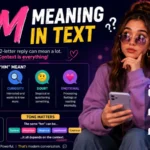
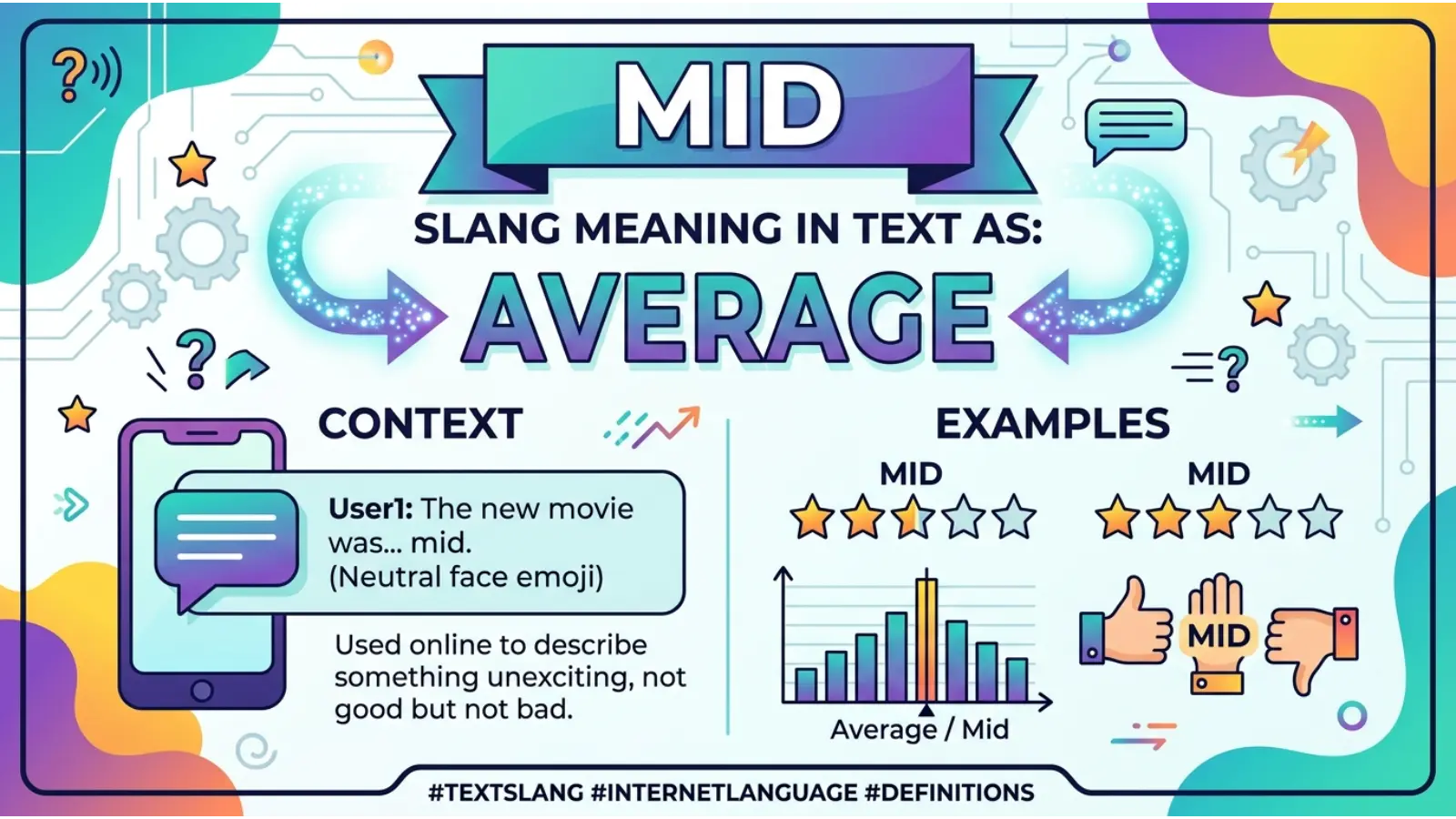
Mid meaning in text has become one of the most searched internet slang phrases, especially as Gen Z and social media users continue creating new ways to express opinions with just a single word. Imagine sending your friend a message saying, “That new movie was amazing!” only to get a reply that simply says, “Mid.”
Wait… was that an insult?
Or maybe someone comments under your favorite singer’s latest post:
“This album is kinda mid.”
Suddenly you’re wondering whether they hated it or just weren’t impressed.
That’s exactly why so many people search for the meaning of mid in text messages, TikTok comments, Instagram captions, Snapchat chats, Discord conversations, and online gaming communities. The word may look simple, but its emotional meaning depends heavily on tone, context, and the conversation itself.
Unlike traditional dictionary words, internet slang carries emotion. One short word can communicate disappointment, sarcasm, indifference, or even playful teasing.
Let’s break it down in a way that actually makes sense.
Quick Definition
In modern internet slang, mid usually means average, mediocre, disappointing, or simply not as good as people claim. It isn’t necessarily terrible—it just isn’t impressive enough to deserve the hype.
Someone calling something “mid” usually means:
- It’s average.
- It’s ordinary.
- It’s overhyped.
- It failed to impress.
- It doesn’t live up to expectations.
Example:
Friend: “That burger was incredible!”
You: “Honestly… it was mid.”
You’re basically saying:
“It wasn’t awful, but it definitely wasn’t amazing.”
At its core, mid expresses emotional disappointment without being overly dramatic.
Mid Meaning in Text as “Average”
The most common meaning of mid is simply average.
Instead of saying:
- It’s okay.
- It’s average.
- It’s nothing special.
Many internet users now just say:
“It’s mid.”
Example:
“The new Netflix show is mid.”
The speaker isn’t saying it’s bad—they’re saying it’s forgettable.
Mid Meaning in Text as “Mediocre”
Sometimes mid becomes slightly harsher.
Here it means something performs below expectations.
Example:
“Everyone hyped that restaurant, but honestly it was mid.”
Emotionally, the speaker feels let down because expectations were much higher.
Mid Meaning in Text as “Disappointing”
One of the strongest uses of mid happens after excitement.
Example:
“I waited six months for this game… it’s mid.”
Notice the frustration.
The disappointment makes the word feel stronger than simply saying “average.”
Mid Meaning in Text as an Insult
Sometimes people use mid to criticize someone or something.
Examples:
“His music is mid.”
“That outfit is mid.”
“Your favorite team is mid.”
In these situations, the word becomes playful teasing or direct criticism depending on the relationship.
Mid Meaning in Text as a Joke
Friends often use mid humorously.
Friend 1:
“I cooked dinner.”
Friend 2:
“Mid 😂”
No one is actually offended.
It’s simply internet humor built around exaggeration.
Mid Meaning in Text as a Meme
On TikTok, X (Twitter), Reddit, and Instagram, mid has become a meme.
People intentionally call wildly popular things “mid” just to spark reactions.
Examples include:
- “Pizza is mid.”
- “Coffee is mid.”
- “Summer is mid.”
Most readers instantly recognize this as playful internet culture rather than a serious opinion.
What Does Mid Mean in Text?
Simply put, mid means something is middle-tier rather than excellent.
Instead of calling something:
- amazing
- incredible
- terrible
you’re placing it right in the middle.
Think of it as giving something a 5 or 6 out of 10.
That balance is exactly why the word has become so popular. It communicates disappointment quickly without sounding overly emotional.
Origin & Background
Although mid originally referred to “middle,” its slang meaning evolved through online communities discussing music, fashion, gaming, sports, and entertainment.
Fans needed a quick way to describe something that wasn’t awful but definitely didn’t deserve massive praise. Over time, “mid” became shorthand for “mediocre” or “overrated.”
The expression gained major popularity through Twitter (now X), TikTok, Twitch streams, YouTube creators, meme pages, and Discord servers. Content creators would casually label albums, sneakers, movies, or viral trends as “mid,” and millions of viewers adopted the term.
Today, the slang appears everywhere—from comment sections and reaction videos to gaming chats and everyday text messages.
Online language changes incredibly fast. Words that once had simple dictionary meanings can evolve into powerful emotional expressions within just a few months.
Real-Life Conversations
WhatsApp Chat
Ali: Did you watch the new superhero movie?
Sara: Yeah.
Ali: How was it?
Sara: Honestly… mid.
Instagram DM
Friend: Rate my new shoes.
You: They’re clean, but kinda mid.
TikTok Comments
Creator: “Best burger in the city!”
Comment:
“Nah… mid.”
Text Messages
Friend:
“I’m buying this phone.”
You:
“I’d save your money. It’s pretty mid.”
Group Chat
Ahmed: That café is amazing!
Usman: Bro… it’s mid.
Everyone: 😂😂😂
Across all these conversations, the emotional pattern is surprisingly consistent.
People use mid when they want to lower expectations without sounding overly harsh. It creates a balance between criticism and casual conversation, making it one of the most flexible slang words on today’s internet.
Emotional & Psychological Meaning
At first glance, mid seems like a simple way to say something is average. But in reality, it carries much more emotional weight than that.
When someone calls a movie, song, outfit, or even a person “mid,” they’re often expressing a subtle emotional reaction rather than making a factual judgment. The word signals that something failed to create excitement, admiration, or lasting impact.
In today’s online culture, where everything is constantly being rated, reviewed, and shared, expectations are incredibly high. People are surrounded by viral content every day, so it takes something truly exceptional to stand out. Calling something mid is a quick way of saying, “I expected more.”
Sometimes the word also acts as emotional protection. Instead of saying, “I hated it,” which can start arguments, people soften their criticism by saying, “It was just mid.”
A Small Story
Imagine two friends going to see the most hyped movie of the year.
One walks out saying,
“That was the best movie ever!”
The other simply smiles and replies,
“Honestly… it was mid.”
That single word tells a whole story. It doesn’t mean the movie was terrible. It means the emotional experience never matched the hype.
Dating conversations work the same way.
Friend:
“How was your date?”
Response:
“They were nice… just kind of mid.”
Here, “mid” doesn’t attack the person. It simply means there wasn’t enough chemistry or excitement to create a real connection.
That’s the deeper psychology behind it.
Usage in Different Contexts
Mid Meaning on Social Media
Social media is where the slang thrives.
You’ll commonly see comments like:
- “This trend is mid.”
- “That song is mid.”
- “The update is mid.”
- “This influencer is mid.”
Most users are sharing quick opinions rather than detailed reviews.
Mid Among Friends & Relationships
Among friends, mid is often playful.
Friend:
“My new haircut looks good, right?”
Friend:
“It’s kinda mid.”
If the friendship is close, everyone laughs.
If the relationship is sensitive, however, the same word may sound hurtful.
Tone always matters.
Mid in Work or Professional Settings
Avoid using mid in professional communication.
Instead of saying:
“The presentation was mid.”
Say:
- “It could be improved.”
- “It met expectations but lacked originality.”
- “There are opportunities to strengthen it.”
Professional conversations value clarity over slang.
Casual vs Serious Tone
Casually, mid sounds light and humorous.
Seriously, it can feel dismissive.
For example:
“That pizza was mid.”
sounds harmless.
But saying:
“Your artwork is mid.”
may discourage someone who spent hours creating it.
The context completely changes the emotional impact.
When NOT to Use It
Although mid is popular, it isn’t appropriate everywhere.
Avoid using it:
- During serious emotional conversations.
- In professional emails.
- With teachers or clients.
- Around people unfamiliar with internet slang.
- In cross-cultural conversations where slang may be misunderstood.
Calling someone’s personal achievement “mid” can also feel disrespectful, even if you intended it as a joke.
Context protects meaning.
Common Misunderstandings
Many people misunderstand the slang because they only know the dictionary definition of “middle.”
Misunderstanding 1: Mid Means “Middle”
Not in internet slang.
Instead, it means average or unimpressive.
Misunderstanding 2: Mid Always Means Bad
Not exactly.
Something can be mid without being terrible.
It’s simply not outstanding.
Misunderstanding 3: Mid Is Always an Insult
Friends often use it jokingly.
Whether it’s offensive depends on tone and relationship.
Misunderstanding 4: Everyone Uses It the Same Way
Different online communities use the word differently.
Gamers, sports fans, music lovers, and TikTok creators may all use mid with slightly different levels of criticism.
Mid vs Similar Slang
| Expression | Meaning | Tone | Usage Context |
|---|---|---|---|
| Mid | Average or disappointing | Casual | Reviews, texting, social media |
| Basic | Ordinary or lacking originality | Slightly critical | Fashion, lifestyle |
| Overrated | Gets more praise than deserved | Critical | Entertainment, sports |
| Trash | Very bad | Harsh | Gaming, memes |
| Fire | Excellent | Positive | Music, fashion, food |
| GOAT | Best of all time | Highly positive | Sports, entertainment |
Although these expressions seem similar, they carry different emotional intensity. Calling something mid is much softer than calling it trash, but noticeably less positive than saying it’s good.
Variations & Types
Internet users have created several playful versions of mid.
Common variations include:
- Super mid
- So mid
- Mid AF
- Mid at best
- Certified mid
- Absolute mid
- Peak mid
- Mid vibes
Some people even exaggerate it for memes:
“This is the most mid thing I’ve ever seen.”
The exaggeration is part of the humor.
How to Respond When Someone Uses “Mid”
Casual Replies
- Fair enough.
- I can see that.
- That’s your opinion.
- Maybe I’m easier to impress.
Funny Replies
- Your taste is mid. 😂
- Bold opinion.
- The comment section won’t like this.
- You’re just trying to start drama.
Mature Replies
- What didn’t you like?
- I’m curious why you think that.
- Everyone experiences it differently.
Respectful Replies
- Thanks for sharing your perspective.
- That’s understandable.
- We don’t have to agree.
Matching the other person’s energy usually leads to better conversations than immediately becoming defensive.
Regional & Cultural Usage
Western Culture
In the United States, Canada, and the UK, mid is common among Gen Z and young Millennials. It’s widely used on TikTok, Instagram, Twitch, YouTube, and gaming platforms.
Asian Culture
Many young internet users in countries like South Korea, Japan, India, and the Philippines understand mid because of global social media trends, although local slang is often mixed with English expressions.
Middle Eastern Culture
English-speaking online communities increasingly use mid, especially among gamers and university students who regularly consume international content.
Global Internet Usage
Today, memes spread across countries within hours. A slang word that begins in one online community can quickly become part of conversations worldwide.
Generational Differences
Gen Z
Uses mid naturally in daily conversations.
Millennials
Generally understand the word but may use it less often.
Older Generations
Some interpret “mid” literally as “middle” and may miss the slang meaning entirely.
Language has become a way for younger generations to express identity, humor, and belonging online.
Is “Mid” Safe for Kids?
Generally, yes.
The word itself is harmless and doesn’t contain offensive language.
However, children should understand that repeatedly calling classmates, hobbies, or creative work “mid” can become hurtful or discouraging.
Teaching respectful communication is more important than avoiding the slang itself.
Frequently Asked Questions
What does mid mean in text?
It usually means something is average, mediocre, or disappointing rather than impressive.
Is calling something mid rude?
Not always. It can be playful among friends but may sound dismissive depending on the situation.
What does mid mean on TikTok?
TikTok users often describe videos, songs, trends, or products as mid when they feel they don’t deserve the hype.
Does mid mean bad?
No. It usually means “just okay,” not terrible.
Which generation uses mid the most?
Gen Z uses it most frequently, although Millennials increasingly understand it.
Can I use mid at work?
It’s better to avoid internet slang in professional communication and choose more formal language.
Conclusion
The phrase mid meaning in text goes far beyond its dictionary connection to the word “middle.” In today’s internet culture, it has become shorthand for describing something as mediocre, average, or slightly disappointing without saying it’s completely bad.
If you’re scrolling through TikTok, replying in a group chat, commenting on Instagram, or texting friends, you’ll probably encounter mid again and again. Understanding both the word and the emotion behind it helps you interpret conversations more accurately and communicate more naturally online.
Modern slang evolves because people are always searching for faster, more expressive ways to share opinions. Today it’s mid. Tomorrow it may be something entirely new.
That’s the beauty of internet language—it constantly changes, but it always reflects how people really feel.

I’m Jake Punman, a humor writer who lives for clever wordplay and laugh-out-loud puns. I love crafting witty lines that turn simple moments into bursts of laughter. My passion is making people smile through creative twists of language. With every pun I write, I aim to add a little more fun to your day.