You’re texting someone late at night. The vibe is casual, maybe a little flirty, maybe a little uncertain. You suggest something, and they reply:
“idts 😬”
Now you pause.
Wait… is that a soft rejection? Are they joking? Are they confused?
That exact moment of overthinking is why people search for “idts meaning in text”. Because in today’s digital conversations, words aren’t just words — they carry tone, emotion, and sometimes hidden meaning.
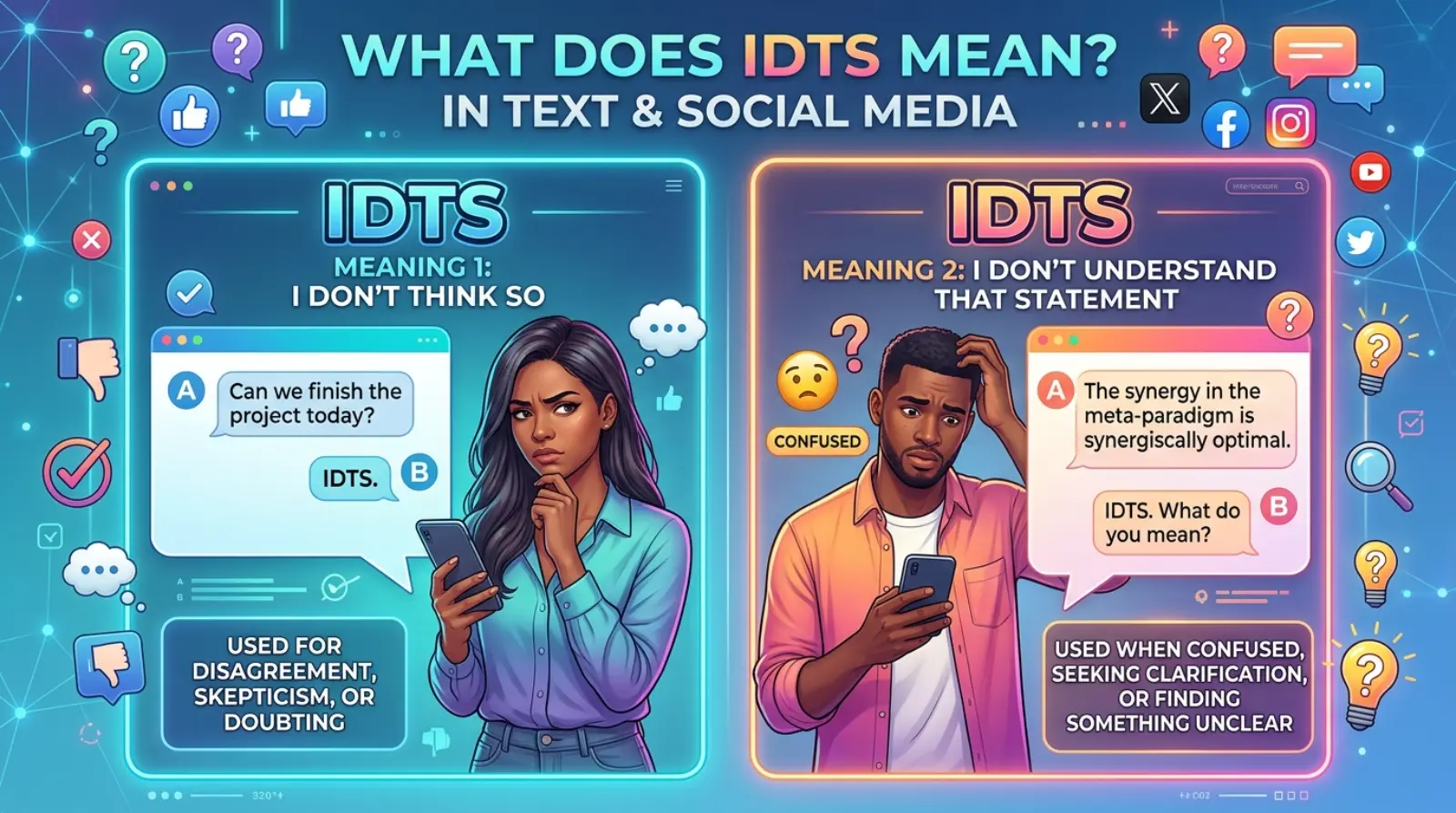
At its core, idts means “I don’t think so” or sometimes “I don’t understand that statement.” But the real meaning depends on how it’s used, who’s using it, and the emotional energy behind it.
Let’s break it down in a way that actually makes sense.
Quick Answer
idts is a casual internet slang abbreviation that typically stands for:
- “I don’t think so” (most common)
- “I don’t understand that statement” (less common)
But here’s the twist — it’s rarely just literal.
Depending on tone and context, it can express:
- A soft rejection
- Light disagreement
- Playful teasing
- Subtle sarcasm
- Mild confusion
- Emotional distance
Examples:
- “You think he likes me?”
→ “idts 😅” (gentle reality check) - “This makes total sense right?”
→ “idts…” (confusion or disagreement)
Core emotional meaning:
👉 Not fully agreeing — but saying it in a softer, less confrontational way.
what does idts mean in text
In everyday texting, idts usually means:
👉 “I don’t think so” — but with a tone filter
Instead of sounding harsh or direct, it feels:
- lighter
- less aggressive
- more socially aware
It’s like saying “no”… without making it awkward.
But sometimes, especially in confusing conversations, it can shift into:
👉 “I don’t understand what you’re saying”
That version usually comes with:
- no emojis
- slower replies
- a slightly serious tone
So context matters. Always.
Origin & Background
idts comes from the classic internet habit of shortening phrases for speed.
Think early texting culture:
- limited characters
- fast replies
- casual typing
It likely evolved from:
- SMS texting era
- chat rooms
- early social platforms
Then platforms like TikTok, Instagram, and Snapchat amplified it.
On TikTok comments, “idts” often shows up in:
- reaction threads
- subtle disagreements
- sarcastic replies
Over time, it shifted from just meaning “I don’t think so” to something more nuanced , a socially polished way to disagree.
And that’s the thing about internet language:
👉 It evolves faster than dictionaries can keep up.
Real-Life Conversations
Here’s how idts actually shows up in modern conversations:
WhatsApp Chat:
- A: “Let’s go out at 7am 😭”
- B: “idts bro”
Instagram DM:
- A: “Do you think she’s into me?”
- B: “idts tbh”
TikTok Comments:
- “This is the best movie ever”
- “idts 💀”
Group Chat:
- A: “We’re all passing this exam easy”
- B: “idts 😭”
Text Message:
- A: “You’re mad at me?”
- B: “idts… just tired”
Emotional Pattern:
Most of the time, idts softens disagreement.
It avoids conflict while still being honest.
Emotional & Psychological Meaning
Here’s where it gets interesting.
When someone says idts, they’re often doing more than just responding — they’re managing emotions.
It can signal:
- Social awareness → “I disagree, but I don’t want tension”
- Emotional protection → “I’m holding back a stronger opinion”
- Confidence → calm disagreement without explanation
- Uncertainty → “I’m not fully sure, but probably not”
- Distance → keeping things neutral
Mini-story:
Imagine you tell a friend:
“Do you think I should text my ex?”
They reply:
“idts…”
That’s not just advice.
That’s:
- concern
- hesitation
- emotional caution
They’re protecting you — without lecturing you.
👉 That’s the deeper psychology behind it.
Usage in Different Contexts
Social Media
On platforms like TikTok or Instagram:
- Often sarcastic or humorous
- Can be slightly savage
Example:
“This outfit is iconic”
→ “idts 💀”
Friends & Relationships
More emotional and subtle.
Example:
“Do you think they care about me?”
→ “idts…” (gentle honesty)
Work or Professional Settings
Rarely used.
If used, it may seem:
- too casual
- unclear
- unprofessional
Casual vs Serious Tone
- Casual: playful disagreement
- Serious: emotional honesty or concern
Tone depends heavily on emojis, timing, and relationship.
When NOT to Use It
Avoid using idts in:
- Formal emails
- Professional communication
- Sensitive emotional arguments
- Conversations with older people unfamiliar with slang
- Cross-cultural discussions where tone may be misunderstood
Because sometimes, what feels casual to you might feel dismissive to someone else.
👉 Context protects meaning.
Common Misunderstandings
1. “It always means no”
Not exactly. It can mean uncertain disagreement.
2. “It’s rude”
Only if used coldly. Tone matters.
3. “It’s always sarcastic”
Sometimes it’s genuinely soft and caring.
4. “It means confusion every time”
That’s a secondary meaning, not the default.
Comparison Table
| Expression | Meaning | Tone | Usage Context |
|---|---|---|---|
| idts | I don’t think so | Soft, neutral | Casual chats |
| nope | No | Direct | Informal |
| nah | No | Chill, relaxed | Friendly convos |
| I disagree | Disagreement | Formal/clear | Professional or serious |
| idk | I don’t know | Uncertain | General use |
Insight:
👉 idts sits in the middle — not too harsh, not too vague. It’s socially balanced.
Variations & Types
You’ll often see different versions like:
- idts tbh → more honest tone
- idts 😭 → playful or dramatic
- idts… → serious or thoughtful
- IDTS → stronger emphasis
- idts lol → light sarcasm
Each variation slightly shifts emotional meaning.
How to Respond When Someone Uses It
Casual Replies
- “fair enough”
- “yeah maybe you’re right”
Funny Replies
- “wow no faith in me 😭”
- “you didn’t even think twice huh”
Mature Replies
- “okay, what do you think instead?”
- “why do you feel that way?”
Respectful Replies
- “got it, I appreciate your honesty”
👉 Matching the energy matters more than the words.
Regional & Cultural Usage
Western Culture
Common in texting and social media, especially Gen Z.
Asian Culture
Used in online spaces but sometimes mixed with local slang.
Middle Eastern Culture
Gaining popularity through TikTok and global content.
Global Internet Usage
Widely understood in digital communities.
👉 Social media has made slang borderless.
Generational Differences
Gen Z
- Uses it naturally
- Understands emotional nuance instantly
Millennials
- Uses it, but sometimes more literally
Older Generations
- May find it confusing or unclear
Language today is identity.
Is It Safe for Kids
Yes — mostly.
But watch for:
- teasing tone
- emotional misunderstandings
- passive communication habits
It’s harmless, but context still matters.
FAQs
1. What does idts mean in texting?
It usually means “I don’t think so,” often in a soft or casual tone.
2. Is idts rude?
Not inherently. It depends on tone and context.
3. Can idts mean confusion?
Yes, sometimes it means “I don’t understand that statement.”
4. Is idts used on TikTok?
Very commonly, especially in comments and reactions.
5. Should I use idts at work?
Not recommended. It’s too informal.
6. Why do people use idts instead of saying no?
Because it sounds softer and less confrontational.
Conclusion
Understanding idts meaning in text isn’t just about translation , it’s about reading emotion through minimal words.
Whether it means “I don’t think so” or “I don’t understand that statement,” it reflects how modern communication works:
- softer
- faster
- emotionally layered
In a world where one short reply can carry multiple meanings, idts shows how people balance honesty with social comfort.
👉 Sometimes, it’s not just what we say , it’s how gently we choose to say it.

I’m Jake Punman, a humor writer who lives for clever wordplay and laugh-out-loud puns. I love crafting witty lines that turn simple moments into bursts of laughter. My passion is making people smile through creative twists of language. With every pun I write, I aim to add a little more fun to your day.