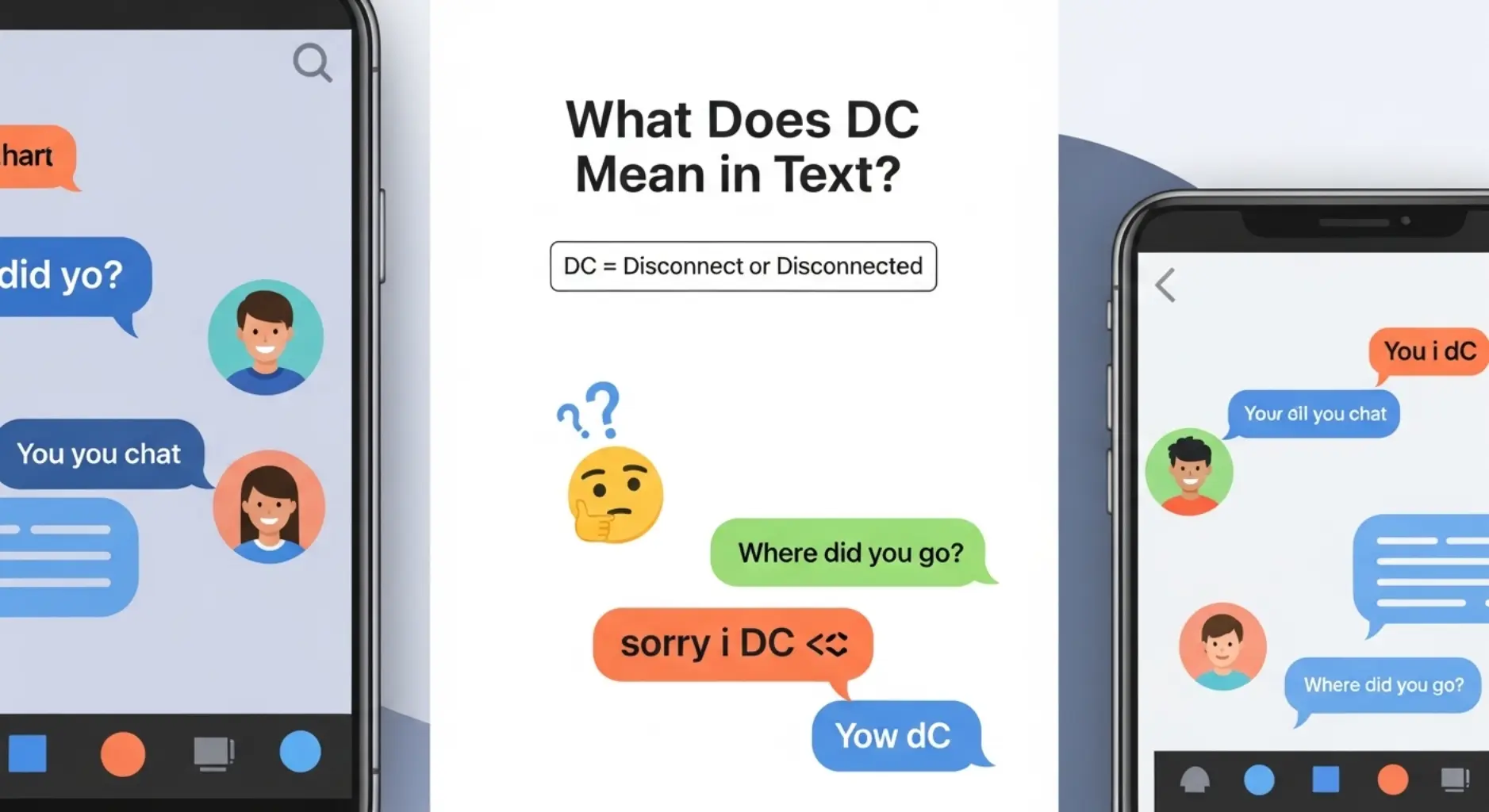
DC Mean in Text — you’ve probably seen it pop up in chats like:
- “Bro sorry I DC 😭”
- “She said that and I just DC tbh”
- “My WiFi DC again 💀”
And suddenly… you pause.
Wait—what does DC actually mean here?
Is it “disconnect”? It “don’t care”? Is someone ignoring you… or just having bad internet?
That tiny two-letter slang carries surprisingly different emotional tones depending on context. Sometimes it’s technical. it’s cold. Sometimes it’s passive-aggressive.
That’s exactly why people search “DC mean in text” — because one meaning can completely change the vibe of a conversation.
👉 Let’s break it down in a way that actually makes sense.
Quick Answer:
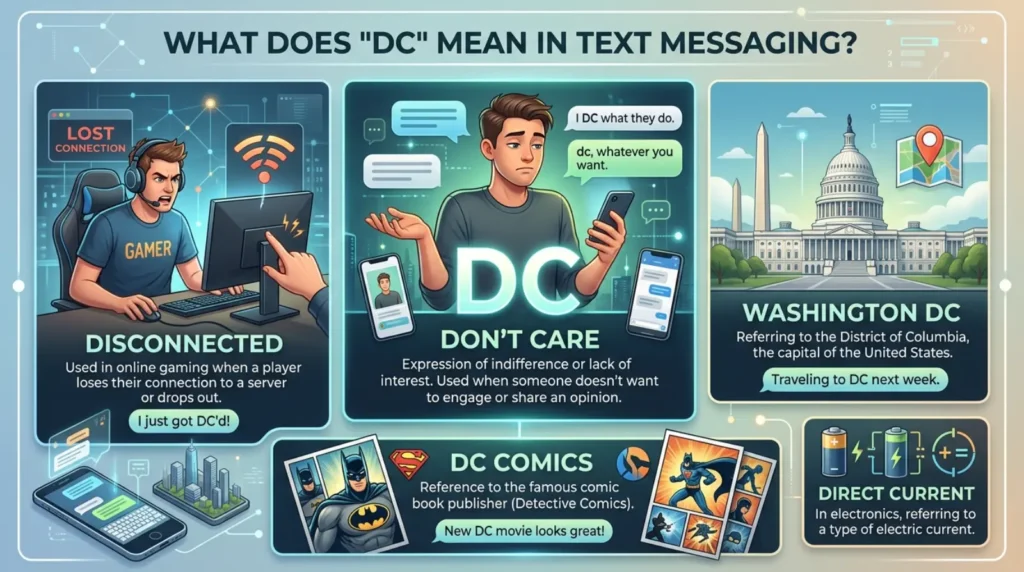
DC in text usually means:
• “Disconnect” or “Disconnected”
• “Don’t Care”
But the real meaning? It depends on how it’s used and what’s happening emotionally in the conversation.
Simple Examples:
• “My internet went dc” → Disconnected (technical)
• “I dc what they say” → Don’t care (emotional)
• “He dc mid convo” → He disappeared or stopped replying
Emotional Summary:
At its core, DC signals detachment — either physically (connection lost) or emotionally (interest lost).
What Does DC Mean in Text
When someone uses DC in text, they’re usually expressing one of two things:
- A break in connection
→ something stopped, ended, or dropped - A lack of emotional investment
→ they don’t care, or don’t want to engage
And those two meanings?
They actually connect in a deeper way…
Because whether it’s internet or emotions—DC always hints at disconnection.
Origin & Background
“DC” didn’t start as slang. It originally came from gaming and tech culture, where “disconnect” was used constantly:
• “I dc’d from the server”
• “Bro I lagged and dc”
Then social media stepped in.
As texting got faster and attention spans got shorter, people began shortening phrases like:
• “I don’t care” → “idc” → sometimes just “dc”
• “Disconnected” → “dc”
Platforms like TikTok, Instagram, and Discord helped spread it. Especially in:
• gaming communities
• meme culture
• fast-paced group chats
Over time, the meaning evolved.
Now, DC isn’t just technical—it’s emotional language.
And that’s how internet slang works:
👉 It starts literal… then becomes psychological.
Usage in Different Contexts
Social Media
- Often used for attitude or confidence
- Example: “Hate all you want, I DC”
Friends & Relationships
- Can be playful or serious
- Example: “You forgot my birthday? Wow DC now?”
Work or Professional Settings
- Avoid using it
- Can seem rude or immature
Casual vs Serious Tone
- Casual: “I DC lol” → light
- Serious: “I DC anymore” → emotional withdrawal
Context shapes meaning more than the word itself.
Emotional Pattern Behind Usage
People use DC when they want distance without explaining everything.
It’s quick. It’s vague.
And sometimes… it protects them.
Emotional & Psychological Meaning
This is where it gets interesting.
Using DC isn’t just about communication—it’s about emotional control.
It can signal:
• detachment → “I’m not affected”
• defense → “I don’t want to care anymore”
• avoidance → “I don’t want this conversation”
• confidence → “This doesn’t matter to me”
• hurt (hidden) → pretending not to care
Mini Story
Imagine this:
Your friend is upset because someone ignored them. Later they say:
“I dc anymore tbh”
But you know they do care.
That “dc” isn’t truth—it’s protection.
👉 It’s easier to say “I don’t care” than admit “that hurt me.”
That’s the deeper psychology behind it.
Usage in Different Contexts
Social Media
• “I dc what people think”
→ confidence or fake confidence
• “He dc mid convo 💀”
→ ghosting culture
Friends & Relationships
• “You don’t reply so I dc now”
→ emotional withdrawal
• “I dc anymore”
→ burnout or disappointment
Work or Professional Settings
Rare and risky.
• “I dc about that deadline” ❌
→ sounds unprofessional
Casual vs Serious Tone
• Casual: joking, light detachment
• Serious: emotional shutdown
Tone changes everything.
When NOT to Use It
Avoid using DC in:
• formal emails
• job conversations
• serious emotional discussions
• with older audiences unfamiliar with slang
• cross-cultural chats where meaning may confuse
Because “dc” can easily sound:
• rude
• dismissive
• cold
👉 Context protects meaning.
Common Misunderstandings
Misconception 1: It always means “don’t care”
→ Sometimes it literally means disconnected
Misconception 2: It’s always rude
→ Not always—tone matters
3: It means confidence
→ Sometimes it hides insecurity
Comparison Table
| Expression | Meaning | Tone | Usage Context |
|---|---|---|---|
| DC | Disconnect / Don’t care | Neutral to cold | Casual chats |
| IDC | I don’t care | Direct, stronger | Emotional responses |
| Ghosting | Disappearing | Avoidant | Dating/social |
| AFK | Away from keyboard | Neutral | Gaming |
| Seen-zoned | Ignored message | Passive-aggressive | Social media |
Insight
“DC” is softer than “IDC” but more ambiguous.
It leaves space for interpretation—and sometimes confusion.
Variations & Types
• dc’d → past tense (disconnected)
• I dc now → emotional shift
• lowkey dc → pretending not to care
• idc vs dc → intensity difference
• dc fr → serious detachment
• dc lol → joking tone
Each version slightly changes the emotional weight.
How to Respond When Someone Uses It
Casual Replies
• “lol same”
• “fair enough”
Funny Replies
• “dc or pretending not to care? 👀”
• “internet dc or emotional dc?”
Mature Replies
• “You sure you don’t care?”
• “It sounds like it still matters a bit”
Respectful Replies
• “Got it, I won’t push”
• “I understand”
👉 Matching energy matters more than the words.
Regional & Cultural Usage
Western Culture
Common in texting, gaming, and dating apps.
Often used casually or sarcastically.
Asian Culture
Less direct emotionally—“dc” may feel too blunt.
Used more in gaming contexts.
Middle Eastern Culture
Can come off as dismissive depending on tone.
People may prefer more expressive language.
Global Internet Usage
Thanks to TikTok and memes, DC is now universal slang.
But meaning still depends on local communication style.
Generational Differences
Gen Z
• Uses “dc” frequently
• Mixes humor with emotional detachment
• Understands nuance instantly
Millennials
• More likely to use “IDC”
• Slightly more direct emotionally
Older Generations
• May misunderstand it
• Might see it as rude or confusing
Language = identity.
And slang shows how each generation handles emotions differently.
Is It Safe for Kids
Generally, yes.
But there are some concerns:
• Kids may use “dc” to hide feelings
• It can encourage emotional avoidance
• Tone may come off as rude unintentionally
Healthy communication still matters.
FAQs
What does DC mean in texting?
It usually means “disconnect” or “don’t care,” depending on context.
Is DC rude?
Not always—but it can sound dismissive if used coldly.
Does DC mean ghosting?
Sometimes. It can describe someone disappearing mid-conversation.
What does “I dc anymore” mean?
It usually signals emotional burnout or detachment.
Is DC used on TikTok?
Yes, especially in comments and captions to show detachment or humor.
Can I use DC at work?
It’s not recommended. It can sound unprofessional or unclear.
Conclusion
So, what does DC mean in text?
At the surface, it means “disconnect” or “don’t care.”
But underneath?
It’s about distance.
Technical.
Sometimes emotional.
Sometimes… both.
In today’s fast-moving digital world, people don’t always explain how they feel.
They just say:
👉 “dc”
And that one tiny phrase can carry:
• frustration
• confidence
• hurt
• indifference
Because modern slang isn’t just language…
It’s emotion, compressed into a few letters.

I’m Maya Giggles, a writer who lives to make people laugh through clever wordplay and cheerful wit. I find joy in creating puns that bring smiles and brighten dull days. Every line I write is crafted to tickle your funny bone and lift your spirits. Through humor and heart, I love spreading laughter one giggle at a time.