HY Meaning in text is one of those internet expressions that can leave people confused the first time they see it. Imagine opening your phone and finding a message that simply says, “hy.” Is the sender saying “hi”, “hey,” trying to get your attention, or does it secretly mean something else?
You might see chats like:
- A: “hy 😊”
- B: “Hey! What’s up?”
Or:
- A: “hy you!”
- B: “Lol, what happened?”
Small messages often carry bigger emotions than they appear to. A single word can start a friendship, restart an old conversation, begin a flirtatious chat, or simply check whether someone is available. That’s why so many people search for hy meaning in text after seeing it on WhatsApp, Instagram, Snapchat, TikTok, or regular SMS conversations.
The internet has changed the way people greet each other. Even tiny spelling differences can reveal personality, mood, or texting style.
Let’s break it down in a way that actually makes sense.
Quick Definition
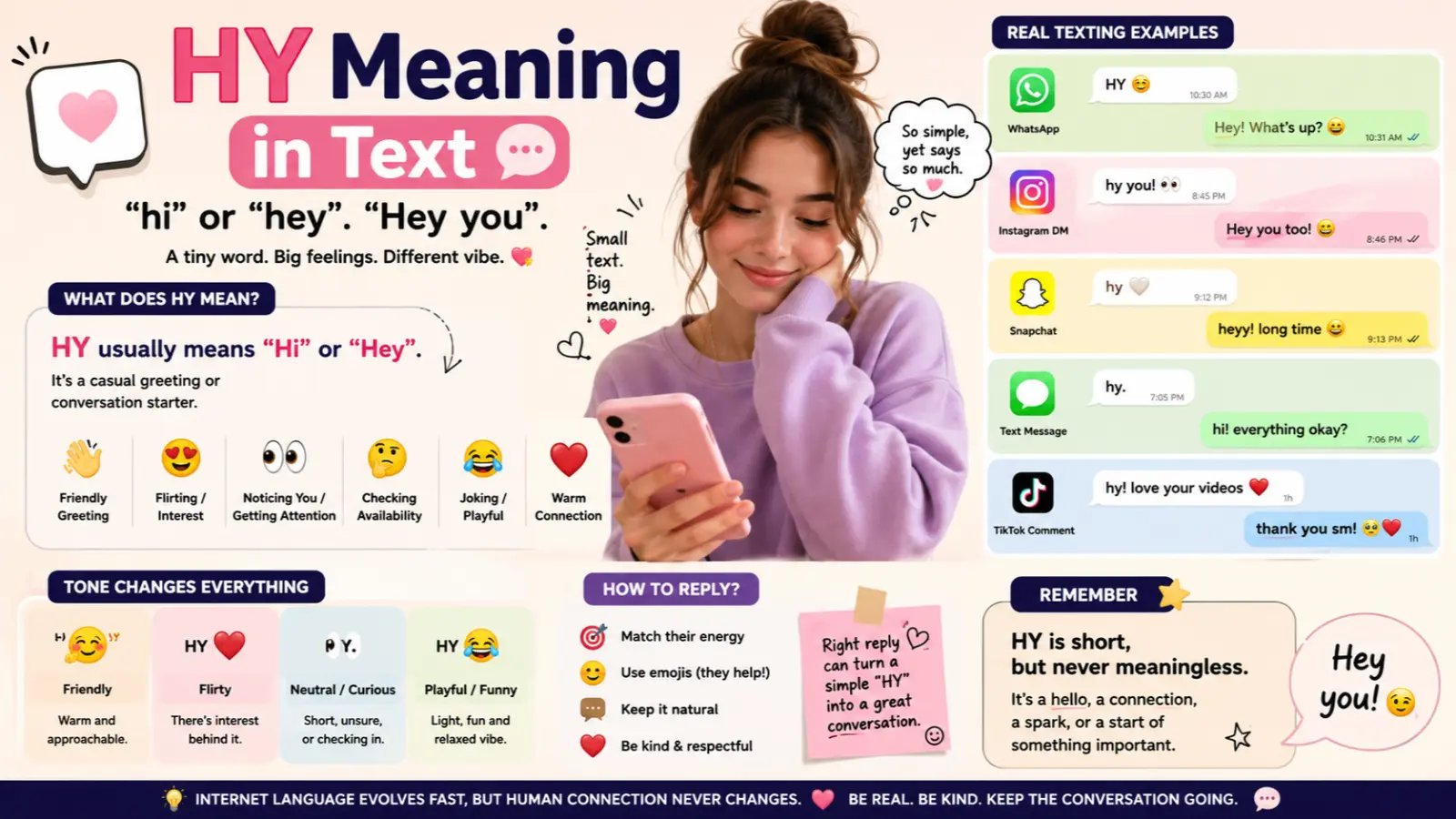
In texting, HY usually means “Hi” or “Hey.” It is simply an informal greeting that starts a conversation.
Depending on the situation, it may also express:
- Friendly greeting
- Excitement
- Flirting
- Checking if someone is online
- Casual conversation starter
- Warm attention
- Playful energy
Example:
HY! Long time no see.
Meaning:
“I’m saying hi and want to start talking.”
Although the word itself is simple, its emotional meaning depends entirely on the relationship, emojis, punctuation, and timing.
HY Meaning in Text as “Hi”
The most common hy meaning in text is simply another spelling of “hi.”
Many people accidentally or intentionally type hy instead of hi, especially on mobile keyboards.
Example:
HY! How are you?
Nothing complicated—it simply means the person is greeting you.
HY Meaning in Text as “Hey”
Another popular meaning is “hey.”
Compared to “hi,” “hey” often feels slightly warmer, more casual, and more personal.
Example:
HY 😊
This often sounds like:
“Hey! I wanted to talk to you.”
Many teenagers and young adults use HY because it feels relaxed and less formal.
HY Meaning in Text as “Hey You”
Sometimes people write HY to mean “Hey you!”
This version feels more personal.
Example:
HY! Missed you today.
Here, the greeting isn’t just saying hello—it is aimed directly at one specific person.
It often carries curiosity, affection, or playful attention.
HY Meaning in Text for Flirting
When someone you like sends:
hy ❤️
the greeting becomes more than just “hello.”
The emotional intent might be:
- Starting a conversation
- Showing romantic interest
- Testing your response
- Getting your attention gently
The word itself stays simple, but emotions add meaning.
HY Meaning in Text to Check Availability
Sometimes people send only:
hy
Nothing else.
They’re waiting to see whether you’ll reply before continuing the conversation.
This is common among friends, classmates, coworkers, and dating partners.
What Does HY Mean in Text?
Simply put, HY usually means “Hi” or “Hey.”
Unlike many internet abbreviations, HY is not usually an acronym with a hidden meaning.
Instead, it is:
- A casual greeting
- A conversation starter
- A friendly opener
- A way to reconnect
- A low-pressure way to begin chatting
Its meaning depends on:
- Who sent it
- Your relationship
- The conversation
- Emojis
- Time of day
- Overall tone
Origin & Background
Unlike traditional abbreviations, HY became popular because of fast mobile typing and informal internet culture.
As texting became common, people started experimenting with spellings:
- hi
- hey
- heyy
- hii
- hiii
- hy
Social media encouraged these creative variations.
Platforms like TikTok, Snapchat, Instagram, Discord, and WhatsApp made short greetings feel more natural than complete sentences.
Meme culture also helped normalize unconventional spellings. Today, nobody is surprised when someone simply says “hy.”
Online language evolves incredibly fast. A tiny spelling change can become part of internet culture almost overnight.
Real-Life Conversations
Sarah: HY 😊
Emma: Hey! Finally you’re awake.
Instagram DM
HY! Loved your latest post.
Thanks! Glad you liked it.
TikTok Comments
HY! Your videos always make my day.
Aww thank you ❤️
Text Message
HY.
Hey! Everything okay?
Group Chat
HY everyone!
Morning!!
Emotional Pattern
Notice something interesting?
People rarely use HY to communicate information.
Instead, they use it to create connection.
The greeting opens the emotional door before the real conversation begins.
Emotional & Psychological Meaning
Greetings may seem ordinary, but psychologically they’re powerful.
When someone sends HY, they’re often saying:
“I’m thinking about you.”
“I want your attention.”
“I’d like to talk.”
“I hope you’re available.”
Even a tiny greeting reduces social distance.
Imagine two friends who haven’t spoken for months.
One finally sends:
“hy”
That’s all.
It looks simple.
But emotionally it can mean:
“I miss talking.”
“I’m nervous.”
“I hope we’re still okay.”
Dating works similarly.
Someone interested in another person often starts with a harmless greeting before revealing their real reason for texting.
HY creates emotional safety.
Instead of jumping into serious topics, it eases people into conversation.
That’s the deeper psychology behind it.
Usage in Different Contexts
Social Media
HY appears everywhere:
- Instagram DMs
- Snapchat
- TikTok
- Facebook Messenger
- Discord
Usually it’s simply a friendly opener.
Friends & Relationships
Among friends:
HY means:
“Let’s chat.”
Among couples:
HY may carry affection.
Example:
HY ❤️
Missing you already.
Work or Professional Settings
Avoid using HY in professional emails.
Instead use:
- Hello
- Hi
- Good morning
Professional communication values clarity and formality.
Casual vs Serious Tone
Casual
HY 😂
Feels playful.
Serious
HY.
Can sound like someone wants an important conversation.
Context completely changes interpretation.
When NOT to Use It
Avoid using HY in:
- Business emails
- Job applications
- Academic writing
- Customer service
- Emotional arguments
- Conversations with people unfamiliar with texting slang
- Cross-cultural communication where spelling differences may confuse readers
A casual greeting isn’t always appropriate.
Context protects meaning.
Common Misunderstandings
Many people misunderstand HY.
Myth: HY always has a hidden meaning.
Reality:
Most of the time it simply means “Hi.”
Myth: HY is rude.
Reality:
Usually it’s friendly.
Myth: HY means flirting.
Reality:
Only if the surrounding conversation suggests romantic interest.
Myth: Everyone uses HY the same way.
Reality:
Age, culture, and platform all influence interpretation.
Comparison Table
| Expression | Meaning | Tone | Usage Context |
|---|---|---|---|
| HY | Hi / Hey | Friendly | Everyday texting |
| Hi | Standard greeting | Neutral | Everywhere |
| Hey | Casual greeting | Warm | Friends |
| Heyy | Friendly attention | Playful | Social media |
| Hiii | Excited greeting | Very warm | Close friends |
| Yo | Informal greeting | Relaxed | Friends |
The extra letters often change emotional intensity rather than dictionary meaning.
Variations & Types
Common variations include:
- hi
- hey
- heyy
- heyyy
- hii
- hiii
- hyyy
- hey you
- hy 😊
- hy ❤️
- hy lol
Each variation changes emotional energy.
More repeated letters usually show greater excitement or affection.
Emojis further strengthen emotional tone.
How to Respond When Someone Uses It
Casual Replies
- Hi!
- Hey!
- Hello!
- What’s up?
Funny Replies
- Well, look who finally texted!
- Survived another Monday?
- Fancy seeing you here.
Mature Replies
- Hi! Hope you’re doing well.
- Nice hearing from you.
Respectful Replies
- Hello, how can I help?
- Hi, thanks for reaching out.
Matching the other person’s energy often makes conversations feel more natural.
Regional & Cultural Usage
Western Culture
HY is widely understood as an informal greeting among younger internet users.
Asian Culture
Many English learners use HY because it resembles “Hi” while remaining quick to type.
Middle Eastern Culture
Young social media users frequently mix HY with emojis and local languages.
Global Internet Usage
Social media has erased many language barriers.
Whether someone lives in New York, Karachi, London, or Manila, HY usually communicates the same friendly intention.
Generational Differences
Gen Z
Uses HY naturally across multiple apps.
Millennials
Often switch between Hi, Hey, and HY.
Older Generations
Usually prefer standard greetings like Hello or Hi.
Language reflects identity.
Younger users constantly reshape internet communication through creative spelling.
Is It Safe for Kids?
Yes.
HY is generally harmless.
However, parents should still encourage children to:
- Talk respectfully online.
- Avoid chatting with strangers.
- Understand digital etiquette.
- Recognize when casual conversations become uncomfortable.
The greeting itself isn’t risky.
The surrounding conversation matters much more.
Frequently Asked Questions
What is the most common HY meaning in text?
It usually means “Hi” or “Hey.”
Is HY rude?
No. It is generally considered a friendly greeting.
Does HY mean flirting?
Not automatically. Flirting depends on the overall conversation and tone.
Why do people type HY instead of HI?
Mostly because of personal texting style, fast typing, or internet habits.
Is HY popular on TikTok and Snapchat?
Yes. Short greetings are common across nearly every social media platform.
Can I use HY at work?
It’s better to use “Hi” or “Hello” in professional settings.
Conclusion
Understanding hy meaning in text is easier once you look beyond the letters themselves. In most conversations, HY simply means “Hi” or “Hey,” while in more personal chats it can also feel like “Hey you,” showing warmth, curiosity, or a desire to connect. Its meaning comes from the people, emotions, and context surrounding it—not just the spelling.
Modern internet language proves that even the smallest greeting can carry personality, emotion, and intention. If you’re messaging a close friend, reconnecting with someone special, or starting a new conversation, hy meaning in text reminds us that simple words often create the strongest connections. Sometimes, one tiny “HY” is all it takes to begin a meaningful conversation.

I’m Grace Punston, a playful writer with a passion for clever puns and joyful wordplay. I love crafting witty lines that make readers grin and giggle. My goal is to spread laughter through smart, lighthearted writing. Every pun I share is a little spark of fun meant to brighten your day.