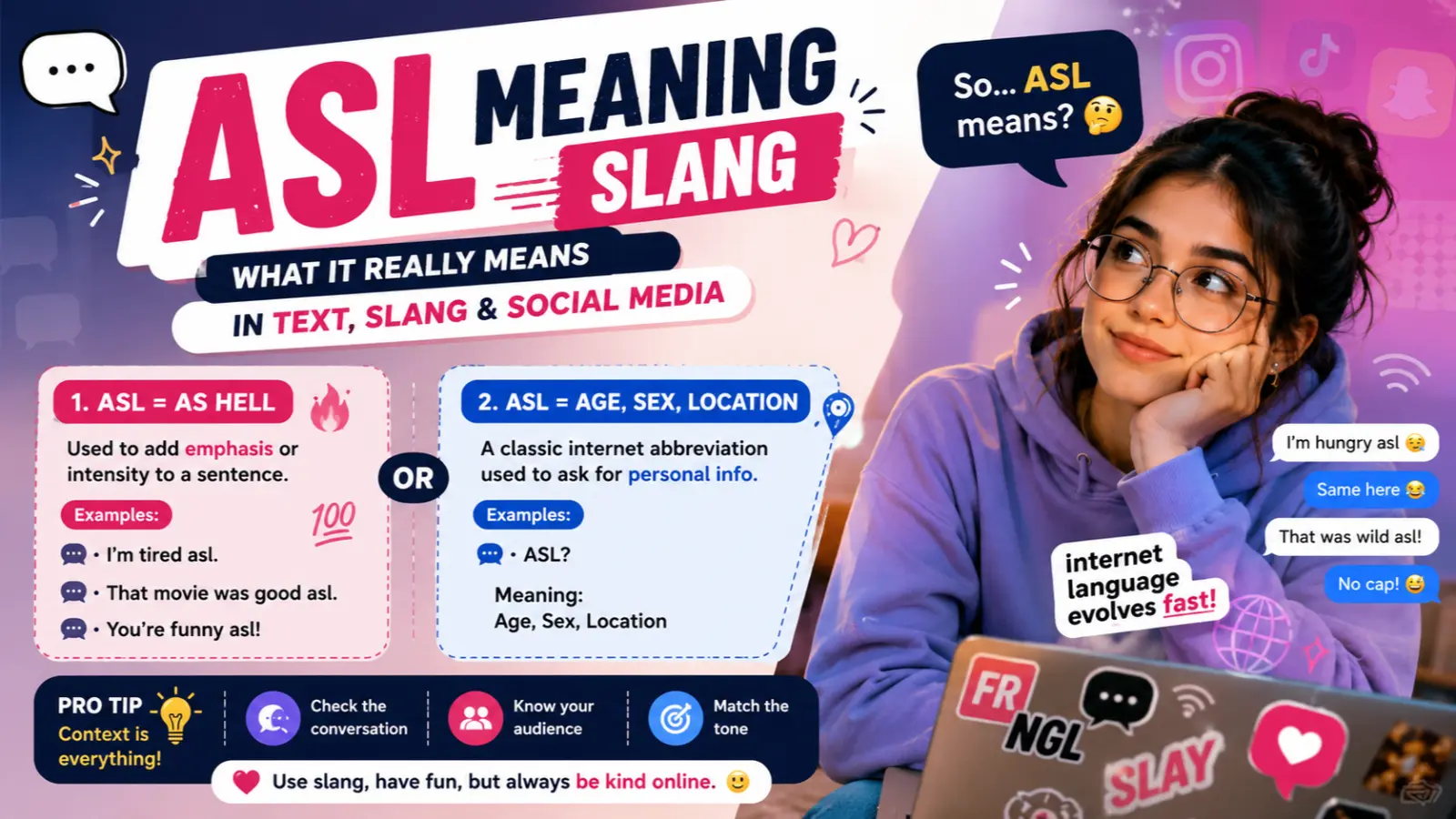
asl meaning slang is one of those internet phrases that can completely change meaning depending on where you see it.
Imagine opening a text that says:
- “I’m tired asl.”
- “ASL?”
- “That movie was funny asl.”
Now you’re wondering…
Does it mean Age, Sex, Location?
Or does it mean As Hell?
If you’ve searched this phrase after seeing it on TikTok, Snapchat, Instagram, Discord, or in a text conversation, you’re definitely not alone. Internet slang evolves incredibly fast, and the same three letters can carry two completely different meanings depending on the conversation.
Understanding the emotional tone behind ASL is just as important as understanding the words themselves. Sometimes it’s simply asking for basic information. Other times it’s adding emphasis, humor, exaggeration, or personality to a message.
Let’s break it down in a way that actually makes sense.
Quick Definition
ASL Meaning Slang has several meanings, and understanding the situation is the key.
- As Hell – Used to make a feeling or description stronger.
- Age, Sex, Location – A classic internet question from early chatrooms.
- American Sign Language – The primary sign language used by many Deaf people in the United States.
- Awful Sex Life – A humorous or sarcastic phrase used in jokes or memes.
Example
- “I’m tired asl.” → As Hell
- “ASL?” → Age, Sex, Location
- “She’s learning ASL.” → American Sign Language
- “He says his ASL is terrible.” → Awful Sex Life (joking)
At its heart, ASL is about expressing meaning quickly, but context determines which meaning is intended.
ASL Meaning Slang as “As Hell”
Among Gen Z and TikTok users, ASL most commonly means “as hell.” Instead of writing the full phrase, people shorten it to “asl” for speed and style.
Examples
- “That movie was scary asl.”
- “I’m hungry asl.”
- “Your new haircut is clean asl.”
Here, ASL intensifies emotions. It can express excitement, frustration, admiration, or even exaggeration. This modern slang pronunciation became popular on social media because “asl” sounds similar to “as hell” when spoken casually.
ASL Meaning Slang as “Age, Sex, Location”
Before social media existed, internet users met in chatrooms like AOL, MSN Messenger, and IRC. One of the first questions strangers asked was:
“ASL?”
It simply meant:
- Age
- Sex
- Location
Example:
A: Hi! ASL?
B: 22/F/Chicago.
This abbreviation helped people introduce themselves quickly online and became one of the earliest internet slang terms.
ASL Meaning Slang as American Sign Language
Not every appearance of ASL is slang.
Sometimes, it refers to American Sign Language, a complete and natural language used by the Deaf community.
Examples:
- “I’m taking ASL classes this semester.”
- “She communicates using ASL.”
This meaning has nothing to do with texting slang, so readers should always look at the surrounding words before assuming the meaning.
ASL Meaning Slang as “Awful Sex Life”
Occasionally, people use ASL humorously to mean “Awful Sex Life.”
This is not a common dictionary definition but appears in jokes, memes, or sarcastic conversations.
Example:
- “His dating stories explain his ASL.”
Because this meaning is uncommon, readers should avoid assuming it unless the conversation is clearly about dating, relationships, or humor.ormal.
ASL Meaning When Noticing Something
Sometimes ASL highlights how strongly someone notices a situation.
Example:
“That line is long asl.”
The speaker is emphasizing just how noticeable something feels.
ASL Meaning When Reacting
People often react emotionally with ASL.
Example:
“That’s crazy asl.”
Instead of calmly saying something is surprising, ASL adds excitement.
ASL Meaning as a Compliment
Friends sometimes use it positively.
Example:
“You’re talented asl.”
It means the compliment feels stronger and more genuine.
ASL Meaning as an Insult
Like many slang expressions, ASL can also strengthen criticism.
Example:
“He’s annoying asl.”
The abbreviation simply intensifies the opinion.
ASL Meaning When Joking
Humor is one of the biggest reasons people use ASL.
Example:
“Bro was running fast asl 😂”
The exaggeration makes the joke funnier.
ASL Meaning When Exposing Someone
Internet users sometimes use ASL while calling out behavior.
Example:
“He’s lying asl.”
The phrase adds confidence to the accusation.
ASL Meaning While Flirting
Flirty conversations often include ASL.
Example:
“You’re cute asl.”
Here it adds playful emphasis.
ASL Meaning as Emotional Expression
Whether someone feels excited, frustrated, shocked, embarrassed, or impressed, ASL works as emotional amplification.
At its core, asl meaning slang is about adding emotion, intensity, or requesting personal information depending on context.
What Does asl meaning slang Mean in Text?
In texting, ASL almost always depends on the sentence.
If someone sends:
“I’m bored asl.”
They mean:
“I’m very bored.”
If someone simply texts:
“ASL?”
They’re asking:
- Age
- Sex
- Location
Context tells you everything.
Gen Z usually interprets it as As Hell, while older internet users often remember the classic Age, Sex, Location meaning.
Origin & Background
The history of ASL perfectly shows how internet language evolves.
During the late 1990s and early 2000s, online chat rooms were filled with strangers trying to introduce themselves quickly.
Typing:
ASL?
Saved time.
Instead of writing three separate questions, people simply used those three letters.
Years later, TikTok, Twitter, Snapchat, and texting culture gave ASL a completely new life.
Young users began shortening “As Hell” into ASL because it was faster, funnier, and fit the internet’s love for abbreviations.
Memes accelerated its popularity. Viral captions, reaction posts, and comment sections helped millions of users adopt the new meaning.
Online language changes incredibly fast. A single abbreviation can gain an entirely new identity within just a few years.
Real-Life Conversations
WhatsApp Chat
Friend:
“I’m sleepy asl.”
You:
“Go take a nap already.”
Instagram DM
Person A:
“You look good asl.”
Person B:
“Stop making me blush 😂”
TikTok Comment
“That transition is smooth asl.”
Text Message
“I’m nervous asl before tomorrow.”
“I know. You’ll do great.”
Group Chat
“Dude is late asl.”
“Nothing new 😂”
In every example, ASL makes emotions feel bigger, more expressive, and more relatable.
Emotional & Psychological Meaning
Slang isn’t only about saving time.
It’s about expressing feelings.
When someone says:
“I’m stressed asl.”
They’re usually looking for understanding, not just describing stress.
Similarly,
“You’re funny asl.”
Feels warmer than simply saying,
“You’re funny.”
The extra emphasis creates emotional connection.
People use slang because it helps them sound authentic, relaxed, and socially connected.
Imagine two coworkers texting after work.
One writes:
“Today was exhausting.”
Another says:
“Today was exhausting asl.”
The second message instantly feels more personal and emotionally honest.
That’s the deeper psychology behind it.
Usage in Different Contexts
Social Media
ASL appears constantly in captions, comments, memes, and reaction posts.
Example:
“This trend is addictive asl.”
Friends & Relationships
Friends use it naturally.
“You’ve changed asl.”
Dating conversations also include compliments.
“You’re gorgeous asl.”
Work or Professional Settings
Avoid ASL in emails, reports, presentations, or professional chats.
Instead, write complete words.
Casual vs Serious Tone
Casually:
“I’m tired asl.”
Serious discussion:
“I’m extremely exhausted.”
Context completely changes whether ASL sounds natural or inappropriate.
When NOT to Use It
Avoid using ASL when:
- Writing professional emails
- Talking to clients
- Speaking with teachers
- Communicating during serious conflicts
- Messaging older relatives unfamiliar with internet slang
- Cross-cultural conversations where abbreviations may confuse people
Remember:
Context protects meaning.
Common Misunderstandings
Many people think ASL always means Age, Sex, Location.
Not anymore.
Others assume ASL is rude.
It usually isn’t.
Some believe it contains profanity.
“As Hell” is informal but commonly accepted in casual internet conversations.
Others misunderstand sarcasm.
Depending on tone, ASL may be humorous, dramatic, affectionate, or exaggerated.
Comparison Table
| Expression | Meaning | Tone | Usage Context |
|---|---|---|---|
| ASL | As Hell / Age, Sex, Location | Casual | Texting, Social Media |
| AF | As F*** | Strong | Friends, Memes |
| FR | For Real | Honest | Conversations |
| NGL | Not Gonna Lie | Personal | Opinions |
| IMO | In My Opinion | Neutral | Discussions |
| TBH | To Be Honest | Honest | Social Media |
Although many abbreviations express emotion, ASL often feels lighter and more playful than stronger alternatives like AF.
Variations & Types
Common internet variations include:
- funny asl
- tired asl
- hungry asl
- cute asl
- loud asl
- weird asl
- happy asl
- broke asl
- old-school ASL? (Age, Sex, Location)
- meme exaggerations like “fast asl”
Each variation slightly changes emotional intensity while keeping the same conversational style.
How to Respond When Someone Uses It
Casual Replies
- Same here.
- I know.
- Totally.
Funny Replies
- You’re dramatic 😂
- Facts.
- No lies detected.
Mature Replies
- I understand how you feel.
- That sounds difficult.
Respectful Replies
- Hope everything gets better.
- Thanks for sharing.
Matching the other person’s emotional energy usually creates the best conversation.
Regional & Cultural Usage
Western Culture
Young English speakers mostly interpret ASL as As Hell.
Asian Culture
Many people recognize ASL through TikTok, gaming communities, and global social media.
Middle Eastern Culture
English-speaking youth increasingly use ASL in casual online conversations, while many older users still associate it with Age, Sex, Location.
Global Internet Usage
Thanks to TikTok, Instagram, YouTube, and online gaming, ASL has become part of global digital communication.
The internet spreads slang faster than any dictionary ever could.
Generational Differences
Gen Z
Uses ASL mostly as As Hell.
Millennials
Usually understand both meanings depending on context.
Older Generations
Often recognize only the original Age, Sex, Location meaning from early internet chat rooms.
Language has become part of online identity, and every generation gives familiar abbreviations new life.
Is It Safe for Kids?
Generally, yes.
When ASL means As Hell, it’s usually harmless informal slang.
However, parents should remind children that:
- slang changes quickly
- not every audience understands abbreviations
- teasing can become hurtful
- professional communication requires different language
Teaching context is more valuable than banning slang altogether.
Frequently Asked Questions
What does asl meaning slang mean?
It usually means either As Hell or Age, Sex, Location, depending on the conversation.
Is ASL rude?
Not necessarily. “As Hell” is informal but commonly used among friends online.
Why do people use ASL in texting?
It makes messages shorter, more expressive, and emotionally engaging.
Why is ASL popular on TikTok?
TikTok encourages quick, catchy language, making abbreviations like ASL spread rapidly.
Which generation uses ASL the most?
Gen Z uses “As Hell” most frequently, while Millennials often recognize both meanings.
Can I use ASL at work?
It’s better to avoid internet slang in professional communication unless you’re certain everyone understands the context.
Conclusion
Understanding asl meaning slang is about more than decoding three letters. Depending on the conversation, it can mean “As Hell,” adding emotional emphasis, humor, or excitement, or it can refer to the classic “Age, Sex, Location“ question from the early days of online chat.
Modern internet language reflects how people connect, joke, flirt, and express emotions in a fast-moving digital world. Recognizing the context behind ASL helps you communicate more naturally and avoid misunderstandings.
As online culture continues to evolve, today’s slang becomes tomorrow’s history—but the human need to express emotion, identity, and connection through language never changes.

I’m Grace Punston, a playful writer with a passion for clever puns and joyful wordplay. I love crafting witty lines that make readers grin and giggle. My goal is to spread laughter through smart, lighthearted writing. Every pun I share is a little spark of fun meant to brighten your day.