SMH meaning in text is one of those internet phrases you’ve probably seen hundreds of times but may have paused to decode the first time you encountered it.
Imagine you’re scrolling through a group chat and someone writes:
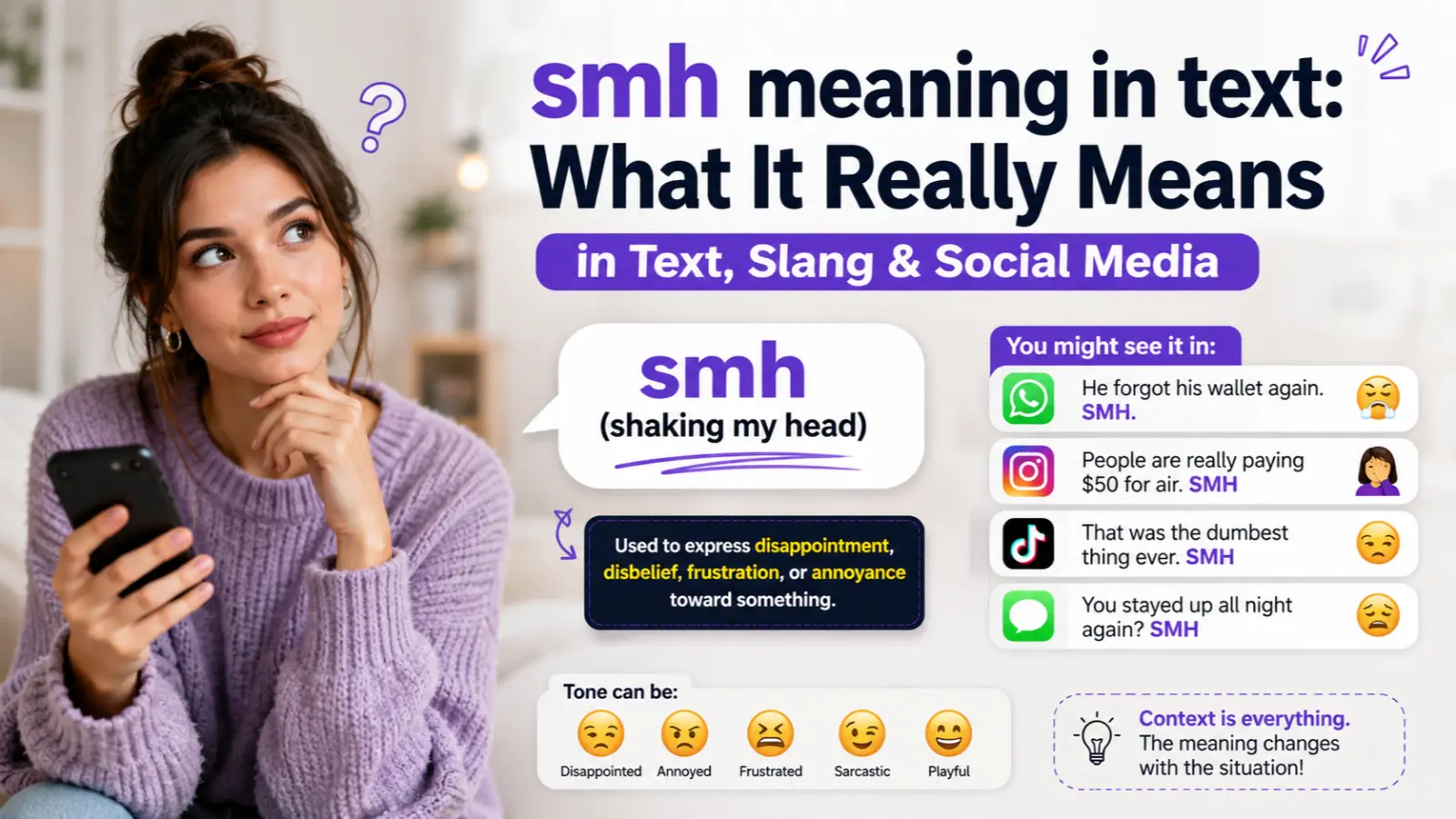
- “He forgot his wallet again. SMH.”
- “You really believed that fake giveaway? smh 😂”
- “She missed the train because she was watching TikTok. SMH.”
At first glance, it can feel confusing. Is it an insult? A joke? A sign of disappointment? Or maybe something else entirely?
The truth is that SMH is much more than a simple abbreviation. It’s a quick emotional reaction that helps people express frustration, disbelief, embarrassment, annoyance, or even playful disappointment without typing a full sentence.
In today’s fast-moving digital world, where reactions matter as much as words, understanding internet slang like SMH helps you better understand conversations, memes, social media culture, and the emotional signals hidden behind short messages.
If you’ve searched for SMH because you saw it on TikTok, Instagram, Snapchat, WhatsApp, or in a text message, you’re definitely not alone.
👉 Let’s break it down in a way that actually makes sense.
Quick Definition
SMH stands for “Shaking My Head.”
People use it when they want to show disappointment, disbelief, frustration, embarrassment, or mild judgment toward a situation, person, or event.
Shaking My Head as a Reaction
The most common use of SMH is reacting to something that seems foolish, surprising, or disappointing.
Example:
“You’re telling me you studied the wrong chapter? SMH.”
Shaking My Head as Disappointment
Sometimes SMH expresses frustration toward someone’s actions.
Example:
“You forgot my birthday again. SMH.”
Shaking My Head as a Joke
Friends often use SMH playfully.
Example:
“You ate the entire pizza by yourself? SMH 😂”
Shaking My Head as Friendly Teasing
Among close friends, SMH can be lighthearted rather than critical.
Example:
“You still don’t know how to mute Zoom meetings? SMH.”
Shaking My Head as Social Commentary
People frequently use SMH to react to news, trends, or viral content.
Example:
“People are paying $50 for a bottle of air. SMH.”
Shaking My Head as Emotional Expression
Instead of explaining disappointment in detail, people simply type SMH.
Example:
“Another delayed flight. SMH.”
At its core, SMH communicates:
“I can’t believe this happened.”
What Does SMH Mean in Text?
When someone uses SMH in a text message, they’re usually expressing a negative reaction without directly arguing or criticizing.
Think of it as the digital version of physically shaking your head when you witness something surprising, disappointing, or ridiculous.
The exact meaning depends on context:
- Disbelief
- Frustration
- Disappointment
- Embarrassment
- Mild annoyance
- Sarcasm
- Playful teasing
For example:
“You spent your entire paycheck on snacks? SMH.”
The sender is likely surprised and slightly judgmental, but possibly joking too.
Origin & Background
SMH originated in early internet messaging culture and online forums.
Long before TikTok and Instagram existed, internet users looked for faster ways to express emotions through text. Since physical gestures couldn’t be seen online, abbreviations became substitutes for real-world reactions.
Just as LOL represented laughter and OMG represented surprise, SMH became the shorthand version of physically shaking your head.
The phrase gained popularity through:
- Online forums
- Chat rooms
- Twitter (now X)
- Meme culture
- Snapchat
- TikTok
As social media evolved, SMH became a universal reaction meme.
Today, a single “SMH” can communicate an entire emotional response more efficiently than a paragraph.
One fascinating thing about internet language is that meanings evolve incredibly fast. Words that start as abbreviations often become emotional symbols that carry much deeper social meaning than their original definitions.
Real-Life Conversations
WhatsApp Chat
Friend 1: “I left my phone in the fridge.”
Friend 2: “SMH. How do you even do that?”
Instagram DM
Person A: “I accidentally liked a photo from 2018.”
Person B: “SMH 😂 That’s embarrassing.”
TikTok Comment
Creator: “I spent $300 on mystery boxes.”
Comment: “SMH. Influencer behavior.”
Text Message
Mom: “You forgot to take out the trash.”
Son: “SMH, I knew I forgot something.”
Group Chat
Friend: “I stayed up until 4 AM watching conspiracy videos.”
Group: “SMH.”
The emotional pattern is consistent. SMH usually signals disbelief, frustration, or playful judgment while keeping the conversation light.
Emotional & Psychological Meaning
SMH is interesting because it does more than communicate information.
It communicates emotion.
When someone uses SMH, they often avoid direct confrontation while still expressing how they feel.
Awareness
SMH signals that the person recognizes something unusual or problematic.
Humor
Many people use SMH to make criticism feel lighter and funnier.
Sarcasm
SMH often adds a sarcastic edge to conversations.
Social Intelligence
People who understand internet culture recognize SMH as a subtle emotional cue.
Emotional Protection
Instead of saying:
“I’m disappointed in you.”
Someone may simply write:
“SMH.”
This softens the emotional impact.
Confidence
Using SMH can sometimes position the speaker as the observer who recognizes an obvious mistake.
Imagine a friend who repeatedly forgets important deadlines.
After the third missed deadline, another friend texts:
“SMH, this is becoming a pattern.”
The message expresses concern, frustration, and mild judgment simultaneously.
👉 That’s the deeper psychology behind it.
Usage in Different Contexts
Social Media
SMH appears constantly on:
- TikTok
- X
Example:
“Another influencer apology video. SMH.”
Friends & Relationships
Friends use SMH frequently for teasing.
Example:
“You forgot your own birthday plans? SMH.”
In relationships, tone matters greatly.
Example:
“SMH, you never listen.”
This feels more serious.
Work or Professional Settings
SMH is generally inappropriate in professional communication.
Avoid:
“Client changed requirements again. SMH.”
Instead, use professional language.
Casual vs Serious Tone
Casual:
“SMH 😂”
Serious:
“SMH. This isn’t acceptable.”
The punctuation changes everything.
When NOT to Use It
Avoid using SMH in:
Formal Environments
Professional emails should remain clear and respectful.
Emotional Conflicts
During serious disagreements, SMH can appear dismissive.
Workplace Communication
It may seem unprofessional.
Older Audiences
Not everyone understands internet slang.
Cross-Cultural Conversations
Some people may misinterpret the meaning.
👉 Context protects meaning.
Common Misunderstandings
It Always Means Anger
False.
SMH often expresses mild disappointment rather than anger.
It’s Always Rude
False.
Many friends use it playfully.
It’s Only for Young People
False.
Many age groups use SMH online.
It Has One Fixed Meaning
False.
Context determines tone.
It’s an Insult
Not necessarily.
Sometimes it’s simply an observation.
Comparison Table
| Expression | Meaning | Tone | Usage Context |
|---|---|---|---|
| SMH | Shaking My Head | Disappointed | Texting, social media |
| LOL | Laughing Out Loud | Funny | Casual chats |
| OMG | Oh My God | Surprise | Social media, texting |
| BRUH | Seriously? | Annoyed or amused | Friends, memes |
| FACEPALM | Embarrassment | Frustrated | Internet culture |
| WTF | Shock | Strong reaction | Informal conversations |
The biggest difference is that SMH combines disappointment and disbelief in a softer, socially acceptable way.
Variations & Types
smh
The standard version.
SMHHH
Extra letters increase emotional intensity.
Example:
“SMHHHH what are you doing?”
smh lol
Combines disappointment and humor.
smh my head
A humorous internet joke because it technically means “shaking my head my head.”
SMH 😂
Shows playful frustration.
SMH Bro
Adds a conversational tone.
Each variation slightly changes the emotional energy behind the message.
How to Respond When Someone Uses It
Casual Replies
- “I know, right?”
- “My bad.”
- “You’re not wrong.”
Funny Replies
- “Let me make worse decisions in peace.”
- “I specialize in poor choices.”
Mature Replies
- “Fair point.”
- “I understand your frustration.”
Respectful Replies
- “I’ll do better next time.”
- “Thanks for pointing that out.”
Matching the other person’s energy helps maintain smooth communication.
Regional & Cultural Usage
Western Culture
SMH is widely understood in texting and social media culture.
Asian Culture
Young internet users commonly recognize SMH through global platforms.
Middle Eastern Culture
English-speaking social media users frequently use SMH in online discussions.
Global Internet Usage
TikTok, Instagram, and meme culture have transformed SMH into a globally recognized reaction.
Digital language increasingly crosses cultural boundaries through social media.
Generational Differences
Gen Z
Uses SMH naturally and frequently.
Often combines it with memes and emojis.
Millennials
Commonly understand and use SMH in texting.
Older Generations
May recognize it but use it less often.
Language often reflects identity, and internet slang helps younger generations create shared cultural signals.
Is It Safe for Kids?
Generally, yes.
SMH is considered harmless internet slang.
However, parents should understand that:
- It can be used sarcastically.
- It may express criticism.
- It sometimes appears in teasing.
Teaching kids about tone and respectful communication is more important than banning harmless abbreviations.
Used responsibly, SMH is simply a modern way to express disappointment or disbelief.
FAQs
What does SMH mean in text?
SMH stands for “Shaking My Head.” It expresses disappointment, disbelief, frustration, or mild judgment.
Is SMH rude?
Not always. The tone depends entirely on context and relationship dynamics.
What does SMH mean on TikTok?
On TikTok, SMH usually reacts to surprising, ridiculous, embarrassing, or frustrating content.
Can SMH be used in professional messages?
Generally no. Professional communication should avoid slang abbreviations.
Do Gen Z users still say SMH?
Yes. Although slang changes rapidly, SMH remains widely recognized and used.
Is SMH the same as facepalm?
They’re similar, but facepalm often emphasizes embarrassment while SMH emphasizes disappointment and disbelief.
Conclusion
Understanding SMH meaning in text helps decode one of the internet’s most common emotional reactions. While SMH stands for “Shaking My Head,” its real power comes from the feelings behind it—disbelief, disappointment, sarcasm, humor, and social awareness.
Modern internet language isn’t just about shortening words. It’s about expressing emotions quickly, efficiently, and in ways that others instantly understand.
Whether you see SMH in a text message, TikTok comment, Instagram caption, or group chat, it usually signals that someone is reacting to something they find surprising, frustrating, embarrassing, or simply unbelievable.
In a world filled with fast-moving conversations, SMH remains a small phrase carrying a surprisingly large emotional message.
Sometimes one simple “SMH” says what an entire paragraph cannot.

I’m Grace Punston, a playful writer with a passion for clever puns and joyful wordplay. I love crafting witty lines that make readers grin and giggle. My goal is to spread laughter through smart, lighthearted writing. Every pun I share is a little spark of fun meant to brighten your day.