Ion Meaning in Text is one of those phrases you’ve probably seen in a message and paused for a second.
“ion wanna go out tonight”
“ion know what you mean”
“ion care fr”
At first glance, it looks like a typo… or maybe someone just forgot to type properly. But then you notice—it keeps showing up. Same spelling. Same vibe.
So what does ion actually mean? Is it lazy typing? Slang? Attitude?
And more importantly… what does it feel like when someone uses it?
Because online language isn’t just about words—it’s about tone, emotion, and identity.
👉 Let’s break it down in a way that actually makes sense.
Quick Definition
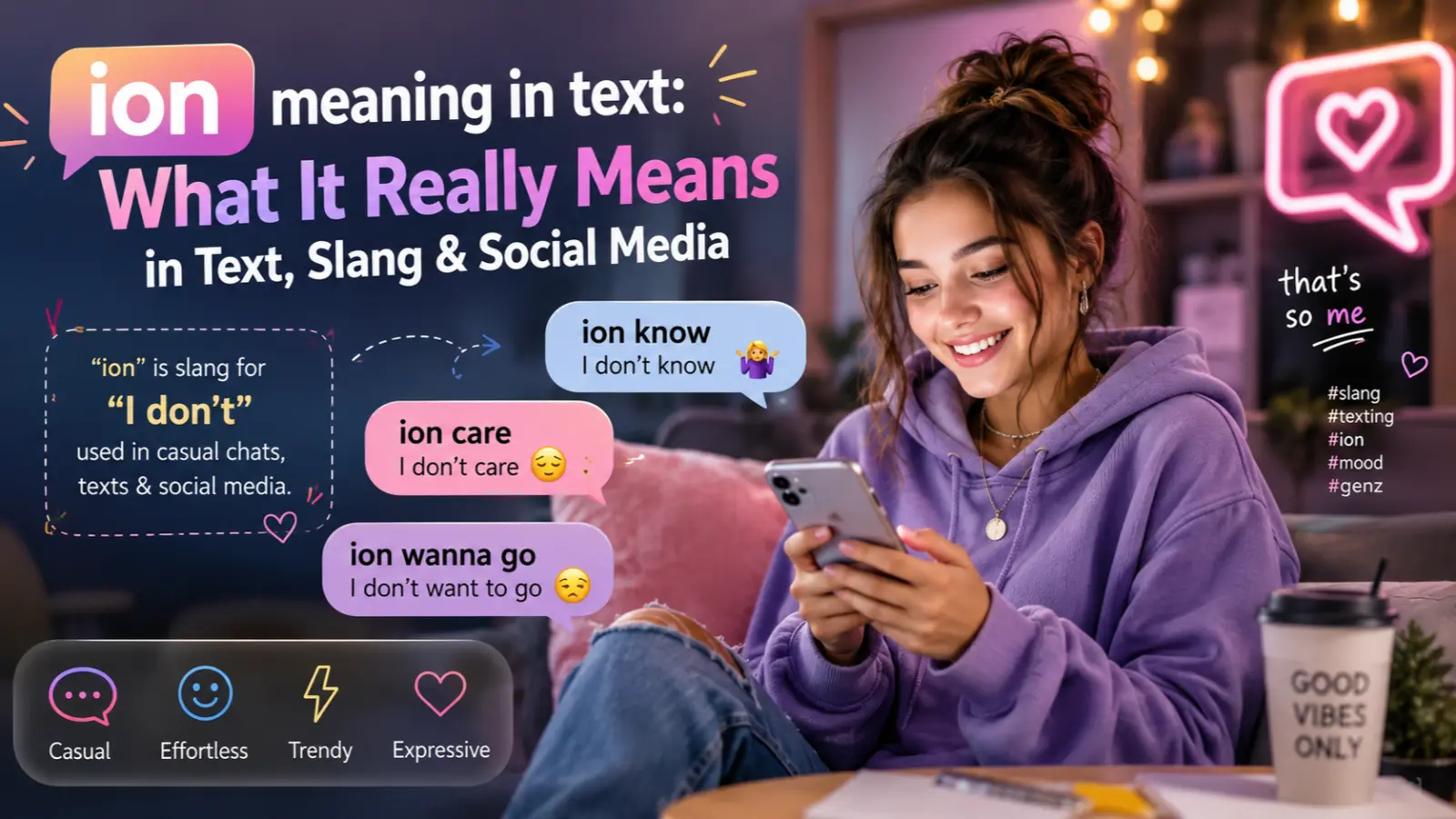
“ion” in texting is a slang shorthand for:
👉 “I don’t”
It’s commonly used in casual conversations, especially in:
- Text messages
- TikTok comments
- Instagram DMs
- Group chats
Core meanings depending on context:
- ion = I don’t want to → “ion wanna go”
- ion = I don’t know → “ion know bro”
- ion = I don’t care → “ion care tbh”
- ion = I don’t think so → “ion think that’s true”
Emotional tones it can carry:
- relaxed / chill
- slightly dismissive
- playful
- sarcastic
- emotionally distant
👉 At its core, “ion” isn’t just shortening words—it’s softening effort and adding attitude.
ion meaning in text – “I don’t”
This is the main meaning of “ion.”
It replaces “I don’t” in a casual, effortless way.
Examples:
- “ion like that movie”
- “ion wanna argue”
- “ion trust him”
Emotional vibe:
Using “ion” instead of “I don’t” feels:
- less formal
- more relaxed
- slightly detached
It’s like saying something without putting too much emotional weight into it.
ion meaning in text – “I don’t know”
Sometimes “ion” is followed by “know,” but often the “know” is implied.
Examples:
- “ion know what happened”
- “ion even know anymore”
Emotional meaning:
- confusion
- emotional overwhelm
- mental exhaustion
It can feel softer than saying “I don’t know,” almost like the person isn’t fully invested in explaining.
ion meaning in text – “In Other News”
Less commonly, ION (in uppercase) can mean:
👉 “In Other News”
Examples:
- “ION, did you see what happened yesterday?”
- “ION, I finally finished that show”
Emotional tone:
- shifting topic
- casual transition
- storytelling flow
This version is more structured and less slang-heavy than the lowercase “ion.”
What does ion mean in text?
In real conversations, “ion” is more about tone than literal meaning.
It signals:
- effortlessness
- emotional distance
- casual energy
- sometimes even coolness
It’s the digital version of a shrug.
Instead of saying:
“I don’t really feel like doing that.”
You just say:
👉 “ion feel like it”
Short. Smooth. No extra emotion.
Origin & Background
“Ion” comes from African American Vernacular English (AAVE), where spoken language often blends sounds naturally.
“I don’t” → pronounced quickly → “ion”
As texting evolved, people started typing how they speak.
Then platforms like:
- TikTok
- Twitter (X)
…pushed it into mainstream internet culture.
Memes, captions, and viral comments made “ion” feel:
- trendy
- expressive
- identity-driven
And here’s the truth about internet language:
👉 It spreads fast, changes faster, and sticks when it feels real.
Real-Life Conversations
WhatsApp Chat
Friend: “You coming tonight?”
You: “ion think so”
Instagram DM
Them: “Do you like him?”
You: “ion even know 😭”
TikTok Comment
Video: drama clip
Comment: “ion trust nobody after this”
Group Chat
Friend: “Let’s study”
You: “ion got the energy bro”
Emotional pattern behind usage:
People use “ion” when they want to:
- sound casual
- avoid over-explaining
- express low emotional investment
- keep things light
Emotional & Psychological Meaning
“Ion” is subtle—but powerful.
It can signal:
- emotional distance → “ion care”
- uncertainty → “ion know”
- low effort communication → minimal typing, minimal energy
- cool detachment → not trying too hard
Mini-story
You text someone you like:
“Do you miss me?”
They reply:
“ion know”
That hits differently.
It’s not a clear “no”… but it’s not warm either.
It creates ambiguity. And sometimes, that ambiguity is intentional.
👉 That’s the deeper psychology behind it.
Usage in Different Contexts
Social Media
- used heavily in comments and captions
- adds personality and relatability
- feels authentic and unfiltered
Example: “ion trusting anyone after this 😭”
Friends & Relationships
- casual conversations
- teasing and joking
- emotional avoidance sometimes
Example: “ion like you like that… or do I?”
Work or Professional Settings
Not appropriate.
“Ion” can come across as:
- unprofessional
- careless
- unclear
Casual vs Serious Tone
- casual → “ion care lol”
- serious → “I don’t agree with this decision”
Tone completely changes meaning.
When NOT to Use It
Avoid “ion” in:
- formal emails
- job communication
- serious arguments
- talking to elders
- cross-cultural conversations
It can feel:
- disrespectful
- confusing
- dismissive
👉 Context protects meaning.
Common Misunderstandings
❌ “Ion is just a typo”
No—it’s intentional slang.
❌ “It’s always rude”
Not always. Tone depends on context.
❌ “It means one thing only”
It can mean:
- I don’t
- I don’t know
- I don’t care
❌ “Everyone understands it”
Not true—especially older audiences.
Comparison Table
| Expression | Meaning | Tone | Usage Context |
|---|---|---|---|
| ion | I don’t | casual, detached | texting, social media |
| idk | I don’t know | neutral | general texting |
| nah | no | direct, sometimes blunt | casual बातचीत |
| I don’t | full phrase | clear, serious | formal & casual |
Insight:
“Ion” feels more emotionally distant than “I don’t,” and more stylish than “idk.”
Variations & Types
- ion know → confusion
- ion care → indifference
- ion wanna → lack of interest
- ion even… → emphasis (emotion or disbelief)
- ION (caps) → “In Other News”
Meme style:
- “ion trusting nobody ever again 💀”
- exaggerated, dramatic, humorous
How to Respond When Someone Uses It
Casual Replies
- “same tbh”
- “I feel that”
Funny Replies
- “ion believe you 😂”
- “ion reading all that 😭”
Mature Replies
- “Okay, no problem”
- “That’s fair”
Respectful Replies
- “Got it, thanks for letting me know”
👉 Matching energy matters. If they’re casual, stay casual. If it feels serious, shift tone.
Regional & Cultural Usage
Western Culture
- heavily used in Gen Z slang
- common in TikTok and urban communities
Asian Culture
- adopted through social media
- less frequent but growing
Middle Eastern Culture
- used in English-speaking youth circles
- mixed with local slang
Global Internet Usage
Social media has made “ion”:
- borderless
- culturally blended
- widely recognizable
Generational Differences
Gen Z
- uses “ion” naturally
- part of daily texting
Millennials
- understand it
- use it occasionally
Older Generations
- often confused
- may see it as incorrect English
👉 Language today is identity, not just grammar.
Is It Safe for Kids?
Mostly yes.
But watch for:
- teasing tone → “ion care about you”
- emotional misunderstanding
- online influence
It’s harmless—but tone matters.
FAQs
What does ion mean in text?
It usually means “I don’t” in a casual, slang form.
Is ion rude?
Not always. It depends on tone and context.
Why do people say ion instead of I don’t?
It feels faster, cooler, and more expressive.
What does ion mean on TikTok?
Same meaning—“I don’t”—often used in emotional or funny comments.
Can I use ion in professional messages?
No, it’s too informal.
Is ion Gen Z slang?
Yes, it’s widely used by Gen Z online.
Conclusion
ion meaning in text goes way beyond just “I don’t.”
It’s about:
- tone
- attitude
- emotional distance
- effortless communication
In a world where people text fast and feel deeply, slang like “ion” helps express both—at the same time.
Sometimes it’s casual.
Sometimes it’s protective.
it says more by saying less.
👉 Because in modern communication, even a small word like “ion” can carry a whole mood.

I’m Lila Wordsmith, a writer who finds magic in clever wordplay and heartfelt expressions. I love crafting puns, wishes, and quotes that make people feel connected and inspired. Every line I write is designed to bring a smile or spark a thought. Through my words, I hope to turn simple moments into something truly memorable.