You’re scrolling through messages late at night. Someone replies:
“that’s so cute uwu 🥺”
or
“miss you… uwu”
And suddenly you pause.
Wait… what does “uwu” actually mean here? It flirting? Is it joking? Is it cringe? Or weirdly… kind of sweet?
If you’ve ever felt that tiny moment of confusion mixed with curiosity, you’re not alone. The phrase “Uwu Mean in Text” , a cute, happy, or affectionate face , has quietly become one of the most emotionally expressive (and misunderstood) pieces of internet slang.
So what’s really going on behind those three little letters?
Let’s break it down in a way that actually makes sense.
Quick Answer:
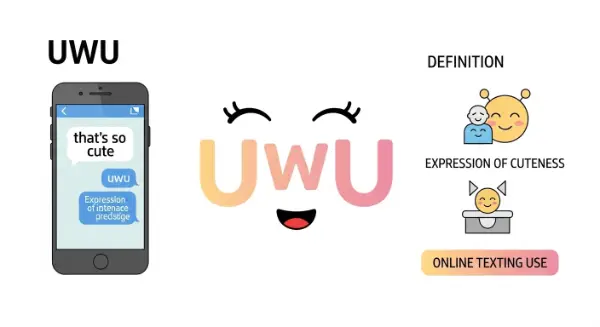
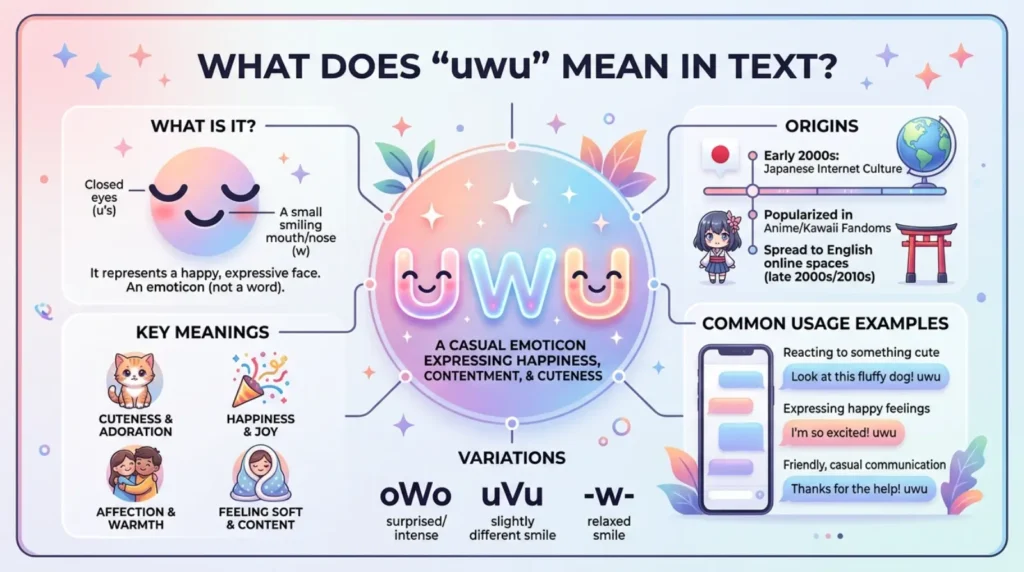
At its core, “uwu” is a text-based emoticon that represents a soft, happy, or affectionate facial expression.
Think of it like:
- Closed, smiling eyes → “u u”
- A small, content mouth → “w”
Together, it creates a vibe that feels:
- cute
- shy
- affectionate
- emotionally warm
- sometimes playful or flirty
But here’s where it gets interesting…
Depending on tone, “uwu” can also be used for:
- reacting to something adorable
- soft flirting
- joking in a slightly cringe way
- being intentionally dramatic
- teasing in a cute tone
- even ironic or sarcastic humor
Examples:
- “you remembered that? uwu” → soft appreciation
- “stoppp that’s too cute uwu” → emotional overload
- “fine… I forgive you uwu” → playful forgiveness
👉 The core emotional meaning?
“I feel something soft, cute, or affectionate right now.”
What Does Uwu Mean in Text
In texting, “uwu” isn’t just a face , it’s a feeling.
It usually signals:
- emotional softness
- vulnerability (in a light way)
- affection without being too serious
- a desire to sound cute or harmless
It’s often used when words alone feel too direct.
Instead of saying:
“I really like that, it made me happy”
People say:
“that made me happy uwu”
Why?
Because it softens the emotional intensity. It feels safer. Less exposed. More internet-coded.
Origin & Background
“Uwu” didn’t just randomly appear. It comes from early internet and anime culture.
Back in the 2000s, online communities—especially anime fans—started using text faces (kaomoji) to express emotions. Faces like:
- ^_^
- _<
- (◕‿◕)
“uwu” evolved from that same visual language.
It became popular in:
- anime forums
- Tumblr culture
- fan communities
- later TikTok and Discord
Over time, it spread into mainstream internet slang.
Then something interesting happened…
People started using it ironically.
What began as genuine cuteness turned into:
- self-aware cringe humor
- meme culture exaggeration
- playful overuse
That’s how “uwu” survived — by evolving.
👉 Internet language doesn’t stay still. It adapts faster than people do.
Real-Life Conversations
Here’s how “uwu” actually shows up in real life:
WhatsApp Chat
“you brought me food? uwu that’s so sweet”
Instagram DM
“your outfit today… uwu 🔥”
TikTok Comments
“this cat is illegal levels of cute uwu”
Text Message
“miss you… uwu”
Group Chat
“he finally replied uwu 😂”
After seeing these, a pattern becomes clear:
👉 “uwu” is rarely about the literal face.
👉 It’s about softening the emotional tone.
It makes messages feel:
- less serious
- more playful
- more emotionally expressive
Emotional & Psychological Meaning
Here’s where things get deeper.
When someone uses “uwu,” they’re often signaling:
- “I don’t want to sound too intense”
- “I’m expressing emotion, but safely”
- “I want this to feel cute, not awkward”
It acts like emotional cushioning.
Why people use it:
- to avoid sounding too direct
- to flirt without pressure
- to express affection casually
- to create a soft identity online
A small real-life moment:
Imagine someone texting their crush:
“I like talking to you”
That feels risky.
Now compare:
“I like talking to you uwu”
Suddenly it feels:
- lighter
- safer
- less serious
- more playful
Same emotion. Different delivery.
👉 That’s the deeper psychology behind it.
Usage in Different Contexts
Social Media
On platforms like TikTok and Instagram, “uwu” is often:
- exaggerated
- playful
- sometimes ironic
Example:
“this edit destroyed me uwu 😭”
Friends & Relationships
Among friends, it’s usually:
- teasing
- joking
- affectionate
Example:
“aww you care about me uwu”
Work or Professional Settings
Here’s the truth:
👉 It doesn’t belong here.
Using “uwu” in emails or professional chats can feel:
- immature
- confusing
- unprofessional
Casual vs Serious Tone
- Casual: “uwu” fits naturally
- Serious: it can feel tone-deaf
Example:
“sorry for your loss uwu” ❌ (completely wrong tone)
When NOT to Use It
Avoid “uwu” in:
- formal communication
- serious emotional situations
- arguments or conflicts
- professional environments
- conversations with older audiences
Because tone matters more than meaning.
👉 Context protects meaning.
Common Misunderstandings
1. “uwu always means flirting”
Not true. It can be friendly or playful too.
2. “uwu is always cringe”
Depends on usage. Irony changed that.
3. “uwu has a fixed meaning”
It’s fluid — tone decides everything.
4. “uwu is childish”
Sometimes. But also intentionally playful.
Comparison Table
| Expression | Meaning | Tone | Usage Context |
|---|---|---|---|
| uwu | Cute, soft emotion | Affectionate / playful | Casual chats, memes |
| owo | Surprise or curiosity | Slightly energetic | Reactions |
| :3 | Mischievous cuteness | Playful | Friends, jokes |
| 🥺 | Emotional vulnerability | Soft / pleading | Emotional texting |
| hehe | Light laughter | Casual | Friendly chats |
👉 “uwu” stands out because it blends emotion + identity + tone all at once.
Variations & Types
You’ll often see:
- UWU (uppercase) → exaggerated emotion
- uwuuuu → extra dramatic cuteness
- uwu~ → flirty tone
- “uwu girl/boy” → meme identity
- ironic uwu → used jokingly
Each variation shifts tone slightly—from sincere to sarcastic.
How to Respond When Someone Uses It
Casual Replies
- “lol okay uwu”
- “you’re funny 😂”
Funny Replies
- “stop being cute 💀”
- “this is illegal levels of uwu”
Mature Replies
- “haha I get what you mean”
- “that’s actually sweet”
Respectful Replies
- “I appreciate that”
- “that means a lot”
👉 Matching energy matters more than the words.
Regional & Cultural Usage
Western Culture
Used heavily in meme culture and irony.
Asian Culture
Closer to original anime-style emotional expression.
Middle Eastern Culture
Used mostly by younger, internet-savvy users.
Global Internet Usage
Now universal—but meaning shifts with tone and culture.
Social media erased borders, but not interpretation.
Generational Differences
Gen Z
Uses it naturally, often ironically.
Millennials
Understand it but use it less.
Older Generations
Often confused or unfamiliar.
👉 Language online isn’t just communication—it’s identity.
Is It Safe for Kids
Mostly, yes.
“uwu” is:
- harmless
- playful
- emotionally expressive
But watch for:
- overuse in teasing
- misunderstanding tone
- exposure to meme culture
Balance matters.
FAQs
1. What does uwu mean in texting?
It represents a cute, happy, or affectionate feeling.
2. Is uwu flirting?
Sometimes, but not always. It depends on context.
3. Is uwu rude?
No. But it can feel inappropriate in serious situations.
4. Why do people use uwu on TikTok?
To express exaggerated emotion or meme humor.
5. Can I use uwu at work?
Not recommended. It’s too casual.
6. Is uwu cringe?
Only if used without awareness. Irony makes it acceptable.
Conclusion
The phrase “Uwu Mean in Text” , a cute, happy, or affectionate face , is more than just internet slang.
It’s a reflection of how people:
- soften emotions
- protect vulnerability
- play with identity
- communicate without saying too much
In a world where texting replaces real expressions, something as simple as “uwu” carries tone, feeling, and intention all at once.
And maybe that’s why it sticks.
Because sometimes…
it’s easier to say “uwu” than to say how you really feel.

I’m Grace Punston, a playful writer with a passion for clever puns and joyful wordplay. I love crafting witty lines that make readers grin and giggle. My goal is to spread laughter through smart, lighthearted writing. Every pun I share is a little spark of fun meant to brighten your day.