what does etc mean in text is one of those tiny internet questions that usually comes from a moment of confusion in a chat.
You’re scrolling through messages like:
- “I need pens, notebooks, glue, etc.”
- “We talked about school, exams, life etc”
- “She was like annoying, dramatic, toxic etc lol”
And suddenly you pause.
Wait… what exactly does etc mean here? it formal? Is it lazy typing? Is it secretly shade? Or just one of those “you get the idea” shortcuts people use when they don’t feel like finishing the sentence?
That’s where the curiosity kicks in. Because online, even small abbreviations carry tone, attitude, and sometimes even emotion.
And weirdly enough, etc is one of those words that feels simple—but behaves differently depending on who’s using it.
👉 “Let’s break it down in a way that actually makes sense.”
👉 what does etc mean in text – Quick Definition
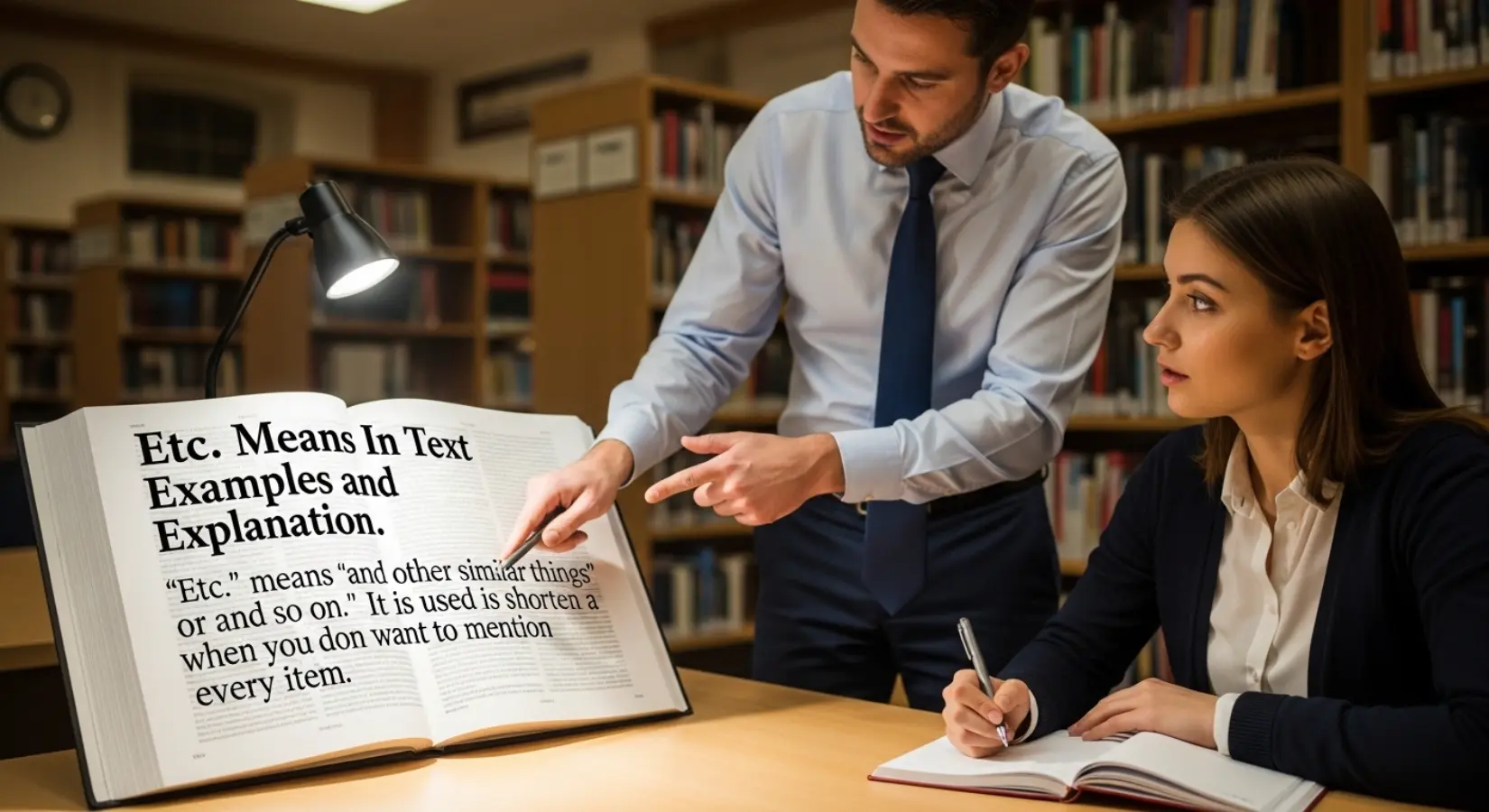
The abbreviation etc comes from the Latin phrase “et cetera,” which literally means:
- “and other things”
- “and so forth”
- “and so on”
In texting and online chat, etc is used to show that a list is not complete because the rest is obvious or not important enough to mention.
But here’s where modern communication gets interesting—its tone can shift depending on context.
It can feel like:
- casual continuation (“I was busy with work, chores, etc”)
- emotional overflow (“stress, anxiety, pressure, etc”)
- playful exaggeration (“he’s rich, famous, travels everywhere, etc lol”)
- subtle dismissal (“don’t overthink it, etc”)
- even passive annoyance (“same excuses, drama, etc”)
Simple examples:
- “Bring snacks, drinks, etc.” → casual list continuation
- “School, assignments, exams, etc are killing me” → emotional stress
- “She said she’s busy, studying, etc” → slightly skeptical tone
👉 Core idea: etc means “you already get the rest” — whether emotionally or logically.
👉 what does etc mean in text in text
In texting, etc isn’t just grammar—it’s social efficiency.
People don’t type “and other things” because it feels slow, formal, and emotionally heavy for casual chats. So they compress it into etc.
But more importantly, it signals:
- “I don’t want to list everything”
- “You understand what I mean”
- “The rest is obvious”
- “Let’s move on”
So in text culture, etc becomes a shortcut for shared understanding.
It’s not just abbreviation—it’s assumed connection between sender and receiver.
If someone uses etc too often, it can even feel like:
- emotional fatigue
- lack of interest in explaining
- or fast-paced thinking style
👉 Origin & Background
The story of etc actually starts far before internet slang.
It comes from Latin “et cetera”, used in formal writing for centuries. It entered English academic and legal writing as a way to avoid unnecessary listing.
Then something interesting happened.
As communication moved online:
- emails simplified it
- texting normalized it
- social media made it casual
- memes made it slightly ironic
On TikTok and Twitter/X-style platforms, etc evolved again. It stopped being purely grammatical and started carrying tone:
- dramatic storytelling (“trauma, chaos, etc”)
- humor compression (“work, stress, dying etc”)
- emotional shorthand
Internet language does this constantly—formal words slowly become emotional tools.
And etc is a perfect example of how language becomes faster, lazier, and more expressive at the same time.
👉 Real-Life Conversations
💬 WhatsApp Chat
A: “What did you do today?”
B: “Work, meetings, stress, etc… I’m tired”
👉 Emotion: exhaustion, mental overload
💬 Instagram DM
“Your feed is goals, aesthetic, vibe, etc 😭”
👉 Emotion: admiration + admiration overflow
💬 TikTok Comment
“This video is funny, relatable, chaotic, etc 😂”
👉 Emotion: collective humor
💬 Group Chat
“We need food, drinks, snacks, plates, etc for the party”
👉 Emotion: organization + urgency
💬 Text Message
“I don’t like drama, arguments, fake people, etc”
👉 Emotion: boundaries + subtle distancing
Emotional Pattern Behind Usage
Across all examples, etc appears when people:
- compress emotions
- assume shared understanding
- avoid over-explaining
- or soften long emotional lists
It’s a shortcut for mental load.
👉 Emotional & Psychological Meaning
On the surface, etc is harmless grammar.
But psychologically, it often reveals something deeper:
1. Cognitive overload
People use it when they’re mentally tired of listing things.
2. Social assumption
It assumes the listener already “gets it.”
3. Emotional filtering
Instead of fully expressing, users compress feelings into shorthand.
4. Digital speed culture
Online communication rewards speed over detail.
A small personal example:
Imagine a friend going through a stressful week. Instead of saying everything, they text:
“Assignments, deadlines, pressure, etc I can’t even think”
They’re not just listing tasks—they’re expressing emotional exhaustion without fully unpacking it.
That’s subtle communication. Almost like emotional shorthand hiding in plain sight.
👉 “That’s the deeper psychology behind it.”
👉 Usage in Different Contexts
Social Media
Used for aesthetic or dramatic listing:
- “vibes, chaos, memories, etc”
Friends & Relationships
Casual emotional shorthand:
- “work, stress, life etc”
Work or Professional Settings
More structured but still informal:
- “reports, emails, meetings, etc”
Casual vs Serious Tone
- Casual: playful, fast, emotional
- Serious: structured, logical, explanatory
Context decides whether etc feels lazy or efficient.
👉 When NOT to Use It
Avoid etc when clarity matters:
- formal emails (job applications, legal writing)
- emotional conflicts (misunderstandings need clarity)
- professional reports requiring detail
- cross-cultural communication where abbreviation confuses
- situations where full explanation is important
👉 “Context protects meaning.”
👉 Common Misunderstandings
1. “It means lazy writing”
Not always. It can also mean efficiency.
2. “It is rude”
No—unless used in dismissive tone.
3. “It hides meaning”
It only shortens lists, not necessarily meaning.
4. “It always feels the same”
Wrong—tone changes everything.
Comparison Table
| Expression | Meaning | Tone | Usage Context |
|---|---|---|---|
| etc | and so on | neutral / casual | texting, writing |
| and so on | continuation | formal | essays, speech |
| and other things | unspecified items | neutral | explanations |
| and stuff | casual continuation | informal | texting |
| blah blah blah | dismissive continuation | sarcastic | casual chat |
👉 Emotionally, etc is the most neutral—but context can turn it warm, lazy, or even slightly dismissive.
Variations & Types
People remix etc in many ways:
- “etc etc” → exaggeration or humor
- “etc…” → trailing emotional tone
- “etc lol” → playful dismissal
- “etc 🙃” → passive sarcasm
- “etc 😭” → emotional overload
- meme usage → chaotic storytelling shorthand
Each variation slightly shifts emotional weight.
👉 How to Respond When Someone Uses It
Casual Replies
- “Got it 😄”
- “Same here”
Funny Replies
- “etc = I’m too tired to list it all 😂”
- “You mean chaos basically?”
Mature Replies
- “I understand what you mean”
- “Makes sense”
Respectful Replies
- “Thanks for explaining”
- “I get the idea”
Matching tone matters more than perfect grammar here.
👉 Regional & Cultural Usage
Western Culture
Common in casual writing and texting.
Asian Culture
Often used in English-learning environments, slightly more formal tone.
Middle Eastern Culture
Used in mixed English-Arabic/Punjabi/Hindi chats for efficiency.
Global Internet Usage
Memes and social media have made it universal shorthand.
👉 Generational Differences
Gen Z
Uses it casually, often emotionally expressive:
- “stress, life, trauma, etc”
Millennials
More structured but still casual:
- “work, meetings, etc”
Older Generations
Prefer full phrases like “and so on”
Language reflects digital comfort levels.
👉 Is It Safe for Kids
Yes—etc is harmless.
But:
- may encourage vague communication
- might reduce clarity in writing practice
- sometimes used in sarcastic tone online
Overall, it’s safe and neutral.
👉 FAQS:
1. What does etc mean in texting?
It means “and so on” or “and other things.”
2. Is etc formal or informal?
It is neutral but used more in casual writing today.
3. Can etc be rude?
Not by itself—tone depends on context.
4. Why do people use etc in chats?
To shorten lists and assume shared understanding.
5. What does etc mean on TikTok?
It’s used for funny, chaotic, or emotional list endings.
6. Do older people use etc differently?
Yes, more formally in writing than in texting.
👉 Conclusion
The phrase what does etc mean in text might look simple, but it opens a window into how modern communication really works.
etc doesn’t just mean “and other things” or “and so forth”, it represents how people think, simplify, and emotionally compress their thoughts in fast digital conversations.
It shows how language adapts to speed, emotion, and shared understanding in online spaces.
At its core, etc is not just grammar, it’s a reflection of how we connect without saying everything.
Because sometimes, people don’t need to explain everything… they just say etc and expect you to feel the rest.
And maybe that’s the most human part of modern texting.

I’m Zara Winkwell, a playful writer who loves blending wit, charm, and creativity into every pun I craft. I find inspiration in everyday moments that can turn into clever wordplay. Making people grin through humor and smart twists of language is my passion. With every line, I aim to turn simple words into a reason to smile.