WTW meaning in text is one of those internet slang terms that can completely change depending on who sends it and where the conversation is happening.
Imagine opening your phone and seeing a message that simply says:
“WTW?”
Or maybe your friend comments:
“WTW tonight?”
Then someone jokingly asks:
“WTW? 😂”
At first glance, those three letters can be surprisingly confusing. Is someone asking to hang out? Starting a conversation? Making a joke about a relationship? Or are they asking about a wedding?
That’s exactly why thousands of people search for the WTW meaning in text every month. Internet slang moves fast, and abbreviations often carry emotional meaning that goes beyond their literal words. The same three letters can express curiosity, excitement, friendship, flirting, or playful teasing depending on the context.
Let’s break it down in a way that actually makes sense.
Quick Definition
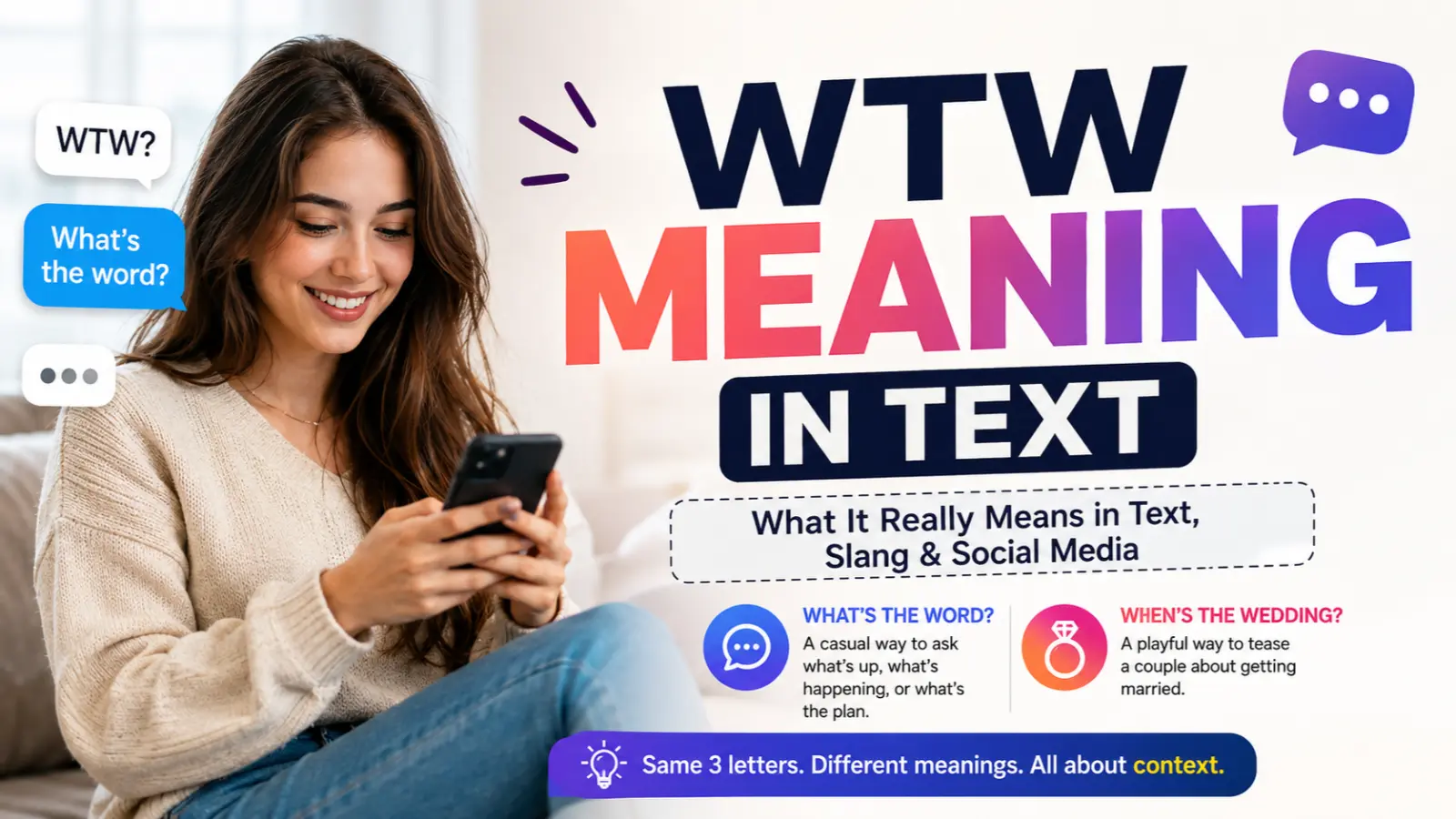
The WTW meaning in text most commonly stands for “What’s the Word?” It is an informal way of asking:
- What’s going on?
- What’s the plan?
- What’s happening?
- What’s new?
- Are we doing something?
In some conversations, especially among friends or family, WTW can also jokingly mean “When’s the Wedding?” This version is usually used to tease couples who appear very close or serious.
Depending on the tone, WTW may be used for:
- Starting a conversation
- Checking plans
- Flirting
- Joking
- Showing curiosity
- Playful teasing
- Reacting to relationship news
- Breaking the silence
Example
Friend: WTW tonight?
You: Nothing yet. Want to grab dinner?
At its heart, WTW is less about the words themselves and more about opening a social connection.
WTW Meaning in Text as “What’s the Word?”
The most popular interpretation of WTW meaning in text is “What’s the Word?”
This phrase is basically another way of asking:
- What’s up?
- What’s happening?
- What’s the move?
- What’s everyone doing?
People often use it to reconnect without sounding too formal.
Examples
- WTW after work?
- WTW this weekend?
- WTW bro?
- WTW everyone?
Emotionally, this version feels casual, friendly, and inviting. It leaves room for conversation instead of demanding one.
WTW Meaning in Text as “When’s the Wedding?”
Another growing meaning of WTW meaning in text is “When’s the Wedding?”
This version usually appears when:
- Friends tease a happy couple.
- Someone posts romantic pictures.
- A relationship becomes very serious.
- People jokingly assume marriage is next.
Examples
Friend: You’ve been together for five years.
Friend 2: WTW? 😂
Instagram Comment:
“You two look perfect together. WTW?”
Here, WTW is playful rather than literal. Nobody necessarily expects a wedding date—they’re expressing excitement about the relationship.
What Does WTW Mean in Text?
In everyday texting, WTW is a flexible conversation starter.
Instead of writing:
- What are you doing?
- What’s happening?
- Do you have plans?
People simply type:
WTW?
Its meaning depends entirely on context.
For example:
- “WTW tonight?” = What are the plans?
- “WTW everyone?” = What’s going on?
- “WTW 😂” = When’s the wedding?
- “WTW after class?” = Want to hang out?
Understanding the relationship between the people chatting is often more important than understanding the letters themselves.
Origin & Background
Like many internet abbreviations, WTW became popular because texting rewards speed.
Instead of typing an entire sentence, users shortened common questions into three memorable letters.
“What’s the Word?” has existed in spoken English for decades, especially in urban communities where it simply meant, “What’s happening?”
As smartphones became the primary way people communicated, the abbreviation naturally spread into text messages.
Later, platforms like TikTok, Instagram, Snapchat, and X helped push WTW into mainstream internet culture.
Meanwhile, “When’s the Wedding?” emerged as a humorous variation in relationship conversations. Social media made playful relationship teasing more common, so this interpretation gained popularity in comments and memes.
Online language evolves quickly because communities constantly create new meanings for familiar expressions.
Real-Life Conversations
WhatsApp Chat
Alex: WTW tonight?
Chris: Movie night at my place.
Instagram DM
Person A: WTW this weekend?
Person B: Beach trip if you’re free.
TikTok Comments
Creator: Couple vacation vlog ❤️
Comment: WTW? 💍😂
Text Messages
Friend: WTW after school?
You: Let’s grab coffee.
Group Chat
Jake: WTW everyone?
Sarah: Bowling?
Ryan: I’m in.
Across all these examples, WTW creates an invitation rather than a demand. It encourages conversation while keeping things relaxed.
Emotional & Psychological Meaning
Internet slang isn’t just about saving time. It’s about managing emotions.
When someone says WTW, they’re often testing the social atmosphere.
They might be:
- Looking for connection
- Feeling bored
- Hoping someone makes plans
- Flirting indirectly
- Checking if they’re included
Think about two friends who haven’t talked in weeks.
Instead of sending a long message explaining everything, one simply texts:
“WTW?”
Those three letters quietly say:
“I’ve been thinking about you.”
“I want to reconnect.”
“I’m open to talking.”
Now imagine coworkers who become close friends.
After work, one texts:
“WTW tonight?”
It’s casual, but it also shows trust and comfort.
That’s the deeper psychology behind it.
Usage in Different Contexts
Social Media
WTW often starts conversations in comments, DMs, and stories.
Example:
“WTW this weekend?”
Friends & Relationships
Friends use WTW to make plans or check in.
Couples may use it casually throughout the day.
The “When’s the Wedding?” version appears as playful teasing.
Work or Professional Settings
WTW is generally too informal for professional emails or workplace communication.
Instead, write:
- Do you have any updates?
- What’s the plan?
- Are you available?
Casual vs Serious Tone
The same abbreviation changes meaning based on tone.
- Friendly: WTW tonight?
- Curious: WTW?
- Romantic joke: WTW 💍
- Flirty: WTW this weekend? 😉
Context changes everything.
When NOT to Use It
Avoid WTW in:
- Business emails
- Job interviews
- Academic writing
- Serious disagreements
- Conversations with people unfamiliar with internet slang
- Cross-cultural communication where abbreviations may confuse readers
Using internet slang in the wrong situation can create unnecessary misunderstandings.
Context protects meaning.
Common Misunderstandings
Many people assume WTW always means the same thing, but that’s not true.
Misunderstanding: WTW only means “What’s the Word.”
Reality: It can also mean “When’s the Wedding?” in playful relationship conversations.
Misunderstanding: It’s rude.
Reality: Most of the time it’s friendly.
Misunderstanding: It’s always flirting.
Reality: Friends use it just as often.
Misunderstanding: It literally asks about weddings.
Reality: Most wedding-related uses are jokes.
Comparison Table
| Expression | Meaning | Tone | Usage Context |
|---|---|---|---|
| WTW | What’s the Word? / When’s the Wedding? | Casual | Texting, social media |
| WYA | Where are you? | Curious | Friends |
| WYD | What are you doing? | Casual | Daily texting |
| WSP | What’s up? | Friendly | Social chats |
| HBU | How about you? | Conversational | Follow-up replies |
Although these abbreviations seem similar, WTW often feels more open-ended and socially inviting.
Variations & Types
Some common variations include:
WTW Tonight
Used for making plans.
WTW Bro
Friendly greeting between friends.
WTW 😂
Usually hints at “When’s the Wedding?”
WTW 👀
Suggests curiosity or interest.
WTW Then?
Can sound slightly challenging or playful.
WTW Fr?
Adds emphasis by asking, “Seriously, what’s going on?”
Each variation slightly changes the emotional energy.
How to Respond When Someone Uses It
Casual Replies
- Not much. You?
- Just relaxing.
- Nothing planned yet.
Funny Replies
- Surviving adulthood. 😂
- Looking for free food.
- Waiting to become rich.
Mature Replies
- Busy today, but free later.
- Let’s catch up this weekend.
Respectful Replies
- Thanks for checking in.
- Good to hear from you.
Matching someone’s energy usually creates smoother conversations.
Regional & Cultural Usage
Western Culture
WTW commonly means “What’s the Word?” and is widely used among younger people.
Asian Culture
Many English-speaking social media users understand WTW, though local slang often mixes with it.
Middle Eastern Culture
Among bilingual users, WTW appears mostly on international platforms like TikTok and Instagram.
Global Internet Usage
Thanks to memes, influencers, gaming communities, and viral videos, WTW now reaches audiences around the world.
Social media continues to erase language boundaries while creating new slang almost every week.
Generational Differences
Gen Z
Uses WTW naturally in texting, gaming, and social media.
Millennials
Generally understand it but may use it less frequently.
Older Generations
Some may confuse the abbreviation or ask for clarification.
Language often reflects identity, belonging, and participation in digital culture.
Is It Safe for Kids?
In most situations, yes.
WTW itself is harmless.
However, parents should remember that any slang can take on different meanings depending on the conversation.
Teaching children to understand context is more valuable than memorizing abbreviations.
Like any online language, respectful communication should always come first.
Frequently Asked Questions
What is the most common WTW meaning in text?
It usually means “What’s the Word?”, which asks what’s happening or what the plans are.
Can WTW mean “When’s the Wedding?”
Yes. Friends often use it jokingly when teasing couples about marriage.
Is WTW rude?
No. It’s generally considered friendly and informal.
Is WTW popular on TikTok?
Yes. TikTok, Instagram, Snapchat, and messaging apps have helped make WTW more popular.
Do different generations use WTW differently?
Yes. Gen Z uses it most naturally, while older generations may be less familiar with it.
Should I use WTW at work?
Usually no. Professional communication is clearer when written in full sentences.
Conclusion
Understanding the WTW meaning in text is about more than memorizing an abbreviation. Whether it stands for “What’s the Word?” to start a casual conversation or “When’s the Wedding?” to playfully tease a happy couple, the phrase reflects how modern digital language builds connection, humor, and shared experiences.
Internet slang keeps evolving because people constantly look for faster, warmer, and more expressive ways to communicate. The WTW meaning in text shows that even three simple letters can carry curiosity, friendship, excitement, or affection depending on the moment.
The next time someone texts WTW, you’ll know it’s not just shorthand—it’s an invitation to connect, share a moment, and keep the conversation alive in today’s fast-moving online world.

I’m Jake Punman, a humor writer who lives for clever wordplay and laugh-out-loud puns. I love crafting witty lines that turn simple moments into bursts of laughter. My passion is making people smile through creative twists of language. With every pun I write, I aim to add a little more fun to your day.