Ash meaning in text is one of those internet slang terms that can leave you scratching your head the first time you see it. Imagine opening a message from a friend that says, “I’m tired ash,” or scrolling through TikTok and spotting comments like, “That outfit is cute ash!”
At first glance, you might wonder If people are talking about volcanic ash, the remains of something burned, or even the tree called ash. In reality, they’re usually talking about something completely different.
That’s exactly why so many people search for ash meaning in text. Modern texting is full of abbreviations, slang, and viral expressions that evolve almost overnight. A phrase that makes perfect sense to Gen Z on TikTok might leave someone else completely confused just a few weeks later.
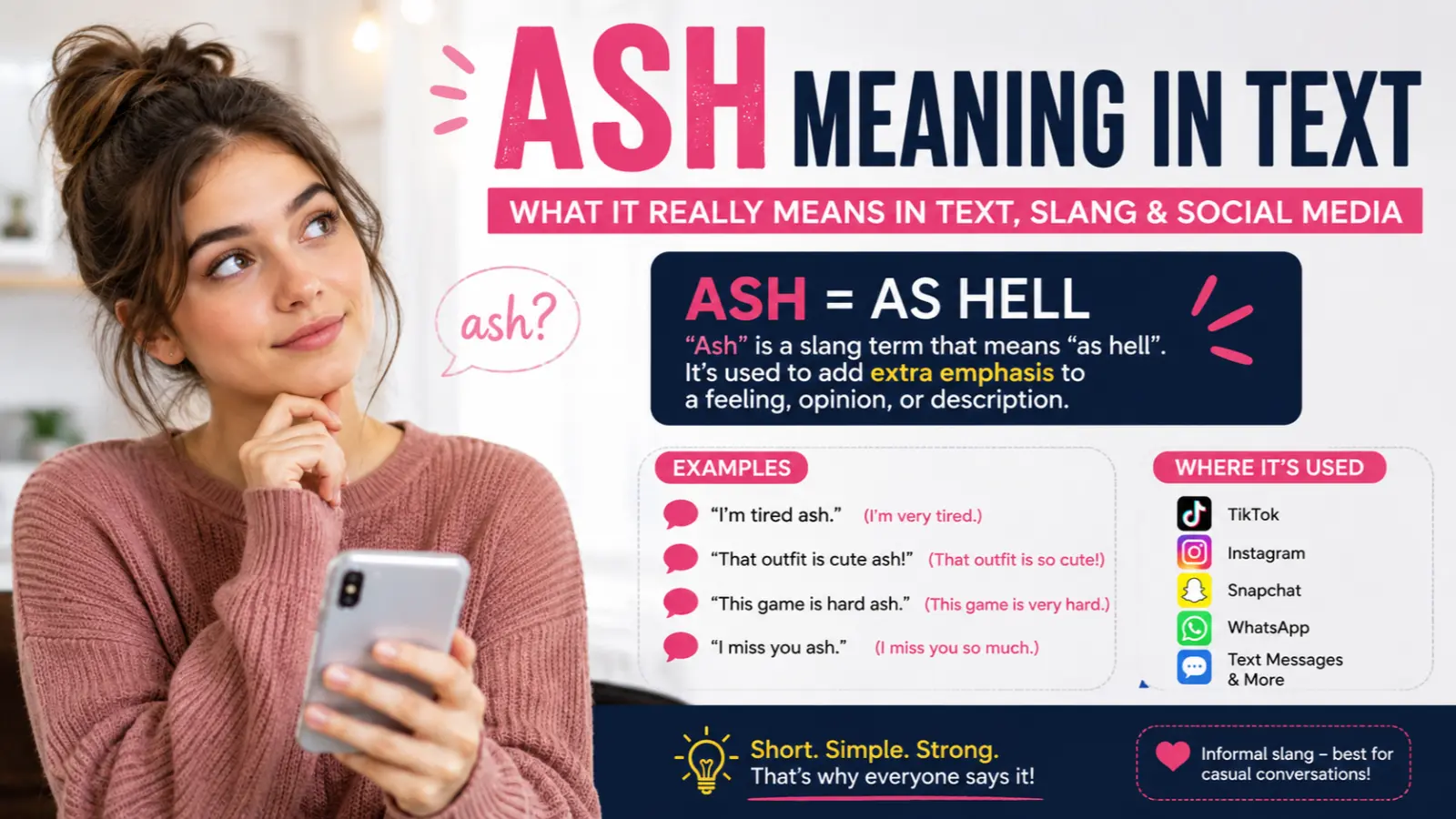
In most online conversations, “ash” is a casual slang abbreviation for “as hell.” Instead of typing the full phrase, people shorten it to make their messages quicker, funnier, and more natural. Saying “It’s cold ash” simply means “It’s really cold,” while “I’m hungry ash” means “I’m extremely hungry.”
The phrase acts as an intensifier, adding extra emotion or emphasis to whatever comes before it. It has become especially popular across TikTok, Snapchat, Instagram, and text messaging, where short, expressive language spreads quickly.
If you’ve ever paused after reading a message and thought, “Wait… what does ‘ash’ actually mean here?” you’re definitely not alone.
Let’s break it down in a way that actually makes sense.
Quick Definition
Ash most commonly means “as hell” in text messages and social media conversations. It’s an informal slang expression used to emphasize a feeling, opinion, or description.
Quick examples:
- “I’m sleepy ash.” → I’m very sleepy.
- “That movie was funny ash.” → The movie was extremely funny.
- “She’s happy ash today.” → She’s really happy.
Depending on the conversation, ash may also have other meanings:
Ash Meaning in Text as “As Hell”
This is by far the most common meaning online. It adds emphasis without sounding overly formal.
Example:
“This pizza is good ash.”
Ash Meaning in Text as “Ashamed”
In some chats, especially when written in uppercase (ASH), it can stand for ashamed.
Example:
“I’m ash after forgetting her birthday.”
Ash Meaning in Text as a Literal Word
Sometimes the word simply refers to ash left behind after something burns, volcanic ash, or other non-slang meanings. The surrounding conversation usually makes this obvious.
Example:
“The fireplace is full of ash.”
The Core Emotional Meaning
Whether someone says they’re “tired ash,” “excited ash,” or “bored ash,” the emotional purpose stays the same: they’re trying to make their feelings sound stronger, more expressive, and more relatable. That’s one reason this slang has become so common in today’s fast-moving online conversations.
What Does Ash Meaning in Text Mean?
If you’re wondering what ash meaning in text really is, the short answer is simple: in most online conversations, “ash” means “as hell.” It’s a slang intensifier that makes an emotion, opinion, or description sound stronger.
For example:
- “I’m hungry ash.” → I’m extremely hungry.
- “This game is hard ash.” → This game is really difficult.
- “She looks pretty ash.” → She looks very pretty.
- “It’s cold ash outside.” → It’s freezing outside.
Unlike formal English, internet slang doesn’t always follow grammar rules. People type the way they speak, and over time, shortened phrases become part of everyday online language. That’s exactly what happened with ash. Instead of writing “as hell,” users simply dropped the space and shortened the phrase to make texting faster and more natural.
Although ash usually means “as hell,” context is still important. In some conversations it may refer to ashamed, while in others it could simply mean the gray powder left after something burns or even be someone’s name. Reading the entire conversation is the easiest way to understand which meaning is intended.
Origin & Background
Like many internet slang terms, ash didn’t appear overnight. It evolved naturally through texting culture, where people constantly shorten words and phrases to communicate faster. Expressions like “gonna,” “wanna,” “fr,” “imo,” and “idk” became common for the same reason—speed and convenience.
The slang version of ash grew from the phrase “as hell,” which has long been used in informal English to add emphasis. Instead of typing two separate words, younger internet users began writing ash, creating a shorter version that looked cleaner in text messages and social media captions.
As TikTok, Snapchat, Instagram Reels, and meme culture exploded, the expression spread rapidly. Influencers, content creators, and everyday users casually wrote comments like:
- “Funny ash.”
- “Cute ash.”
- “Fast ash.”
- “Expensive ash.”
Because millions of people saw these phrases every day, the slang quickly became part of everyday digital communication. Today, it’s especially common among Gen Z and younger Millennials, although many older users are beginning to recognize it as well.
One interesting thing about internet language is that it rarely stays the same for long. A phrase that starts in a small online community can become worldwide slang within months, only to be replaced by something new a year later. That’s what makes digital language so fascinating—it constantly evolves with the people using it.
Understanding expressions like ash isn’t just about learning new words. It’s about understanding how people express emotion, humor, personality, and identity in today’s online world.
Real-Life Conversations
The easiest way to understand ash meaning in text is to see how real people use it in everyday conversations. Notice how the slang naturally adds emotion and emphasis without changing the overall meaning of the sentence.
WhatsApp Chat
Alex: Are you coming to the gym today?
Sam: Nah, I’m tired ash after work.
Here, “tired ash” simply means Sam is extremely tired and doesn’t have the energy to work out.
Instagram DM
Emma: Your vacation photos are pretty ash! 🔥
Lily: Aww, thank you! It was the best trip ever.
In this context, ash emphasizes the compliment, making it sound more enthusiastic and genuine.
TikTok Comments
Comment 1: This edit is clean ash.
Comment 2: I watched this like ten times already!
TikTok users often use ash because it’s quick to type and matches the platform’s casual, expressive style.
Text Messages
Jake: Is the new restaurant good?
Noah: Yeah, it’s good ash. You should try it.
Rather than writing “really good” or “as hell,” the slang makes the recommendation sound more relaxed and conversational.
Group Chat
Friend 1: Who’s ready for finals?
Friend 2: Definitely not. I’m stressed ash. 😭
Almost everyone in the chat immediately understands that the speaker feels overwhelmed.
After looking at these examples, a clear pattern appears. People don’t use ash to sound rude—they use it to make their emotions feel bigger, funnier, or more relatable. Whether they’re joking, complaining, complimenting someone, or sharing excitement, the slang helps their personality come through in just a few characters.
Emotional & Psychological Meaning
Internet slang isn’t only about shortening words. It’s also about expressing feelings in a way that feels authentic and socially connected.
When someone says, “I’m bored ash,” they’re usually doing more than describing boredom. They’re inviting others to relate, laugh, or respond. The exaggeration creates a sense of shared emotion, making conversations feel more engaging.
Imagine a group of friends waiting for a delayed movie. One person texts, “We’ve been waiting here for an hour. I’m hungry ash.” Everyone laughs because they understand the feeling instantly. The phrase isn’t meant to be taken literally—it’s a playful way of expressing frustration while keeping the mood light.
Using slang like ash also signals familiarity with internet culture. It shows that someone understands modern texting habits and feels comfortable communicating in a casual, informal way. Among younger users, it can even create a sense of belonging within online communities.
At the same time, context matters. The same phrase that feels funny in a group chat could sound too informal in a work email or a conversation with someone unfamiliar with internet slang.
That’s the deeper psychology behind it.
Usage in Different Contexts
The meaning of ash stays mostly the same across different platforms, but the tone changes depending on where and how it’s used. Understanding the context helps you know whether it’s playful, emotional, or simply a casual way to add emphasis.
Ash Meaning in Text on Social Media
Social media is where ash is most commonly used. On platforms like TikTok, Instagram, Snapchat, and X, people use it to make captions, comments, and replies sound more expressive.
Examples:
- “This song is catchy ash.”
- “That transition was smooth ash.”
- “I’m obsessed with this outfit ash.”
Here, the slang makes opinions feel stronger and more engaging without writing long explanations.
Ash Meaning in Text Between Friends & Relationships
Friends often use ash to exaggerate emotions, jokes, or compliments. Because there’s already trust and familiarity, the slang feels natural rather than offensive.
Examples:
- “You’re funny ash.”
- “I miss you ash.”
- “That date was awkward ash.”
In relationships, it can even add a playful or flirty tone when paired with compliments.
Ash Meaning in Text at Work or in Professional Settings
Although ash is common in casual conversations, it’s usually best to avoid it in professional communication.
Instead of writing:
- “I’m busy ash today.”
Write:
- “I’m extremely busy today.”
Professional emails, business chats, and workplace messages are generally better suited to standard English.
Casual vs. Serious Tone
The same word can create very different impressions depending on the situation.
Casual
- “This pizza is good ash.”
- “I’m tired ash.”
Serious
- During an important discussion or emotional conversation, using slang like ash may make your message seem less sincere or overly informal.
That’s why understanding your audience is just as important as understanding the slang itself.
When NOT to Use It
Like most internet slang, ash isn’t appropriate for every situation.
Avoid using it in these situations:
Formal Communication
Business emails, job applications, academic writing, and official documents should use clear, professional language instead of slang.
Emotional Conflicts
If someone is upset or discussing a serious issue, exaggerated slang may accidentally make your response seem dismissive.
Speaking with Older Audiences
Not everyone is familiar with modern internet abbreviations. Older family members or people who don’t spend much time online may misunderstand what you mean.
Cross-Cultural Conversations
Internet slang changes from country to country. Someone learning English might interpret ash literally instead of understanding it as “as hell.”
Professional Social Media
If you’re representing a brand or business, it’s usually safer to choose language that everyone can understand.
Context protects meaning.
Common Misunderstandings
Even though ash is popular, people still misunderstand it.
Misunderstanding #1: It always means fire ash.
Not in texting. Most of the time, it simply means “as hell.”
Misunderstanding #2: It’s always offensive.
Not necessarily. While it’s based on the phrase “as hell,” many people use it casually without intending to be rude.
Misunderstanding #3: Everyone understands it.
Internet slang changes quickly. Someone unfamiliar with online culture may have no idea what ash means.
Misunderstanding #4: It has only one meaning.
Context matters. Depending on the conversation, ASH can sometimes mean ashamed, refer to a person’s name, or simply describe literal ash left after something burns.
The best way to understand ash meaning in text is to read the entire conversation instead of focusing on the word by itself.
Ash Meaning in Text vs Similar Expressions
| Expression | Meaning | Tone | Common Usage |
|---|---|---|---|
| Ash | As hell | Casual, expressive | Texting, TikTok, Snapchat |
| AF | As f*** | Strong, bold | Friends, memes, social media |
| Very | High degree | Neutral | Everyday conversation |
| Really | Strong emphasis | Polite | Casual and professional |
| So | Mild emphasis | Friendly | Speech and texting |
Although all of these expressions add emphasis, they create different impressions. Ash feels youthful and internet-driven, while very and really sound more neutral. AF is stronger and often considered more explicit.
Variations & Types
Internet slang changes constantly, and ash appears in several creative forms.
Playful Versions
- Funny ash
- Cute ash
- Rich ash
- Loud ash
Emotional Versions
- Happy ash
- Sad ash
- Excited ash
- Nervous ash
Meme Variations
Some users intentionally exaggerate the spelling for humor:
- ashhhh
- ashhh 😭
- ash fr
- ash 😂
These variations don’t change the meaning—they simply make the emotion feel bigger.
How to Respond When Someone Uses “Ash”
Casual Replies
- “I know, right?”
- “Same here!”
- “For real.”
Funny Replies
- “You survived though 😂”
- “That’s actually wild.”
- “I’m laughing ash.”
Mature Replies
- “I understand how you feel.”
- “That sounds exhausting.”
- “I hope things get better.”
Respectful Replies
- “Thanks for telling me.”
- “I appreciate your honesty.”
- “I’m here if you need to talk.”
Matching the other person’s energy usually makes conversations feel more natural.
Regional & Cultural Usage
Western Culture
The slang ash is most common in American internet culture, especially among younger users on TikTok, Snapchat, and Instagram.
Asian Culture
Many English learners recognize ash through social media, although it isn’t widely used in everyday offline conversations.
Middle Eastern Culture
Young bilingual users may understand the slang from online content, while others interpret the word literally.
Global Internet Usage
Thanks to viral videos, memes, and influencers, ash has spread far beyond English-speaking countries. Social media continues to make internet slang more global every year.
Generational Differences
Gen Z
Gen Z uses ash naturally in texting, gaming chats, and social media.
Millennials
Many Millennials understand the term, although they may still prefer words like really or super.
Older Generations
Older adults may confuse ash with its literal meaning unless they’re familiar with internet slang.
Language often reflects identity, and slang helps each generation express itself in unique ways.
Is Ash Safe for Kids?
In most cases, ash is a harmless slang expression used to emphasize emotions or opinions. However, because it comes from the phrase “as hell,” some parents or schools may consider it mildly inappropriate.
Children may also copy slang without understanding when it’s suitable to use. Teaching them that different situations require different language is often more helpful than banning the word completely.
Frequently Asked Questions
What does ash mean in text?
It usually means “as hell,” adding strong emphasis to a feeling or description.
Is ash a bad word?
Not exactly. It’s informal slang and is milder than many internet expressions, but it may still be inappropriate in formal settings.
What does “tired ash” mean?
It means very tired or extremely tired.
Why do people say ash instead of as hell?
It’s shorter, faster to type, and has become popular through texting and social media.
Is ash popular on TikTok?
Yes. TikTok has played a major role in spreading the slang among younger internet users.
Should I use ash in work emails?
No. Professional communication is usually better with standard English such as very, extremely, or really.
Conclusion
Understanding ash meaning in text is about more than learning another internet abbreviation. It’s about recognizing how modern communication continues to evolve through texting, memes, and social media.
Today, ash most commonly means “as hell,” giving people a quick and expressive way to emphasize emotions, opinions, and everyday experiences. Whether someone says they’re “tired ash,” “happy ash,” or “funny ash,” the goal is usually the same—to make the message feel stronger, more relatable, and more personal.
As online language keeps changing, staying curious about new slang helps you connect with conversations instead of feeling left behind.
Sometimes, a tiny three-letter word can say a lot more than it seems.

I’m Lila Wordsmith, a writer who finds magic in clever wordplay and heartfelt expressions. I love crafting puns, wishes, and quotes that make people feel connected and inspired. Every line I write is designed to bring a smile or spark a thought. Through my words, I hope to turn simple moments into something truly memorable.